12-04-2025
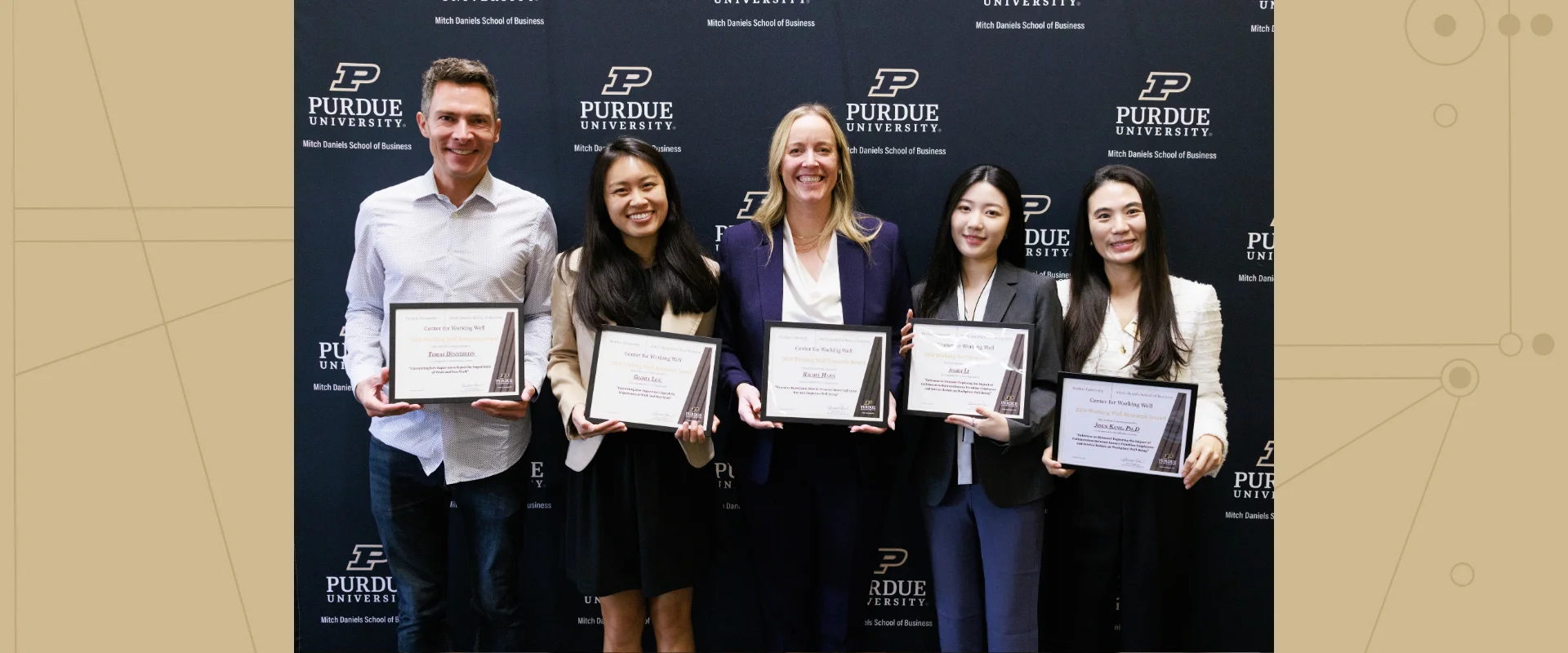
The Center for Working Well (CWW) at Purdue University’s Daniels School of Business has announced the recipients of its 2024–25 Center for Working Well Research Awards, recognizing three cutting-edge studies addressing the challenges and opportunities employees face in the modern workplace.
The awards, which provide up to $5,000 in support for each project, underscore the center’s mission to develop a robust understanding of what “working well” means to employees and organizations, from reducing burnout to promoting sustainable performance and inclusive relationships at work and home.
Awardees are expected to conduct their research within one year and present their findings at the annual Working Well Research Conference during the MSHRM Case Competition, where organizational and community leaders convene to learn about emerging insights in workforce well-being.
This year’s selected studies explore timely topics: how menstruation symptoms shape employees’ engagement at work, how leaders’ everyday behaviors signal their values around work and non-work roles, and whether collaboration with service robots enhances or harms frontline workers’ experiences in luxury retail.
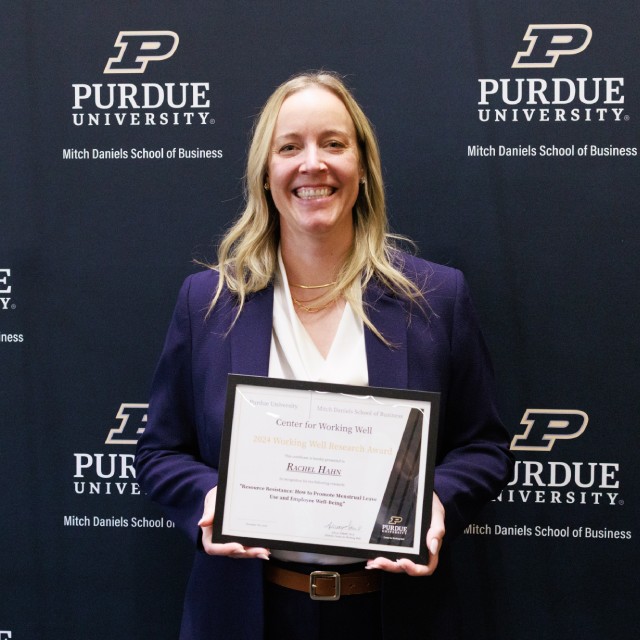
By Rachel Hahn (Postdoctoral Research Fellow, Daniels School of Business) and Aqsa Dutli (PhD Student, Daniels School of Business)
The first award-winning study examines an understudied but widespread issue affecting millions of employees: how menstruation-related symptoms influence absenteeism, presenteeism, and day-to-day well-being. Hahn and Dutli note that “menstruation-related symptoms can significantly impact employees’ productivity, yet little research has examined how workplace accommodations may mitigate these negative effects.” Their project applies job demands-resources theory and the allostatic load model to conceptualize menstrual symptoms as a job demand with cascading effects on work engagement.
The researchers propose that taking time away from work due to severe symptoms may actually be restorative. According to the abstract, “menstruation-related absenteeism serves as a recovery mechanism that enhances next-day work engagement,” while forcing oneself to work through symptoms — or “menstruation-related presenteeism” — “acts as a stressor that diminishes it.”
The study also investigates whether menstrual leave policies can buffer these negative effects by functioning as an organizational resource. Using an experience-sampling method, full-time menstruating employees will complete surveys twice daily for 20 workdays, allowing the team to measure symptoms, stress, vigor, engagement and daily performance. Ultimately, the researchers aim to “offer evidence-based guidance for organizations seeking to implement menstrual leave policies,” with the goal of improving long-term retention and well-being.
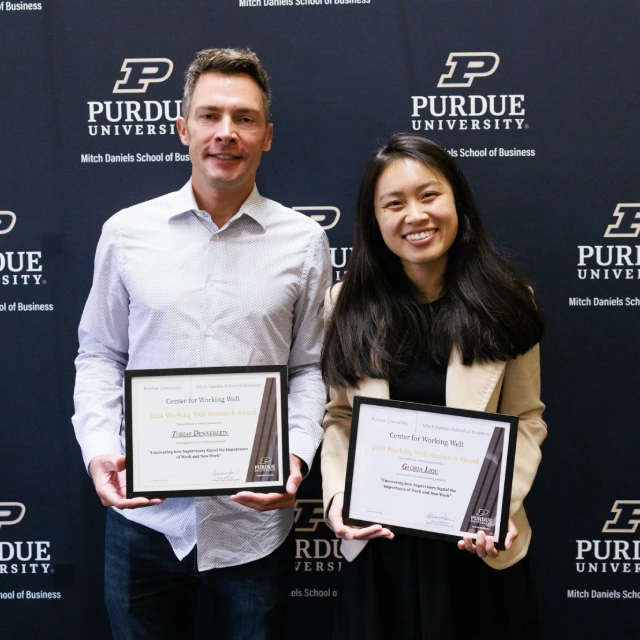
By Gloria Liou (PhD Candidate, Psychological Sciences), Tobias Dennerlein (Assistant Professor, Daniels School of Business), and Louis Tay (Professor, Psychological Sciences)
The second awarded project focuses on leadership behaviors — not the traditional kinds associated with direct supervision, but subtle everyday actions that may unintentionally influence employee well-being. The research team writes that “leaders in organizations play a critical role in promoting vital organizational outcomes,” and that supervisor support has historically been treated as a general perception or limited to direct helping behaviors.
The abstract identifies a major gap: even when supervisors are not explicitly engaging in supportive actions, their personal work habits and choices can “affect subordinate well-being and behavior.” The authors argue that current measurement tools fail to capture these broader behaviors, making it difficult for organizations to train or evaluate leaders effectively.
Their project seeks to identify and classify these overlooked behaviors to give employers and supervisors clearer insight into how leaders’ own work–life boundaries shape the experiences of those they manage. The researchers expect their results to “ensure the effectiveness of work–life policies” and provide organizations with practical tools for shaping positive supervisor–employee dynamics.
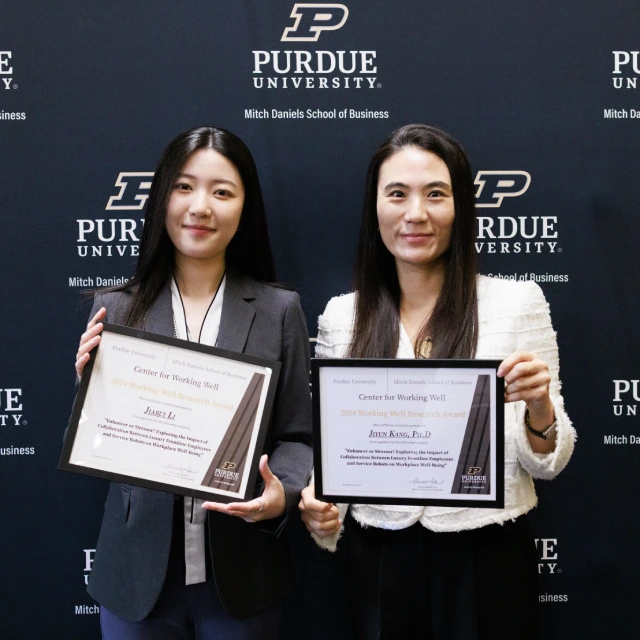
By Jiarui Li (PhD Candidate, Consumer Science) and Jiyun Kang (Associate Professor, Consumer Science)
The third award-winning study turns to the rapidly evolving intersection of service work and automation. In luxury retail, frontline employees (FLEs) play a critical role as the face of high-end brands, but the abstract notes that these workers face “higher physical, mental, and social stressors,” and that “more than half of luxury FLEs [plan] to leave their jobs due to poor workplace well-being.”
With luxury retailers increasingly adopting service robots, Li and Kang aim to determine whether human-robot collaboration serves as an “enhancer or stressor” of employee well-being. Their study investigates how robots may alleviate heavy demands — such as physically strenuous tasks or difficult interactions with high-net-worth clients — and whether the introduction of automation creates new forms of isolation or role ambiguity.
The researchers hope their findings will “provide strategies for optimizing luxury FLEs’ work environments,” contributing to sustainable working practices and improved employee retention in a sector undergoing rapid technological change.
Together, these three award-winning studies reflect CWW’s commitment to advancing empirical understanding of the factors that shape employee well-being. From biological stress cycles to leadership behavior to automation in frontline work, the 2024–25 awardees are helping illuminate what “working well” truly means in today’s evolving workplace.
The call for the 2025–2026 Center for Working Well Research Awards closes on December 12, 2025.