PhD in MANAGEMENT
The OBHR PhD Program at the Mitch Daniels School of Business prepares students to advance cutting-edge research on people and organizations. With rigorous training and close faculty mentorship, our graduates are equipped to launch successful academic careers at leading research universities.
We are excited to be admitting doctoral students for the 2027-2028 academic year.
To connect with faculty, hear from current students, and learn more about our program, please join us for our information session on November 16th from 7:00pm-8:00pm EST.
Register to Join >>Designed for aspiring academic professionals, the PhD program in Organizational Behavior and Human Resource Management (OBHR) will provide you the personalized mentorship and rigorous educational platform from which to launch a successful career at a research-oriented university.
By exposing you to classic and cutting-edge theories, literature streams, research methods, and analytical techniques, our world-renowned faculty will help you conduct exciting and impactful research, embrace innovative teaching, and engage in broader conversations on issues employees and their organizations are facing today. We believe it is critical to build your research skills from the outset of your time in our program such that your research record stands out in a highly competitive academic job market.
Our OBHR PhD Program is led by scholars who are shaping the field through influential research and dedicated mentorship. We foster a collaborative, future-oriented culture that equips students to publish in top journals and to generate scholarship that matters for how people work and live. With the launch of the Center for Working Well, Purdue is uniquely positioned as a hub for innovative, practice-relevant research on employee well-being and organizational effectiveness.

We intentionally foster a collegial and supportive environment where students are both challenged and encouraged to excel. Our program emphasizes close collaboration with faculty and peers, creating a scholarly community that is rigorous, engaged, and future-oriented. You’ll develop as a researcher within a learning environment designed to prepare you for a long, successful, and resilient career in academia.
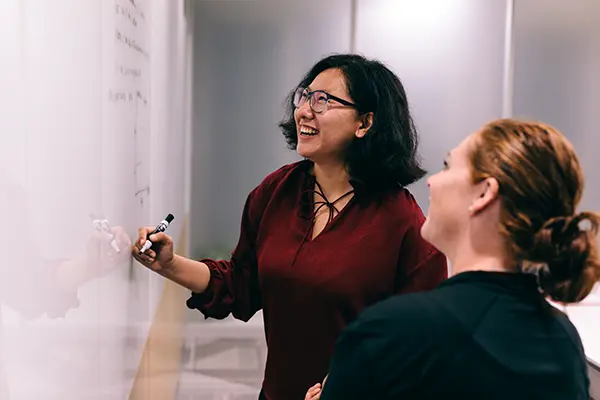
Fitting with Purdue University’s tripartite mission of learning, discovery, and engagement, the Center for Working Well (CWW) is a cutting-edge research hub at the forefront of challenges facing modern workforces. Its mission is to develop a robust understanding of what “working well” means to employees and organizations. OBHR PhD students are invited to join as CWW student affiliates, apply for competitive grants to support their research, and take part in year-round programming—including speaker series, research coffee hours, the CWW Research Conference, and more.
As a land-grant, research-1 university with science, technology and engineering in its DNA, Purdue provides the resources of a world-class institution and a commitment to accessible, high-impact education. At the Daniels School of Business, this means pairing rigorous research training with a supportive community — ensuring our doctoral students have the mentorship, tools, and momentum to thrive as scholars.

Purdue will place you in the heart of one of the nation’s most spirited college towns. You’ll enjoy the energy of a Big Ten campus alongside the ease and affordability of a community with a low cost of living. With Chicago and Indianapolis just a short drive away, you’ll experience an ideal balance of focus, accessibility, and conditions that support a positive doctoral journey.
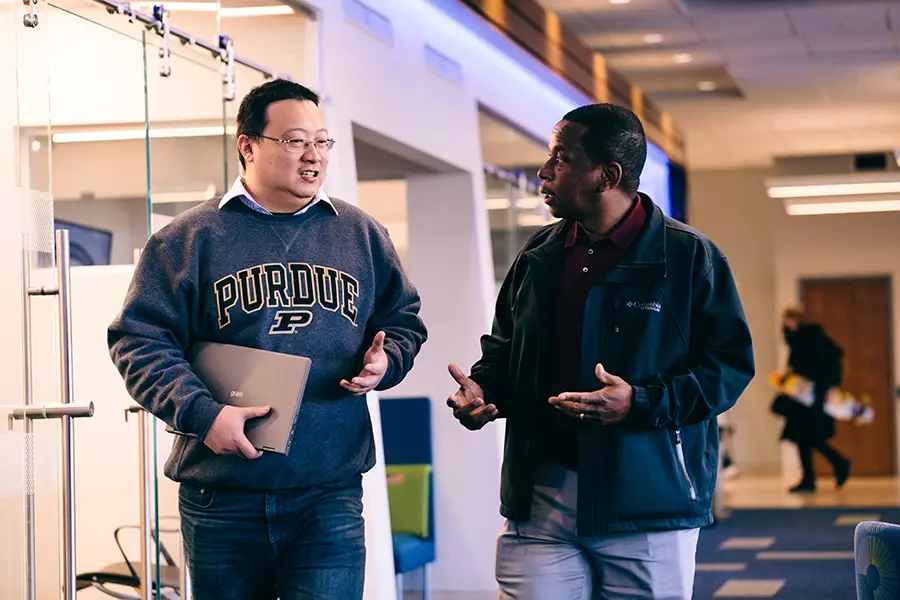
Explore our Research publications >>
Nielsen, J. D., Sharma, K., & Goering, D. D. (forthcoming). Impact, Interrupted: How and When Thwarted Prosocial Impact Undermines Employee Performance and Retention. Academy of Management Journal. https://doi.org/10.5465/amj.2024.0445
Zipay, K. P., & Rodell, J. (2025). Have your cake and eat it too? Understanding leisure-work synergizing and its impact on employee thriving. Organization Science, 36(4), 1574-1597.
Gabriel, A. S., Lee, Y. E., Koopman, J., Rosen, C. C., Lee, Dutli, A., & Bush, J. T. (2025). The receipt of venting at work: A multi-study investigation of affective and behavioral reactions for venting recipients. Personnel Psychology, 78, 205-227.
Li, Y., Huang, Z., Dineen, B., Wang, M., & van Jaarsveld, D. (2025). Voluntary Turnover Rate Fluctuations, Human Resource Practices, and Innovation: A Within‐Organization Investigation. Personnel Psychology, 78(1), 103-122.
Ballinger, G. A., Schoorman, F. D., & Sharma, K. (2025). What we do while waiting: The experience of vulnerability in trusting relationships. Academy of Management Review, 50(4), 768-787.
Smith, T. A., Dennerlein, T., Courtright, S. H., Kirkman, B. L., & Zhang, P. (2025). Why do bootlickers get empowered more than boat-rockers? The effects of voice and helping on empowering leadership through threat and goal congruence perceptions. Journal of Applied Psychology. Advance online publication. https://doi.org/10.1037/apl0001303
Kleshinski, C. E., Wilson, K. S., Street, J. S., & Rosokha, L. M. (2024). Coping with work-nonwork stressors over time: A person-centered, multistudy integration of coping breadth and depth. Journal of Applied Psychology, 109, 1765-1793.
Nielsen, J. D., & Gish, J. J. (2024). When old and new selves collide: Identity conflict and entrepreneurial nostalgia among ex‐entrepreneurs. Personnel Psychology, 77(1), 165-195. https://doi.org/10.1111/peps.12626
Mitchell, M. S., Sharma, S., Zipay, K. P., Bies, R. J., & Croitoru, N. (2024). Considering personal needs in misdeeds: The role of compassion in shaping observer reactions to leader leniency. Journal of Applied Psychology, 110(4): 512–535.
Gabriel, A. S., Diefendorff, J. M., & Grandey, A. A. (2023). The acceleration of emotional labor research: Navigating the past and steering toward the future. Personnel Psychology, 76, 511-545.
Dennerlein, T., & Kirkman, B. L. (2023). The forgotten side of empowering others: How lower social structural empowerment attenuates the effects of empowering leadership on employee psychological empowerment and performance. Journal of Applied Psychology, 108(11), 1856–1880. https://doi.org/10.1037/apl0001100
Dineen, B. R., Yu, K. Y. T., & Stevenson‐Street, J. (2023). Recruitment in personnel psychology and beyond: Where we've been working, and where we might work next. Personnel Psychology, 76(2), 617-650.
Gabriel, A. S., Ladge, J. J., Little, L. M., MacGowan, R. L., & Stillwell, E .E. (2023). Sensemaking through the storm: How postpartum depression shapes personal work-family narratives. Journal of Applied Psychology, 108, 1903-1923.
Sharma, K., Schoorman, F. D., & Ballinger, G. A. (2023). How can it be made right again? A review of trust repair research. Journal of Management, 49(1), 363-399.
Bartels, A. L., Nahrgang, J. D., Sessions, H., Wilson, K. S., Wu, L., & Law-Penrose, J. (2022). With a frown or a smile: How leader affective states spark the leader-follower reciprocal exchange process. Personnel Psychology, 75, 147-177.
Ashkanani, A. M., Dunford, B. B., & Mumford, K. J. (2022). Impact of motivation and workload on service time components: An empirical analysis of call center operations. Management Science, 68(9), 6697-6715.
Dennerlein, T., & Kirkman, B. L. (2022). The hidden dark side of empowering leadership: The moderating role of hindrance stressors in explaining when empowering employees can promote moral disengagement and unethical pro-organizational behavior. Journal of Applied Psychology, 107(12), 2220–2242. https://doi.org/10.1037/apl0001013
Bloom, M., Colbert, A. E., & Nielsen, J. D. (2021). Stories of calling: How called professionals construct narrative identities. Administrative Science Quarterly, 66(2), 298-338. https://doi.org/10.1177/0001839220949502
McClean, S. T., Yim, J., Courtright, S. H., & Dunford, B. B. (2021). Transformed by the family: An episodic, attachment theory perspective on family–work enrichment and transformational leadership. Journal of Applied Psychology, 106(12), 1848–1866.
Wilson, K. S., Kleshinski, C. E., & Matta, F. K. (2021). You get me: Examining the implications of couples’ depersonalization agreement for employee recovery. Personnel Psychology, 74, 265-293.
Zipay, K. P., Mitchell, M. S., Baer, M. D., Sessions, H., & Bies, R. J. (2021). Lenient reactions to misconduct: Examining the self-conscious process of being lenient to others at work. Academy of Management Journal, 64(2), 351-377.
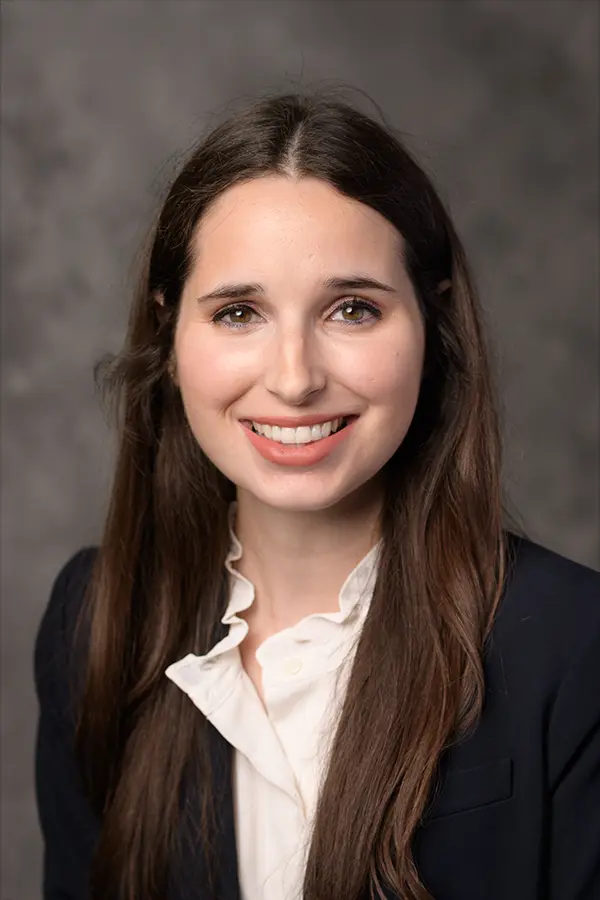
My training at Purdue provided the skills, knowledge, and experiences that formed the foundation of my career as a scholar. Through strong mentoring relationships, collaboration with faculty and research, participation in doctoral seminars, and being part of a supportive group of doctoral students who became close friends, my time at Purdue was personally and professionally enriching.”
Catherine Kleshinski
PHD GRADUATE, 2021
Assistant Professor of Management - Indiana University
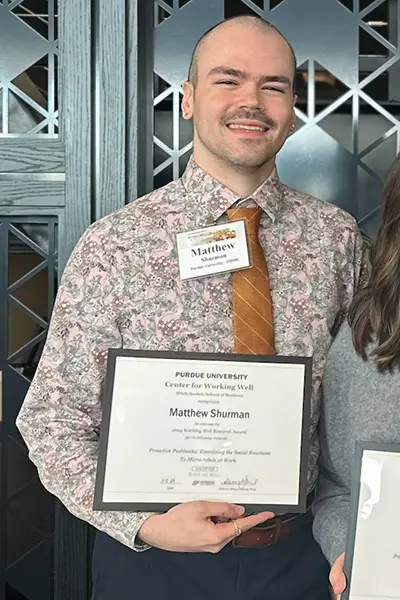
Joining the OBHR Program at Purdue was the best choice I could have made for my academic journey. The combination of rigorous coursework and genuinely supportive faculty has prepared me well for the research I’m conducting and the projects I’m leading. Just as importantly, the OBHR doctoral community is genuinely encouraging—we support one another through challenges and motivate each other to do our very best work.”
Matthew Shurman
Current PHD Candidate
Graduates of Purdue's OBHR PhD program over the years have secured placements at top research universities in the U.S. and abroad, including...
The OBHR doctoral curriculum consists of 46 total credit hours completed over four-five years. The curriculum is broken down into the following focus areas: major specialization, research methods, managerial courses, and elective courses.
Students choose elective courses in consultation with their advisor and/or PhD Coordinator. Courses in I/O Psychology or the same academic discipline are recommended.
For detailed descriptions of the courses, please visit Purdue’s online Course Catalog.
In your first year, you’ll be paired with a first-year coach advisor—a research-active faculty member on the OBHR PhD Committee who supports your onboarding and early development. You’ll begin foundational coursework, taking several classes each semester focused on scholarship, theory, and methodological training. You’ll also develop an independent research proposal with the guidance of a faculty advisor and present your early progress as part of your first-year milestones.
In your second year, you’ll complete your remaining required coursework while advancing research with faculty collaborators and identifying your emerging research interests. You’ll continue building your independent research project through data collection, analysis, and presentation. This year also includes expanding your academic network through faculty engagement, visitors, and conferences. You’ll conclude the year by taking your preliminary exams, marking your readiness for dissertation-focused work.
Your third year deepens your development as a scholar. You’ll advance multiple research projects, sharpen your skills in theorizing, design, analysis, and writing, and begin submitting manuscripts for publication. This is also your first year teaching an undergraduate course. By the end of the year, you will select your primary advisor to guide your dissertation work.
During your fourth year, you’ll form your dissertation committee, propose your dissertation, and make meaningful progress on your studies. You’ll continue expanding your research pipeline, enhancing your teaching skills, and participating actively in the academic community through conferences and professional engagement. This year is about refining your scholarly identity and preparing for the transition to independence.
Your fifth year centers on completing your dissertation and preparing for the job market. You’ll advance your research with a strong emphasis on independence and maintain momentum with faculty co-authors. You’ll finalize and defend your dissertation, develop your job market materials, and take the final steps toward launching your academic career and graduating.

If you have questions about doctoral study in Organizational Behavior and Human Resources (OBHR), feel free to contact our OBHR PhD Coordinator, Dr. Kate Zipay, at KZipay@purdue.edu.
For questions about the admissions process or other PhD programs at the Daniels School of Business, email businessphd@purdue.edu and an Admissions Specialist will connect you with the appropriate department representative.