02-13-2026
The energy was high in the Rawls Hall third-floor atrium as Purdue University students showcased their startup ideas at the final event of the 37th annual Burton D. Morgan Venture Concept Competition, hosted by the Mitch Daniels School of Business.
More than 150 attendees, including students from across Purdue’s colleges and leaders from the university’s innovation and entrepreneurship community, gathered to celebrate student-led venture building and interdisciplinary collaboration.
Thirteen student teams won a combined $50,000 in prizes at the event. Ten finalist teams, selected as “Standout Concepts,” delivered 10-minute pitches to a panel of experienced venture capitalists, competing for the top three awards. An additional nine teams presented one-minute elevator pitches to compete for special category prizes. Judges described the concepts as “a few steps away from being investment-ready,” highlighting the quality and maturity of the ventures.
The competition on December 10, 2025, marked the culmination of an intensive 10-week venture-building process inspired by a venture studio model. More than 120 teams and 250 students from across Purdue participated, representing Engineering (37%), Business (26%), Science (25%), Polytechnic (10%) and other disciplines (2%). Participants engaged in workshops, weekly challenges and office hours focused on customer discovery, value proposition design, market sizing and competitive analysis. Teams were evaluated on how effectively they demonstrated a validated, scalable opportunity for value creation.
“The mission of the competition is to provide the platform, tools, direction and environment for driven builders to earn confidence in their pursuit of value creation,” says Kostas Grigoriou, clinical assistant professor at the Daniels School of Business and competition lead. “It is meant to be their first big push to go from ‘zero to one.’ The outcome is boosting entrepreneurial confidence to keep building.”
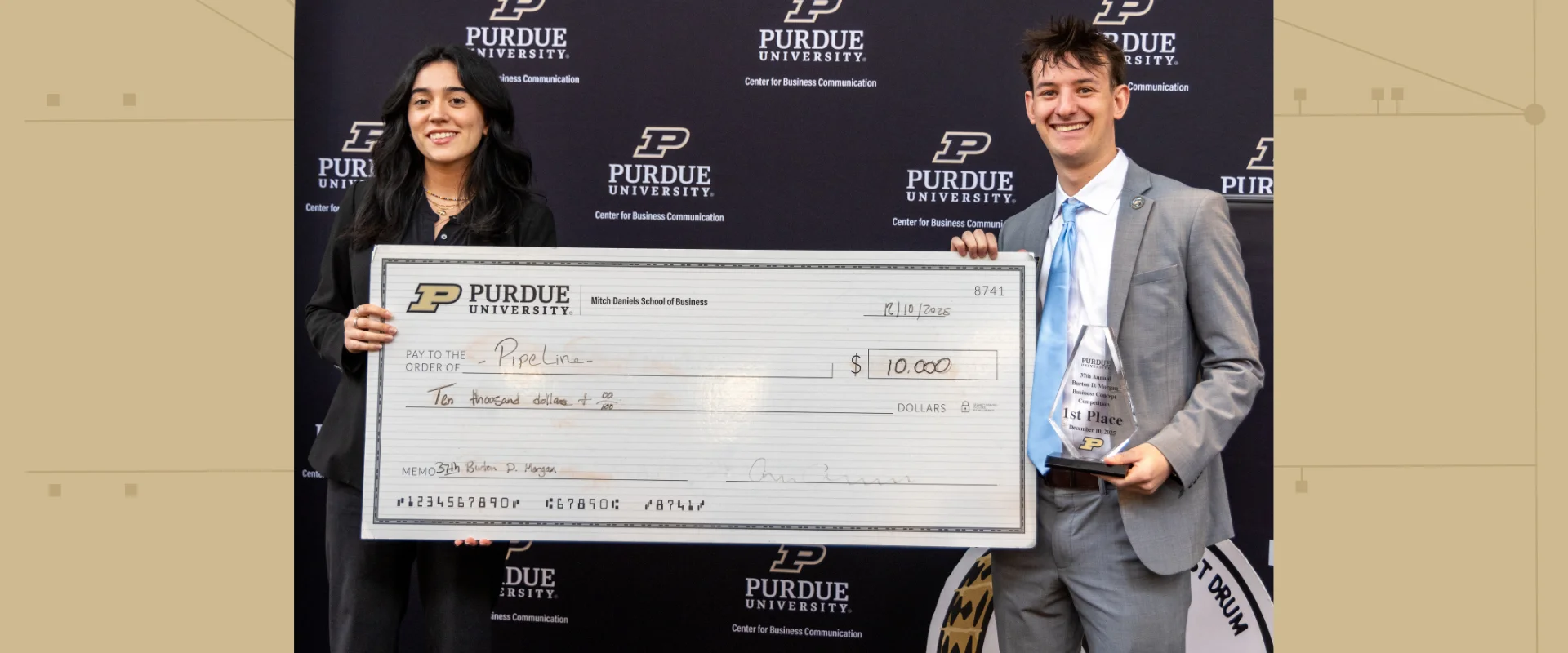
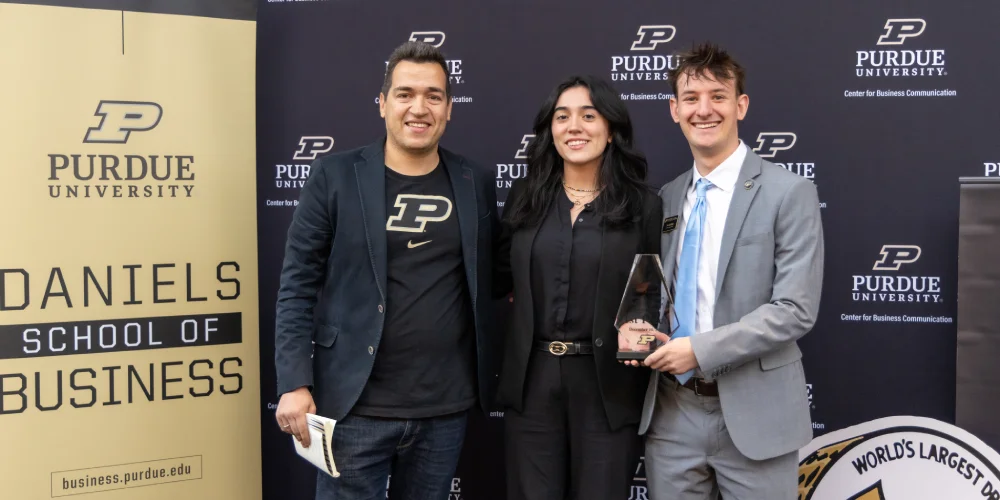
The first-place prize of $10,000 was awarded to PipeLine, founded by Ben Gottlieb and Filippa Rodriguez, both students in the Daniels School of Business. PipeLine is developing an operating system for small- and medium-sized trade contractors, beginning with a focus on reducing costly rework through an AI-powered solution that helps companies send the right technician with the right parts on the first visit.
“The final event felt like the culmination of months of building, iterating and pushing ourselves far outside our comfort zones,” says Gottlieb. “That’s why I chose Purdue — because it’s a place where you are encouraged to build, regardless of your major. This isn’t the end. It’s the beginning of something much bigger.”
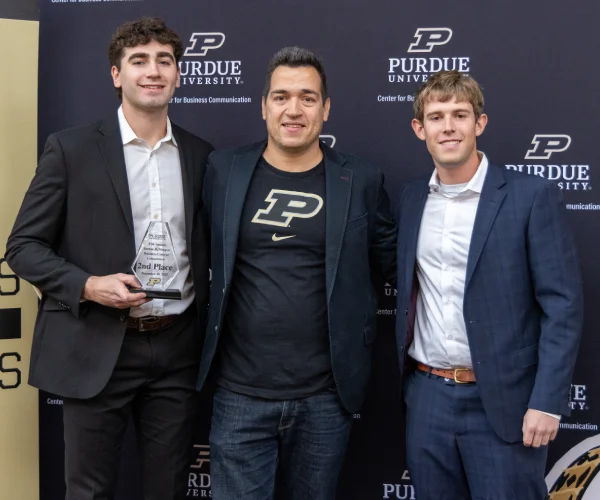
Second place and $7,000 went to Oppit, created by Liam Scherb from the College of Engineering and Quinten Lane from the Daniels School of Business. Oppit is building a low-cost wireless sensor and real-time data dashboard that enables mid-sized manufacturers to bring legacy machines online for improved visibility, predictive maintenance and labor optimization.
“Huge thanks to Kostas Grigoriou, the judges and the manufacturers supporting our pilot deployments,” says Scherb. “We’re excited to keep executing, validating ROI and building.”
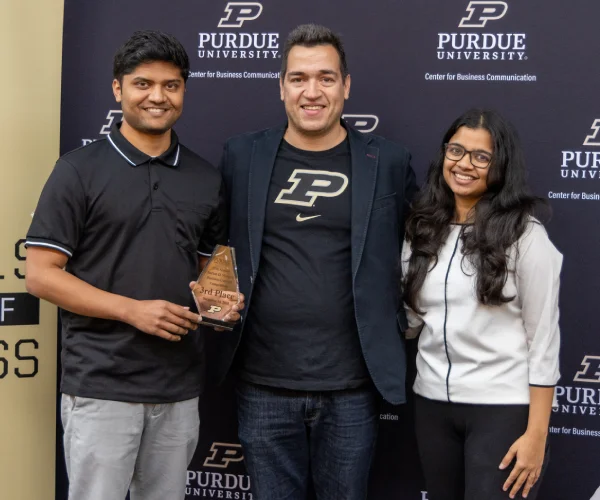
The third-place $5,000 prize was awarded to Litmetrics, founded by Archana Tatavarthi and Surya Kazipeta, both from the Daniels School’s Master of Business and Technology (MBT) program. Litmetrics is developing an AI-driven intake and case qualification platform for plaintiff law firms, designed to capture and prioritize new client inquiries and reduce administrative workload.
“Our platform tackles missed calls, slow follow-ups and overloaded staff that lead to lost high-value cases,” says Kazipeta. “We’re grateful for the feedback and mentorship from the judges and faculty and excited to build on this momentum.”
Seven additional finalist teams each received $3,000 as “Standout Concept” award winners:
FrameCut noted that the process provided a realistic view of how ventures are built, from early customer interviews to pitching in front of investors. “We went from a raw idea to user stories, code, and finally defending our product under pressure,” says Bhushan Udaykumar. “The experience was intense, humbling and deeply rewarding.”
Shubham Agarwal, also from FrameCut, added that being surrounded by other highly motivated teams was one of the most valuable aspects of the event. “The level of creativity, grit and clarity shown by the other teams was incredible,” he says. “That environment made it one of the best learning experiences I’ve had at Purdue.”
Students from Illume echoed similar sentiments. Sanketh Patil says the competition reshaped his understanding of product development and business modeling, while Dhruba Pujary described the program as an iterative journey that pushed teams to continuously refine their ideas. “Qualifying among the top teams out of 120 gave us access to exceptional feedback,” Pujary says. “But this isn’t the end — we’ll keep improving and building.”
Three additional teams received special category awards. Nova Solutions won Best Customer Discovery for its strong validation process. Bridge received the Best Pivot award for successfully adapting its concept based on market feedback, while Polistock earned the “This Could Be Big!” prize, recognizing high growth potential.
The final event was judged by a panel of external venture experts, including Drew Beechler of Alloy Partners, Landon Young of Elevate Ventures, Katelyn Vierk of High Alpha, Mickey Swortzel of Roll Tack Ventures and Mitch Black of HG Ventures.
The Burton D. Morgan Venture Concept Competition is supported by the Daniels School of Business and is designed to foster entrepreneurial thinking and early-stage venture creation among Purdue students. The 38th edition of the competition will be offered in Fall 2026, continuing the university’s commitment to innovation, interdisciplinary collaboration and student-led entrepreneurship.
Many students also take the path from the competition to Venture X, a three-course, year-long, progressive and transformative journey in venture building that offers a more intensive experience. Led by Grigoriou, students begin in Venture X1, which runs parallel to the competition and is where students discover meaningful problems worth solving. Venture X2 is for those who want more and opt to double down and proceed into building and commercializing with funding and support, while Venture X3 focuses on attracting and assembling resources for launch.