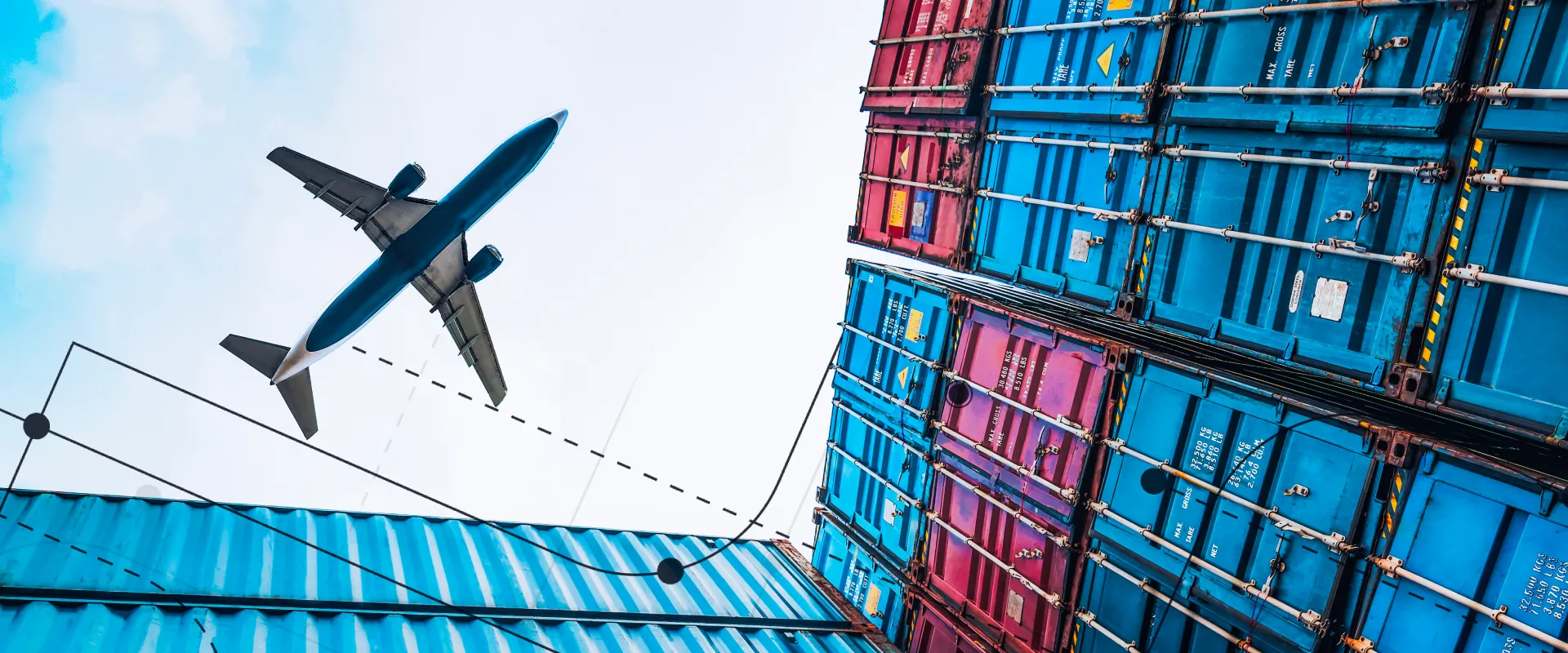
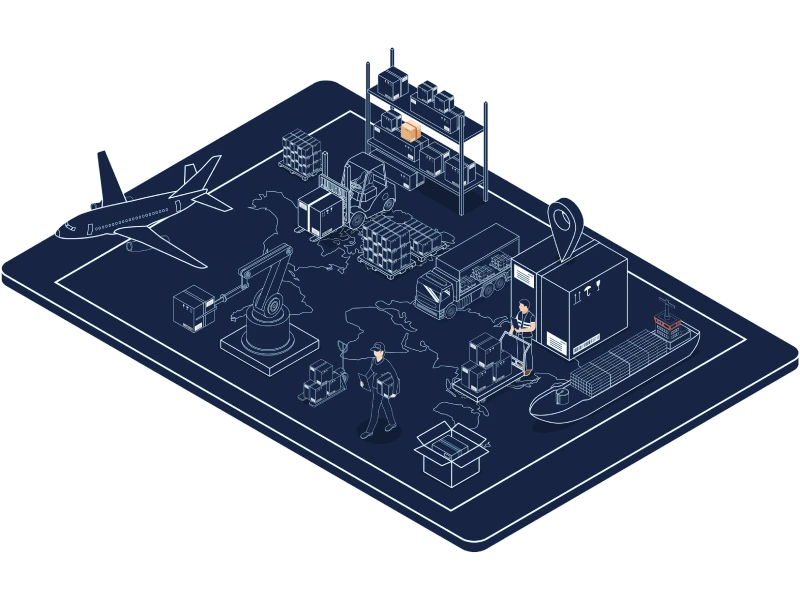
A pioneering project at the Krenicki Center for Business Analytics and Machine Learning at Purdue University’s Daniels School of Business is reimagining how decisions are made in mid-mile transportation logistics. By leveraging artificial intelligence, simulation and optimization techniques, the initiative aims to improve real-time performance in multi-modal networks that combine air and road transportation.
“This project reimagines decision-making in mid-mile transportation logistics with decentralized, online decisions for routing in a multi-modal transportation network,” says Mohit Tawarmalani, executive associate dean for strategy, research and innovation and the Allison & Nancy Schleicher Chair at the Daniels School. “The use cases include analysis of policies that control deadhead miles and their resulting effect on warehouse congestion, analyzing the impact of disruptions to a warehouse, and creating an ability to make specific, measurable promises that the business can realistically and consistently deliver.”
Abhishek Baskar, a Krenicki Center data scientist who earned a Purdue master’s degree in Business Analytics and Information Management in August 2025, played a critical role in shaping the project’s development. His responsibilities centered on analyzing the order generation process and warehouse decision practices. He then designed and tested several heuristic policies to simulate their performance in a logistics network.
“The skills that I developed the most were solution design and problem-solving. Previously, I had applied those skills mainly in the context of analyzing data, defining metrics and deriving insights. But in this project, I used them to develop rules and policies for different aspects of mid-mile operations.”
Abhishek Baskar MSBAIM ’25
“He provided several insights that we have now adopted in the simulation framework,” says Tawarmalani, who served as faculty mentor on the project along with Bruno Ribeiro, an associate professor of computer science. “These included specific insights into order fulfillment processes and locations, integration of air and road transport networks and a policy for attaching closed containers to trucks on specific routes.”
For Baskar, the experience was transformative. “The biggest takeaway for me was the experience of working with Professors Ribeiro and Tawarmalani,” he reflects. “I learned a lot from their approach to problem solving and from their out-of-the-box thinking. It really helped me improve my own problem-solving and critical thinking skills.”
Beyond conceptual learning, the project gave Baskar the chance to apply and expand his technical expertise in a new way. “The skills that I developed the most were solution design and problem-solving,” he explains. “Previously, I had applied those skills mainly in the context of analyzing data, defining metrics and deriving insights. But in this project, I had to use them to develop rules and policies for different aspects of mid-mile operations, including those which mirrored real-world operations but were also suitably modified for our use case. It really helped expand my thinking of how to tackle and solve problems.”
The project has also had a lasting impact on his career goals. “This experience will allow me to pursue opportunities in the supply chain analytics and logistics verticals, since my work had a lot to do with understanding the business processes associated with these verticals,” Baskar says. “It has also helped me develop a strong base for research, which I am sure will come in handy for more technical roles.”
Looking ahead, the project is entering a new phase that will deepen its reliance on artificial intelligence. “The project is now moving into a phase where AI will learn various characteristics and performance measures and their dependence on controllable inputs,” Tawarmalani says. “We will then transition to generating policies by combining AI and optimization for improving real-time performance using decentralized, online decision-making. We will also study the impact of disruptions, technological advancements and policy changes on the performance of the logistics network.”