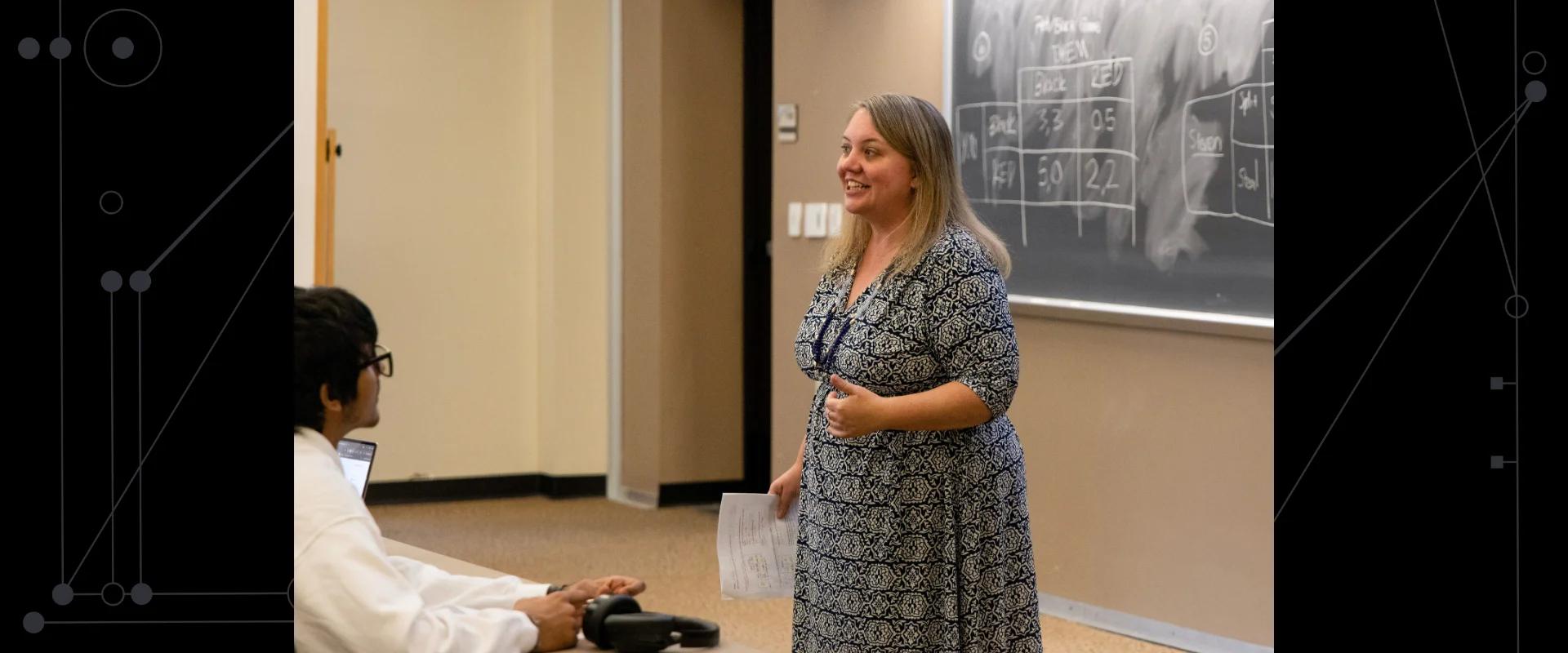
From her first brush with economics as a fourth grader to her current role directing the Purdue Center for Economic Education (PCEE), Clinical Assistant Professor Erin Yetter's career has been a steady pursuit of helping others understand how the world works through the lens of economics.
Her path — including three stops in Delaware and stints in Kentucky, Florida, Arizona and finally Purdue — reveals not only an enduring fascination with economics but also a deep commitment to making the subject engaging and accessible for students and teachers alike.
For Yetter, her journey into economics began long before college. As a fourth grader, she participated in the “Meaningful Economics” competition, an experiential learning opportunity that allows students to build and apply knowledge in economics, entrepreneurship, and personal finance. “My team actually won in one of the competition areas, and I thought it was pretty cool,” she recalls.
That early experience left a lasting impression, but Yetter didn’t initially plan to study economics. When she arrived at Eastern Kentucky University, she was a forensic science major — until a general education requirement reignited her childhood curiosity.
I've loved economics since I was ten years old. Now I get to help others discover that same excitement. That's what makes this my dream job.
“I had an amazing professor who blew my mind about what economics was and could be,” she says. “I thought I’d minor in it, but the more classes I took, the more I realized that’s really what I loved.” She switched her major to economics and political science, setting herself on a path she’s followed ever since.
After earning her undergraduate degree, Yetter relocated to Florida, where she worked for T. Rowe Price before returning to academia to pursue a master’s degree in economics. It was during this time that she discovered her passion for teaching — and the unique challenge of teaching economics well.
“Just because you have all the content knowledge in the world doesn’t make you a good teacher,” she says. “That was my ‘aha’ moment.” The realization led her to the emerging field of economic education, which combines economics and pedagogy to help instructors effectively communicate economic principles.
Her curiosity turned into action. After completing her master’s, she began teaching introductory economics at Hillsborough Community College in the evenings — while working full-time. Those experiences laid the foundation for her eventual decision to pursue a doctorate in economic education.
When Yetter enrolled at the University of Delaware, she became the first student admitted to its new PhD program in economic education — a joint effort between the economics department and the School of Education. The program’s structure required students to balance rigorous quantitative work in economics with qualitative research and theory in education.
“It was very difficult to navigate,” she says. “In econ, it’s all math and coding. In education, it’s reading and writing papers. You’re wearing two very different hats.”
Her perseverance paid off. After completing her coursework, she joined the Federal Reserve Bank of St. Louis as an economic education specialist at the Louisville Branch, finishing her dissertation while working full-time.
At the St. Louis Fed, Yetter found the perfect venue to combine her research, writing and teaching skills. Her role involved training K–12 teachers, developing classroom curriculum and publishing research in economic education. “We ran workshops on topics like teaching economics through children’s literature or environmental issues,” she says. “I wrote 15 lessons while I was there, which is a lot in our field.”
Her work also extended into Indiana — part of her Fed territory included the southern part of the state — giving her early exposure to the region’s educators and schools. That experience would prove valuable years later when she arrived at Purdue.
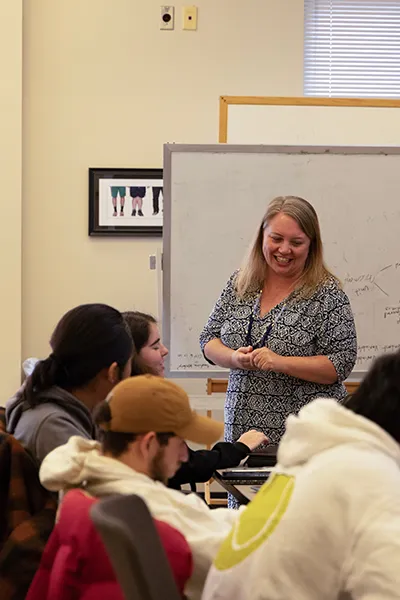
After several years at the Fed, Yetter took a faculty position at the University of Arizona, where she focused exclusively on teaching economics. She continued offering workshops on the side — especially during the pandemic, when virtual teacher trainings became vital.
After returning to Delaware to care for her mother, Yetter worked as a visiting faculty member at her alma mater and part-time for a consulting firm. “My mom jokes that I’m not happy unless I’m running around like a crazy person doing 19 different jobs,” Yetter says. Even amid the upheaval, she kept teaching and mentoring, proving her commitment to education’s impact.
In 2025, Yetter accepted the position as director of the Purdue Center for Economic Education. Remarkably, she had once written that very title — though as “assistant director” — on a “future CV” assignment during her PhD program. “I never dreamed the job would actually open,” she says. “I manifested it into the universe, and it came true.”
Since arriving at Purdue, Yetter has been reinvigorating the center. She’s launching new outreach programs, building school partnerships and growing teacher workshops. She’s also working to introduce the Meaningful Economics competition here in Indiana, the same competition that first inspired her as a child.
Yetter is equally energized by Purdue’s students. “I’ve been pleasantly surprised by how bright and engaged they are,” she says. “They’re professional, organized and a joy to teach.” She also praises the Daniels School’s collaborative culture: “Everyone here is friendly and collegial. It’s a great environment.”
For Yetter, the future of PCEE is about connection — between teachers, students and the broader community. She regularly attends local networking events to raise awareness of the center’s work. “Sometimes people just need a reminder that we exist,” she says. “Once they hear what we do, they want to get involved.”
Her plans for the coming years include expanding professional development opportunities for teachers, fostering more collaboration with local schools and financial institutions, and inspiring the next generation to see economics not as abstract theory, but as a practical tool for understanding everyday life.
“I’ve loved economics since I was ten years old,” Yetter says. “Now I get to help others discover that same excitement. That’s what makes this my dream job.”