05-14-2026
Until Mickey Swortzel’s husband walked into their kitchen and said, “I want to start a company,” she thought she knew what her career would look like: corporate ladder, big organization, clear path. Instead, that offhand moment turned them into entrepreneurs.
Now she helps other entrepreneurs get the funding to grow.
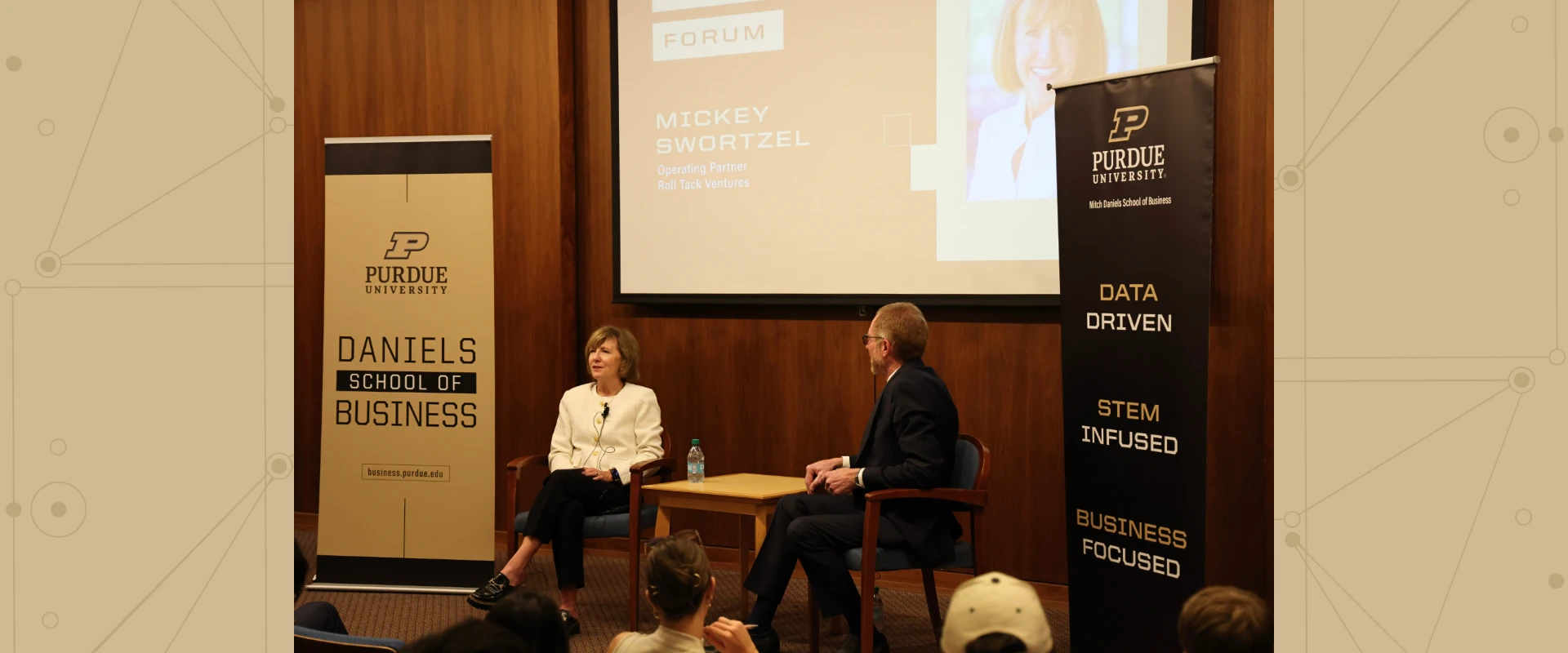
In her recent appearance at the Daniels School, where she is a Business Fellow, Swortzel provided an outline of what it means to lead and to seek venture capital.
Swortzel clarified that not every good business is a venture-backable one. A hair salon or HVAC company can be profitable — but they usually won’t grow tenfold in five years, which is the growth trajectory venture funds are built around.
In her world, a “good business” for venture capital has a few key characteristics:
Swortzel calls early-stage “weaving and iterating” normal, but she’s looking for companies that have already landed on a clear product-market fit.
In her current role, Swortzel helps Roll Tack, a venture capital firm, invest at the Series A and B stage, and she draws a simple map for how companies get there:
Timing matters. Her team looks at 3,500 companies a year, which is about 50-60 a week, and does deep diligence on about 35. By the time you knock on her door, you are competing against hundreds of other founders who already have customers, traction and a clear reason why money will accelerate growth, not just extend runway.
She also reminds founders that venture is a long game. A typical investment might run 10 years before an exit through acquisition or IPO. When Swortzel backs you, she’s assuming you’ll be in each other’s lives for a decade.
If venture capital is a two‑sided marketplace, you’re also choosing them. Each VC firm specializes, so companies should do some research. Swortzel’s fund doesn’t try to compete with coastal giants; instead, they lean into their Midwest roots and B2B focus. They look for:
Research funds as carefully as they research you. Look for a match on stage, sector and geography.
Look beyond the check size. Ask how they help with customer introductions, industry access and navigating later rounds.
Swortzel says it starts with attitude. She looks for humble, teachable founders who listen without being swayed by every opinion. Overconfidence, unwillingness to take input or customers who churn as fast as they arrive are all red flags.
Before she was the one writing checks at Roll Tack, Swortzel was the entrepreneur worrying about making payroll. She tells the story of a recession that forced her to cut 30% of her staff, even as the company was growing. It was painful and personal, yet necessary.
Her decision-making framework from those years still shapes how she leads and invests:
Eentrepreneurship rarely offers balance. Swortzel jokes that she was a 24/7 entrepreneur, 24/7 mom, and 24/7 wife — and she didn’t want it any other way. What mattered more to her was flexibility: driving every field trip, answering emails from the car, and embracing the joy of the work.
Above all, she credits resilience, a strong co‑founder and lifelong learning. She has never been a programmer, but she now talks comfortably about scraping the web and building AI‑enabled sourcing tools for her firm, simply because she decided to figure it out.
For founders, that mindset may be as important as any metric in the data room.
Watch the full discussion.
The Daniels School’s Executive Forum is held in person on the West Lafayette campus during the academic year and is open to the public, as seating permits. Watch past speakers on the Executive Forum podcast.