03-12-2026
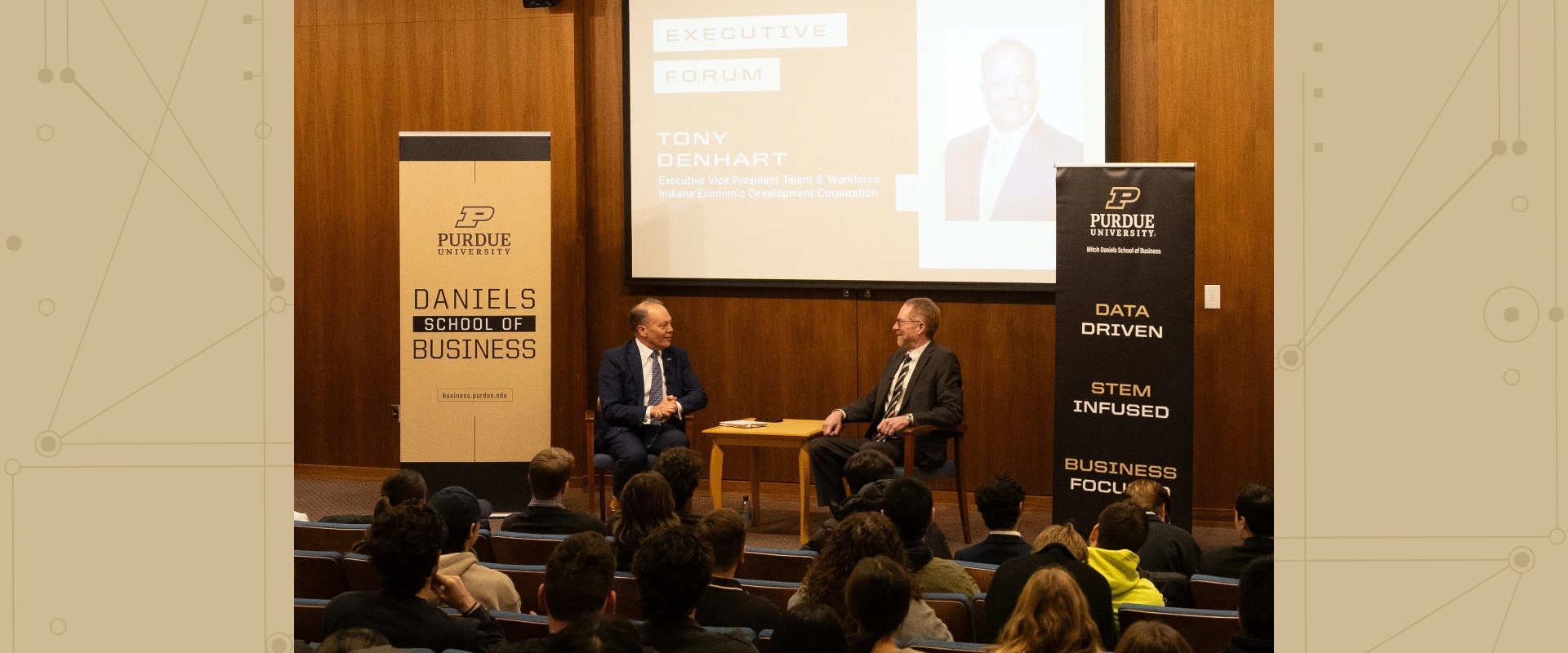
Indiana’s economy is being grown for a future of advanced manufacturing, high‑tech investment and opportunity for graduates — and the Indiana Economic Development Corporation (IEDC) is at the center of that shift, Tony Denhart said during a recent Executive Forum. As executive vice president of workforce and talent and a longtime Purdue partner, Denhart underscored how intentional economic development is reshaping the state’s industrial base and career landscape.
Indiana is already one of the most manufacturing‑intensive states in the country, with its location, logistics network and higher education system giving employers a powerful reason to build and expand here. Denhart pointed to investments in sectors such as semiconductors, EVs, advanced manufacturing, hyperscale data centers, agriculture, defense and life sciences — from companies like Eli Lilly, Meta, Rolls-Royce, Cummins, Amazon Web Services, Elanco, SK hynix and many more — as evidence that Indiana is attracting high‑wage, high‑tech jobs that did not exist in the state just a few years ago. Programs like the state’s READI quality‑of‑place initiative further bolster that strategy by improving housing, childcare, trails and arts — factors that matter to both companies and talent.
For business leaders, the message is:
Make workforce your primary economic development lever, not a support function — no project works without the right people on site and in the pipeline.
Build formal partnerships with universities, K–12 and local organizations to create sustained talent funnels instead of one-off hiring pushes.
Map your growth plans against the state’s priority sectors — semiconductors, EV, life sciences, hyperscale data centers — to ride existing investment, incentives and ecosystem buildout.
Re-skill existing employees toward these higher‑value activities so you are not the “muffler manufacturer” left behind when technology or regulation shifts.
Engage in local conversations about housing, childcare and quality‑of‑place; these are now competitive factors for attracting and retaining employees.
Participate in or co-fund regional initiatives like trails, arts and community assets that make it easier for graduates to see themselves staying in your market.
Encourage teams to use generative AI for drafting, analysis and repetitive work, with clear guardrails on ethics and confidentiality.
Set an internal expectation that roles will evolve quickly — 70% of skills may change in four years, so it’s critical to build continuous upskilling and experimentation into job design.
Treat every campus touchpoint, plant tour or community event as a recruiting moment, and ensure leaders show up prepared to spot and follow up with talent.
Coach managers to build long-term relationships with schools and alumni; those networks become a durable advantage in tight labor markets.
In a time of rapid technological and economic change, Denhart framed the IEDC’s work as fundamentally generational: aligning today’s investments so that Indiana’s children, grandchildren and great‑grandchildren can build meaningful, well‑paid careers without leaving the state — unless they choose to.
View and listen to Denhart’s Executive Forum appearance:
The Daniels School’s Executive Forum is held in person on the West Lafayette campus and is open to the public, as seating permits. Follow the business school on LinkedIn to learn about upcoming Forum speakers and more, and watch past speakers on the