09-16-2025
Few things are more energizing than the chance to shape a department positioned at the crossroads of business, analytics and technology — a place where rigorous research and data-driven decision-making will directly impact the next generation of business leaders. Our world is being transformed by advanced analytics, AI and rapid technological change. To build the future of business, the Daniels School has embraced a bold restructuring designed to foster market responsiveness, business and STEM specialization, and leadership excellence.
Our Quantitative Methods Department sees both opportunities and challenges for higher education with the rise of AI. We must prepare students to take advantage of these powerful technologies while also ensuring they understand the limits, risks and ethical considerations. Leading this department means bringing together the right people and ideas to meet that challenge and prepare our students to lead with confidence in a rapidly changing world.
Throughout my career, I’ve focused on bridging quantitative research with real-world business challenges. Whether working in market design or AI-powered analytics, I have seen the tangible benefits when academic rigor meets business practice. I’ve also prioritized collaborations that span economics, computer science and business — critical intersections for tackling the complex challenges our students will face. This multidisciplinary perspective shapes how I lead and how I envision the department’s impact.
We are committed to cultivating a department culture rooted in innovation, inclusivity and collaboration. Our team encourages faculty and students to take smart, intellectual risks and to work across disciplinary lines. We want everyone to feel empowered to challenge assumptions and pursue big ideas. Our goal is to inspire a shared purpose: applying analytics and quantitative methods to drive meaningful impact in both business and society.
As we launch this department, our top priorities are:
Success means being recognized as a hub where innovative teaching and pioneering research meet. Tangibly, we’ll measure our progress through strong placement outcomes for our graduates, high-impact research (both academically and in the business world) and greater external support from both industry and alumni, clear indications that we deliver real value to all stakeholders.
One of the biggest current challenges in business education is how to bridge the gap between cutting-edge technical tools. Decision-making and strategy need technical depth. By blending the diverse technical backgrounds of our faculty — from computer science, statistics and engineering — with business know-how, we ensure that students don’t just learn quantitative methods; they learn how to use them to solve authentic challenges facing markets, organizations and society.
Our modular and flexible curriculum allows us to adapt rapidly, adding or revising courses as technologies evolve. Close ties to industry mean we receive feedback in real time, ensuring our students and faculty always operate at the frontier of business needs. Our interdisciplinary mindset enables quick pivots in research focus, letting us stay ahead teaching to stay at the frontier.
Never Miss a Daniels Insight
Join our blog readership to get data-driven business insights and analysis of industry trends delivered to your inbox Monday through Thursday.
The Daniels School’s mission is to produce business leaders ready for the future of work. Our vision: grow “bilingual leaders”— people who are fluent in the technical language of analytics and AI, and equally comfortable translating those insights into business strategy. Our graduates will be prepared to connect engineers and executives, turning data into ethical, strategic decisions that drive organizations — and society — forward.
We produce leaders who can speak with the CTO at 10 a.m. and the CFO an hour later — then make the decision at noon.
Our faculty structure both curriculum and research agendas around real-world relevance and impact. Experiential learning, live projects and case studies are built into the classroom. On the research side, we focus on high-value problems, such as market design and responsible AI, ensuring our work is both academically rigorous and societally impactful.
Our new structure opens up incredible opportunities — for interdisciplinary research initiatives, for partnerships with Purdue’s world-class engineering and computer science programs, and for industry collaborations that give students hands-on experience. This autonomy to innovate and take bold risks positions the Daniels School and our Quantitative Methods Department as pioneers in business education.
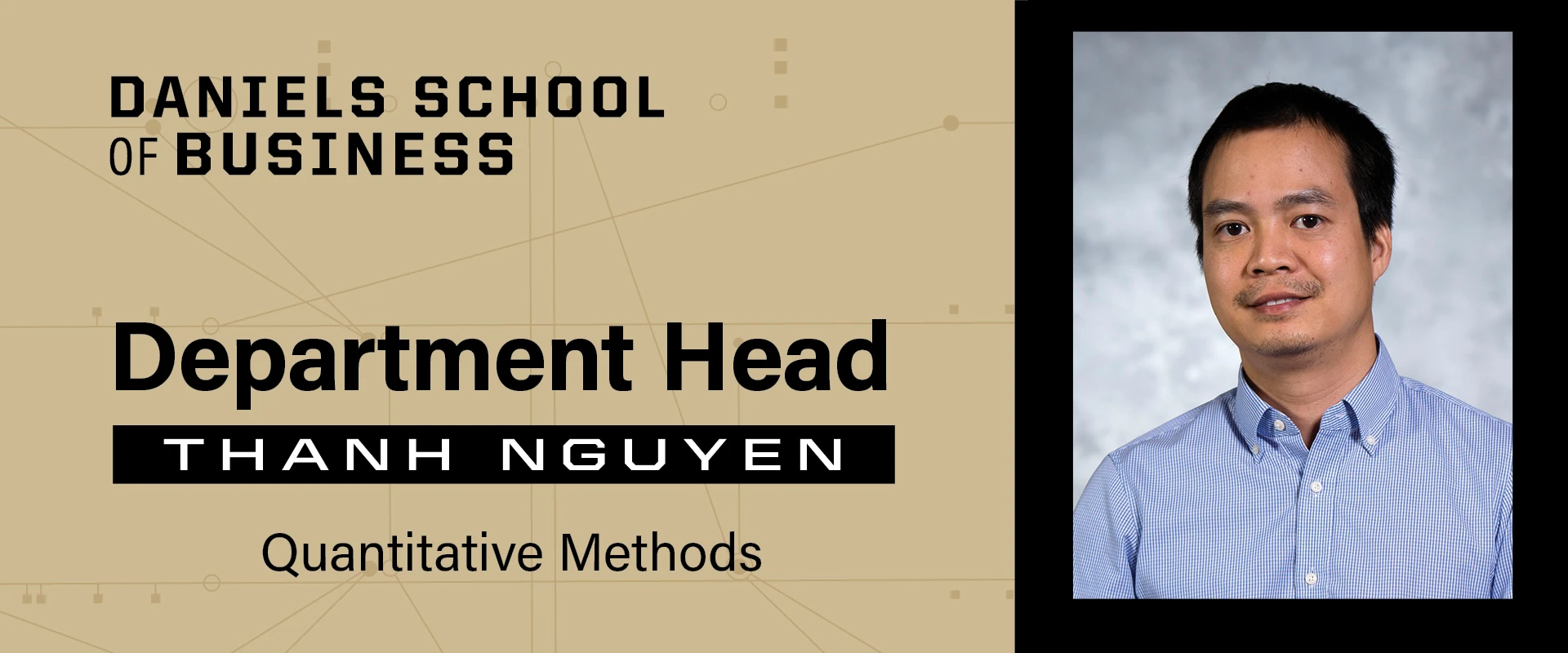
Thanh Nguyen is the Lewis B. Cullman Rising Star Professor at the Daniels School of Business. His research spans the intersection of economics, management science and computer science, and has been published in the American Economic Review, Journal of Political Economy, Management Science, and Operations Research. Professor Nguyen is particularly interested in market design, network economics, computational game theory and combinatorial optimization. He earned his PhD from Cornell and a bachelor’s degree from Eötvös Loránd University, Hungary.