09-29-2025
The recent restructuring at the Daniels School and the creation of the Supply Chain and Operations Management Department is more than an administrative shift — it’s a strategic realignment to address today’s market needs, to fuse business with STEM excellence, and to cultivate the next generation of leaders.
The unique chance to design our own processes for how this department operates, based on what our students and faculty need, is both a responsibility and a thrill. As supply chain and operations experts, process design and execution are in our DNA. I’m energized by the opportunity to shape foundational practices that will guide our department for years to come.
Throughout my career, I’ve been fortunate to gain a perspective critical for this role, from serving as associate dean of what is now the Krannert Graduate Institute to directing our one-year MBA program (which QS World University Rankings just named 18th out of 62 online MBA programs in North America). Those experiences give me invaluable insight into both program design and the internal processes that make an academic department effective. My academic credentials — research, editorial work for leading journals, and roles on university committees — underscore my commitment to faculty mentorship and scholarly leadership. Constructive feedback, meaningful faculty reviews and fostering an environment of high standards are cornerstones for me.
From the start, our approach has been simple but powerful: hire world-class talent, support them and let them excel. That’s why we boast top-five national rankings year after year in supply chain and operations management. Our department culture is collaborative, inclusive and deeply supportive, qualities I’m proud to continue building upon as we embrace this new structure.
Our vision for the coming year is ambitious and focused on three priorities. First, we’re forging even stronger ties with our alumni and business partners, developing a dedicated Corporate Advisory Board to hone our curriculum, provide mentoring and create hands-on learning opportunities across all our programs. Second, we are targeting 20% growth in our MSGSCM (Master of Science in Global Supply Chain Management) program, striving to reach 50 students per year. To get there, we’ll improve admissions yield, expand scholarships and systematically gather student feedback to continually refine the student journey. Third, we are strengthening our undergraduate pipeline, aiming for 50 students per year in the Supply Chain and Operations Management major, launching new scholarships and introducing a minor for engineering students. Our goals are not just about numbers; they’re about broadening access and deepening impact.
Success, for us, is defined by meeting these goals: growing our programs, raising our national standing, placing our PhD graduates at top institutions and supporting our faculty to remain at the forefront of research and teaching. To reach these outcomes, we continue to streamline operations so that our people can focus on what truly matters: teaching, research, service and advancing the student experience.
Never Miss a Daniels Insight
Join our blog readership to get data-driven business insights and analysis of industry trends delivered to your inbox Monday through Thursday.
The business landscape is evolving at lightning speed. Technologies like AI and IoT are revolutionizing supply chains, yet many organizations are struggling to adapt. Our department, with its deep ties to industry leaders and research-driven faculty, is uniquely positioned to teach both the foundational principles and the technical skills needed for Industry 4.0. Our size and new structure mean we can respond rapidly: with fewer than 20 faculty members, feedback can be acted on quickly and decisively. We turn insights from our industrial partners directly into curriculum innovation and skill-building for our students.
Experiential learning has long been our hallmark. Our students take on consulting projects, enroll in 6-to-12-month co-ops and internships, and engage directly with practitioners at networking events and site visits. We have notably embraced technology: regular curriculum reviews, strong partnerships with SAP and SAS, and integration of AI tools across courses ensure our students are learning how to leverage these advancements responsibly and effectively. Project management education, rooted in real-world needs, remains a department strength.
Our faculty are at the cutting edge, researching data-driven decision modeling, publishing in top journals, organizing conferences, and writing influential books. In spring 2026 we launch our new Data Science for Decision Making center, to further connect research with real-world business challenges. Our curriculum is rigorous and responsive, offering high-demand electives in areas like hospital operations, digitized supply chains, sustainable operations, and advanced manufacturing.
Our school’s new structure opens a wealth of collaborative and interdisciplinary opportunities, including the establishment of a specialized industry advisory board and expanded partnerships for projects, co-ops and jobs. The Daniels School began with a focus on industrial management; now, as a stand-alone department, we are poised to build on that legacy — developing the ecosystem required to lead in business education, not just for today, but for the future.
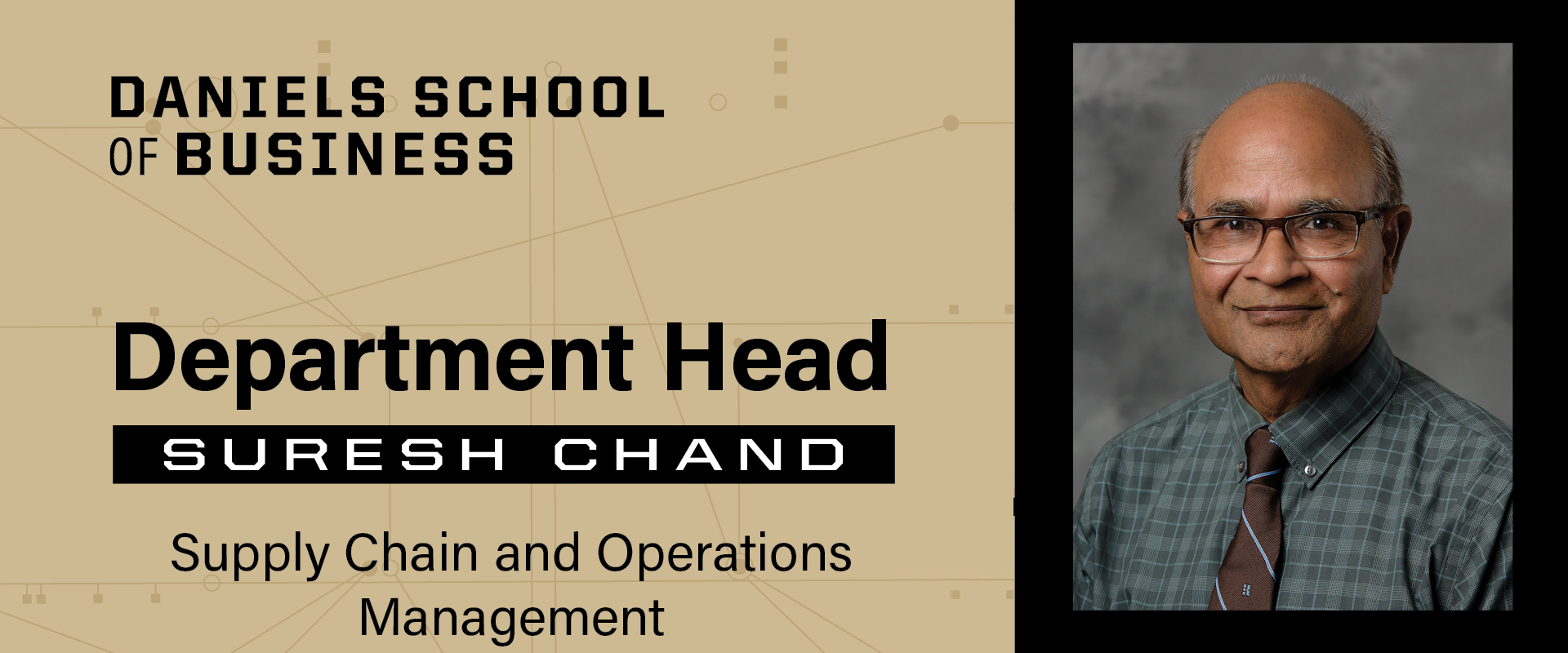
Supply Chain and Operations Management Department head Suresh Chand is the Louis A. Weil Jr. Chair of Management and Professor of Operations and Supply Chain Management at Purdue’s Daniels School. His research and teaching interests include analysis and improvement of production processes on dimensions of cost, quality, time and flexibility, with applications in manufacturing and healthcare, as well as capacity and production planning that improves volume flexibility, reduces flow time for patients, and develops supply chain models to match supply with demand with multiple orders.