09-22-2025
When I look across our expanded Organizational Behavior and Human Resource Management (OBHR) team, what stands out is the great potential we have to build on our excellent foundation. We have an extraordinary and collegial faculty, and I’ve been consistently impressed — and grateful — for their willingness to share ideas and collaborate on shaping our future. The recent addition of a robust business communications faculty has unlocked new energy and reach for our department, enabling us to connect with external audiences more authentically and effectively.
Perhaps my greatest excitement comes from the vital role our department plays in today’s dynamic business ecosystem. OBHR scholarship and teaching have never been more crucial. Our faculty sit at the leading edge of research into holistic employee experiences — work that directly impacts organizational success, employee well-being and overall performance. It’s much easier to lead when you believe so deeply in the importance of the work.
My journey to this role was shaped by diverse experiences. After completing college ROTC, I became a division officer on a U.S. Navy ship, responsible for 15 sailors at age 23. This role taught me discipline, teamwork and the value of clear communication — all elements I bring to departmental leadership. Serving as Officer of the Deck was another formative challenge, but it reinforced the critical nature of managing people and processes with both calm and focus. These lessons — combined with research into what builds engagement and culture — are cornerstones of my approach to leading our department.
With our team growing from 15 to 24 in the last two years, we are ready to embrace new challenges — and exciting opportunities. I’m committed to sustaining the collegial, “small department” culture that has always set us apart. At the same time, our expanded skills and expertise demand a culture of external engagement, where we showcase talent and invite new partnerships.
Looking ahead, we have three top departmental goals:
Never Miss a Daniels Insight
Join our blog readership to get data-driven business insights and analysis of industry trends delivered to your inbox Monday through Thursday.
Success for us takes many forms. At this year’s Academy of Management meetings in Copenhagen, the Daniels School’s OBHR reputation was roundly praised — a testament to our rising stature. Using a scholarly ranking algorithm developed by peers at Texas A&M and Georgia, we’re proud to be ranked 12th for faculty publications in 2024 (13th over five years), and we’re motivated to rise even higher. On the student side, continued strong MSHRM placements and engaged corporate partners mark key indicators. We’re also striving for even deeper external engagement—measured, in part, by faculty contributions to date in forums like the Daniels Insights Blog.
Business education faces major shifts, and I believe we’re well-positioned to lead dialogue around work/non-work balance and the importance of “working well.” Rooted in Purdue’s One Health initiative, we’re exploring the tension between workforce productivity and well-being — not as opposing forces, but as goals that can be achieved together. Our faculty’s expertise in talent management, leadership and trust will assist our strides in these areas.
In sum, the future for OBHR — and the Daniels School as a whole — is bright. We are building a department and school that's uniquely equipped to meet the demands of a changing business world while developing leaders ready for what’s next. I’m proud to be part of this journey.
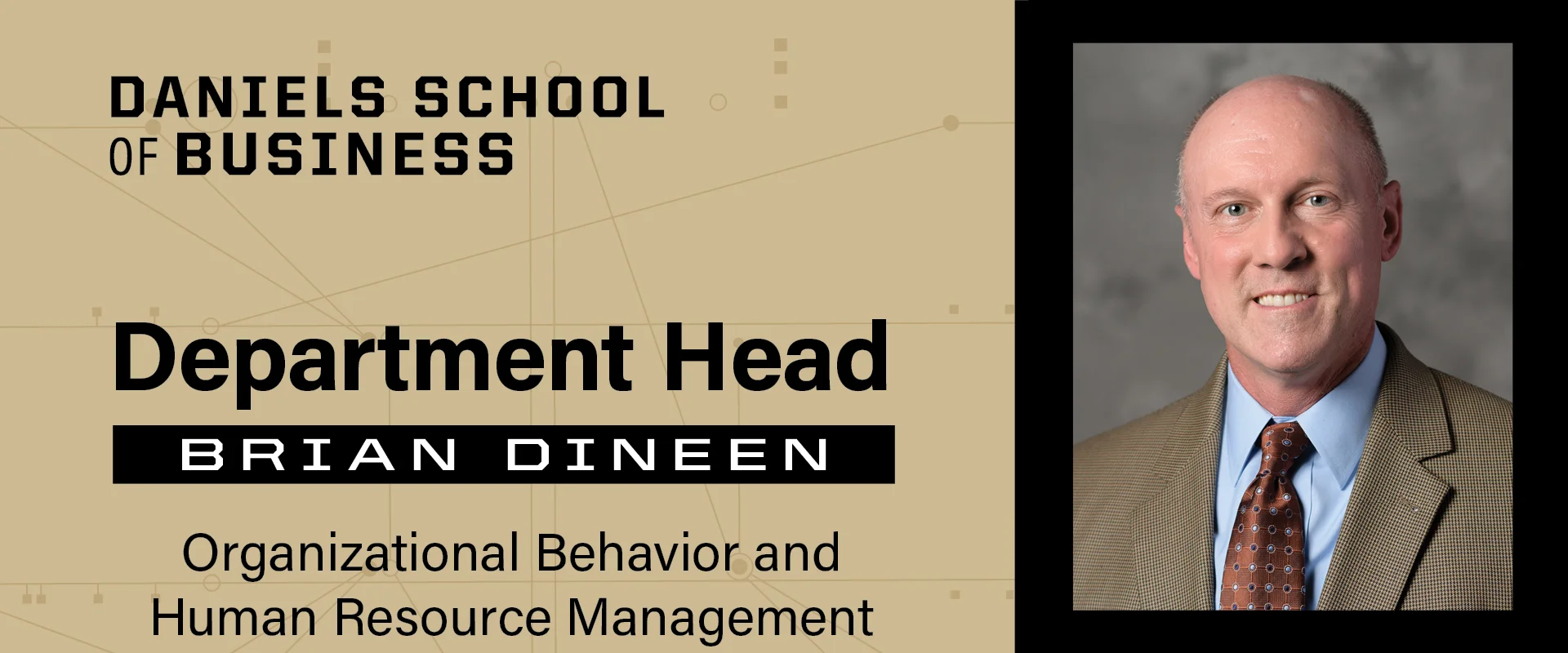
Brian Dineen is the Leeds Professor of Management and Department Head for Organizational Behavior and Human Resource Management. His research focuses on recruitment, job search and employee retention, including recruitment messaging, applicant quality and employment branding. His work has appeared in top journals like Academy of Management Journal and Journal of Applied Psychology. Professor Dineen teaches Human Resource Management, Organizational Behavior, and Negotiations to undergraduate, graduate, and PhD students. He also serves on the editorial boards of several leading journals, including Journal of Applied Psychology and Journal of Management.