11-05-2025
The mood in Washington may have shifted with the new administration, but the real story of 2025 has been unfolding in boardrooms, trading floors and factory offices across the country. After months of volatility and debate, the U.S. economy appears both stronger and stranger than many expected — thriving amid uncertainty, expanding under tariffs and investing furiously in artificial intelligence.
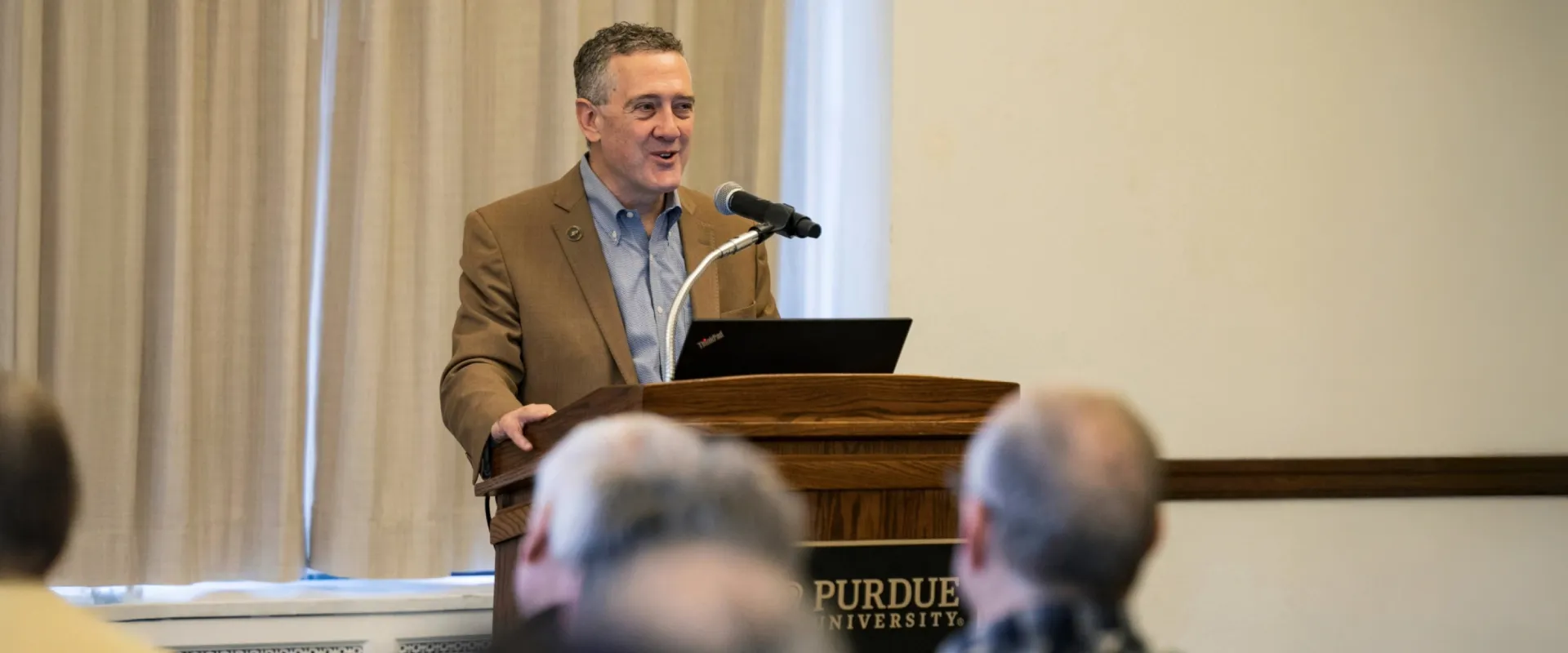
In his recent talk, “Decoding the U.S. Economy,” given as part of the President’s Council Back to Class program, Jim Bullard, Dr. Samuel R. Allen Dean of Purdue’s Mitch Daniels School of Business, offered a candid, data-driven narrative of how policy shocks, business psychology and the AI boom are reshaping the economic landscape.
Drawing on his experience as a longtime Federal Reserve policymaker, Bullard invited the audience of alumni to view the economy as a constantly moving puzzle — one that demands a steady eye for patterns, not headlines. “In the Fed world that I came from, you’re always asking: ‘Where are we, and what should policy do next?’” he said.
“The markets thought they’d seen this movie before,” Bullard continued, noting the assumption that a second Trump presidency would simply extend policies from the first term. “That turned out to be wrong.” Instead, Bullard described an administration that arrived “far more ambitious and better prepared than anyone expected,” with sweeping fiscal and trade actions that initially rattled investors.
The months following the 2024 election were marked by turbulence. Equity markets began to decline in February 2025 as the new administration rolled out aggressive policy measures and reignited global trade disputes. Bullard noted that when businesses face uncertainty, “they tend to stall.” Investment and hiring slowed in the first half of the year as executives “tried to take on board the idea that many more things were going to happen than they had thought.”
Yet by mid-year, the fog began to lift. The administration succeeded in passing a major fiscal bill through reconciliation by July 4, removing some uncertainty about future tax provisions. At the same time, fears that the revived trade war might trigger a global recession proved overblown. “Cooler heads prevailed for the most part,” Bullard said, noting that while China reacted strongly, most trading partners avoided escalation. “The recession fears did not materialize, and that’s why we’ve had a rally since the spring.”
By the second half of 2025, economic growth had reaccelerated. The Atlanta Fed’s GDPNow tracker estimated a real annualized growth rate of 3.9 percent — what Bullard called “boom times for the U.S. economy.” Markets that had braced for stagnation were now facing the opposite scenario.
Several factors supported the rebound. The new fiscal legislation promised incentives for business investment, particularly through enhanced depreciation provisions. Meanwhile, the artificial-intelligence boom spurred rapid capital spending on data centers and computing infrastructure. “Mega-cap companies are worried for the first time that someone could take their revenue stream away,” Bullard said, describing an arms race between tech giants and emerging AI challengers.
Despite the strong output data, the labor market showed signs of strain. Job creation slowed to an average of just 27,000 per month over the summer, compared with the typical 150,000 to 200,000 pace. Bullard attributed much of the weakness to two factors: business hesitation amid policy uncertainty and a sharp tightening of immigration rules. “Firms don’t want to make billion-dollar investments or hire a bunch of people when they’re worried about what the policy’s going to be,” he explained.
Still, broader indicators suggested the job market remained fundamentally sound. The unemployment rate hovered near 4 percent, unemployment claims were stable and the Kansas City Fed’s labor conditions index signaled an “average-looking labor market.”
Inflation, however, remained above target. As of October 2025, it was holding near 3 percent — too high for the Federal Reserve’s comfort but well below its 2022 peaks. Bullard countered the idea that tariffs were to blame for elevated prices. “Trade policy affects only about 10 percent of the consumption basket,” he said. “Inflation is controlled in the medium term by the Fed, not by trade policy.” He predicted that inflation would drift back toward 2 percent through 2026 as monetary policy stayed moderately restrictive.
While growth has outperformed forecasts, Bullard warned that fiscal deficits remain a looming risk. The new administration’s policies have kept federal deficits near 6.5 percent of GDP — levels that “will put upward pressure on U.S. interest rates.”
Tariff revenues have softened the blow slightly. “President Trump figured out a way to raise tax revenue through the back door,” Bullard said, noting that import duties are now a significant source of federal revenue despite the administration’s anti-tax rhetoric. But globally, he said, “fiscal deficits are very high” and that shared pressure is keeping global interest rates elevated.
Against this backdrop, the Federal Reserve began cutting interest rates in September 2025, lowering the policy rate by 25 basis points and signaling two more cuts by year-end. Bullard cautioned that the December move was “more uncertain now than it was,” given the economy’s renewed strength. Nevertheless, he said the Fed’s stance remains “somewhat restrictive” — tight enough to maintain downward pressure on inflation while supporting growth.
For now, Bullard believes the U.S. is on a solid footing: growth resilient, inflation manageable and monetary policy easing gradually. But he reminded his audience that uncertainty — whether from trade policy, fiscal imbalances or political volatility — remains the economy’s silent variable. “The main way uncertainty affects growth is through the decisions that businesses make,” he concluded. “And that’s what we’ll keep watching.”