10-21-2025
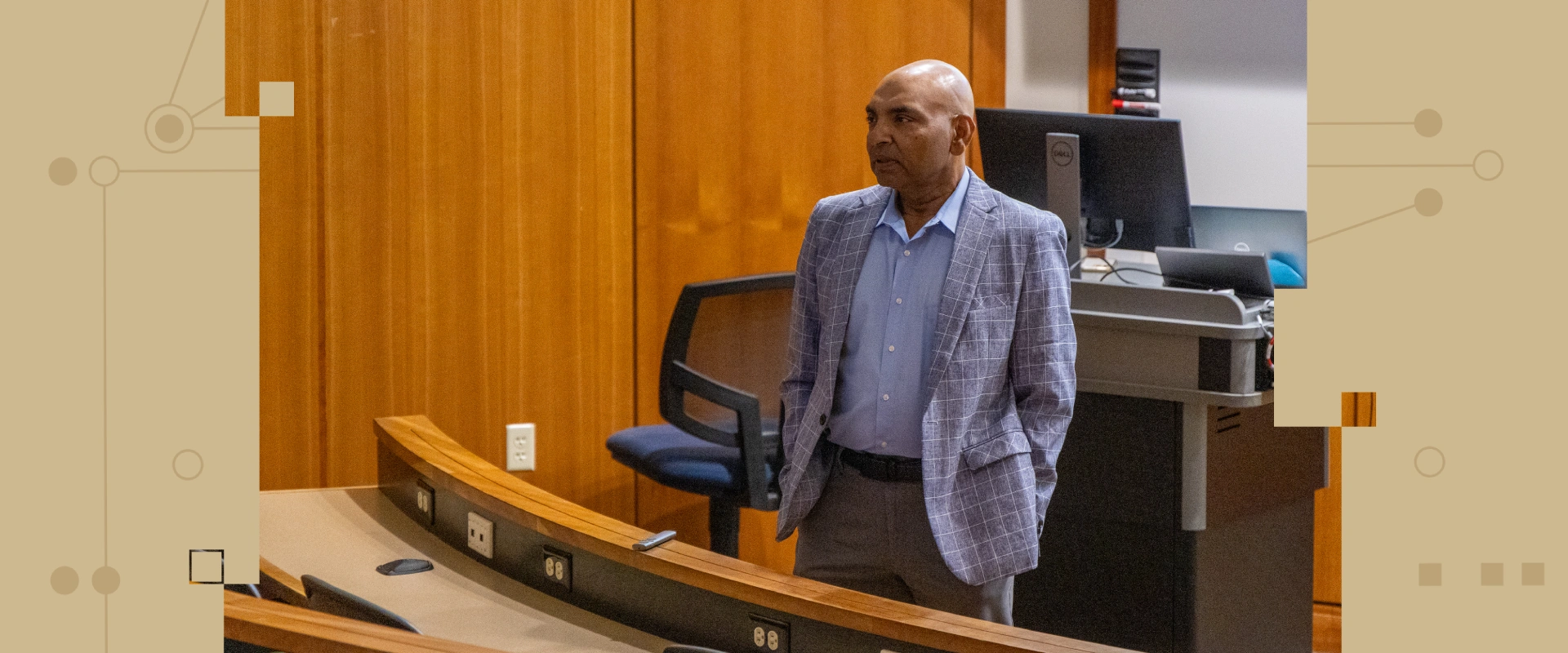
This semester’s Dean’s Distinguished Lecture tackled an increasingly vital issue for business: the role of Artificial Intelligence (AI) in the workplace. In his talk, “The Future of Organizing Work: The Borgs Paradox and Preserving Human-AI Complementarity,” Alok Gupta, the Curtis L. Carlson Schoolwide Chair in Information Management at the University of Minnesota’s Carlson School of Management, synthesized over a decade of research on the complexities of human-AI collaboration.
His work challenges the assumption that AI should simply replace humans, instead arguing for a more nuanced model where AI augments human capabilities, automates routine tasks and enables people to focus on higher-order challenges requiring creativity, judgment and strategic thinking. “The future of work involves a blended environment where humans and AI work together,” he said. “This requires that knowledge workers understand their own limitations to effectively collaborate with AI, with humans ultimately retaining control over decision-making and final judgment.”
At the center of this research is the Borgs Paradox: While reliance on AI tools can increase short-term individual productivity, it can also erode unique human knowledge — the specialized, experience-driven insights that AI cannot replicate. This over-reliance, which Gupta terms the “Borgs effect” from Star Trek — Borgs are cyborg creatures with high individual performance but no individuality — leads to homogenization of thought, reduced diversity of perspectives and ultimately undermines the wisdom of crowds that drives innovation and effective decision-making.
“A key factor fueling the paradox is humans’ lack of metaknowledge — the ability to accurately assess one’s own strengths and limitations,” Gupta said. “Without it, people often make poor delegation choices, ceding too much control to AI systems even when their own distinctive judgment is more valuable.”
To address these challenges, Gupta and his collaborators propose a strategic task allocation framework that balances:
He further emphasizes the importance of maintaining human involvement and not fully automating decision-making, especially for high-stakes, high-consequence decisions. The goal should be to leverage the complementary strengths of humans and AI.
Central to this approach is the design of personalized AI advice systems that adapt to individual workers’ decision patterns. “Rather than offering uniform guidance, such systems preserve human individuality while optimizing joint performance,” Gupta said. “This design ensures that humans remain in control, exercising final judgment while benefiting from AI support.”
Gupta argues that the future of organizing work lies in cultivating a blended work environment in which humans and AI collaborate as partners. Success depends not only on technological design but also on developing workers’ metacognitive skills — helping them recognize when to trust AI and when to rely on their own expertise.
“Ultimately, preserving human complementarity is essential to sustaining innovation, creativity and collective intelligence,” Gupta said. “The challenge is not simply to deploy AI for efficiency gains, but to design human-AI ecosystems that leverage the best of both.”