09-23-2025
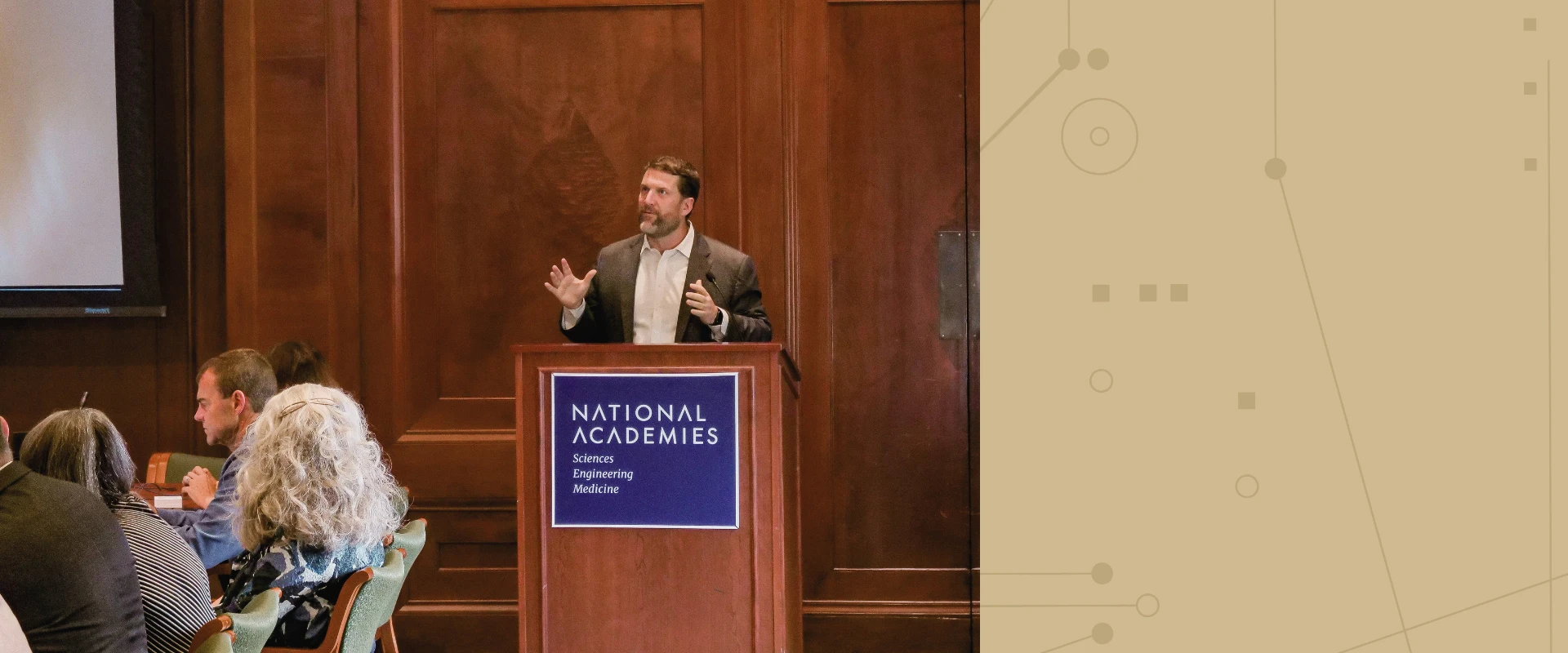
There is no more important organization in the world that invests in and develops real estate than the U.S. federal government, with more than 359 million square feet of space in 770,000 buildings valued at over $2.2 trillion. As director of a Purdue University center that provides thought leadership on real estate as a product one invests in and develops, I was honored to be asked by the National Academies of Science, Engineering and Medicine to serve on the organizing committee of a workshop in Washington, D.C. earlier this month.
The motivation behind the Next Steps in Estimating Facility Renewal Costs workshop was twofold. First, an increasing number of federal facilities are well beyond their designated useful lives. Given constant neglect due to the budget cycle and recent changes to the labor market, it is unclear which buildings should be renewed at taxpayer expense or recirculated back to private enterprise. Second, recent world events have made clear that the United States must again think strategically about national safety and be in a state of readiness not witnessed since the Cold War ended. Understanding how best to maintain and revitalize mission-critical facilities, including those that house our nation’s aging supply of nuclear weapons, was a recurring theme throughout the workshop.
Two days of presentations and panels will result in a publication summarizing the organizing committee’s observations later this year. These included presentations by current and former high-ranking officials from the National Nuclear Security Administration, Office of Management and Budget, Lawrence Livermore National Laboratory and the Department of Defense. Purdue Construction Management Technology Assistant Professor Deniz Besiktepe was invited to present her research on recent technological advances in the creation of digital twins of buildings and perceived barriers to adoption within a federal setting, which was especially insightful.
The future of the building environment demands more than isolated solutions. It requires systems thinking. This perspective treats buildings, infrastructure and people as interconnected parts of a larger ecosystem. By moving beyond linear, short-term fixes, systems thinking helps us recognize interdependencies, anticipate long-term impacts and design smarter, more sustainable strategies. Besiktepe’s presentation showcased how this mindset is reshaping facility management and construction, as well as the way we plan for renewal costs. A major industry challenge is estimating facility renewal costs accurately. Outdated approaches and siloed data often force facility managers into reactive decisions rather than proactive planning.
Besiktepe highlighted how new technologies such as building information management (BIM), Internet of Things sensors, geographic information systems, light detection and ranging, large language models and machine learning can unify information across the building lifecycle to produce clearer, more actionable forecasts. With these tools, leaders can replace guesswork with evidence-based decision-making. Her presentation also explored the benefits and barriers of digital transformation. Tools like advanced heating, ventilation and air conditioning management, building automation systems, visitor tracking, drones and cloud platforms can lower costs, improve safety and enhance efficiency.
Yet, adoption faces hurdles: most digital twins of buildings were not originally designed for operations and often result in fragmented data platforms, cybersecurity concerns and cultural resistance when modified. To overcome these obstacles, Besiktepe shared strategies for successful adoption: Pilot projects that demonstrate quick wins, involving staff in tool selection and presenting technology as an enabler of efficiency all help build trust. Clear ROI examples, such as energy savings and reduced downtime, strengthen the business case. Finally, her presentation underscored the need for a culture of continuous learning. With technology advancing rapidly, training must be ongoing and supported by collaboration across teams and partnerships with universities and industry groups.
The workshop left me with two main observations. First, the federal government was at the forefront of facility asset management practices in the 1990s during the Base Realignment and Closure (BRAC) process, but strategic asset management within private industry has exceeded it in recent years. Second, despite several technological advances, the majority of our economic understanding of how facilities age and the marginal benefits of maintaining them remains unchanged since the early 1980s. This lack of recent research resulted in many of the economists the committee initially invited to present being not only long retired but often deceased.
These experiences reinforced to me why Purdue University’s unique approach to training real estate students to think and focus on the asset is the correct one. Our Dean V. White Real Estate Finance Program was founded to provide educational opportunities and thought leadership on real estate as a product that you invest in and develop — we are on the right track.
Mike Eriksen is a Professor of Economics at the Daniels School of Business and Director of the school’s Dean V. White Real Estate Finance Program. His research and thought leadership centers on economic development, housing, public policy, and public/private partnerships.