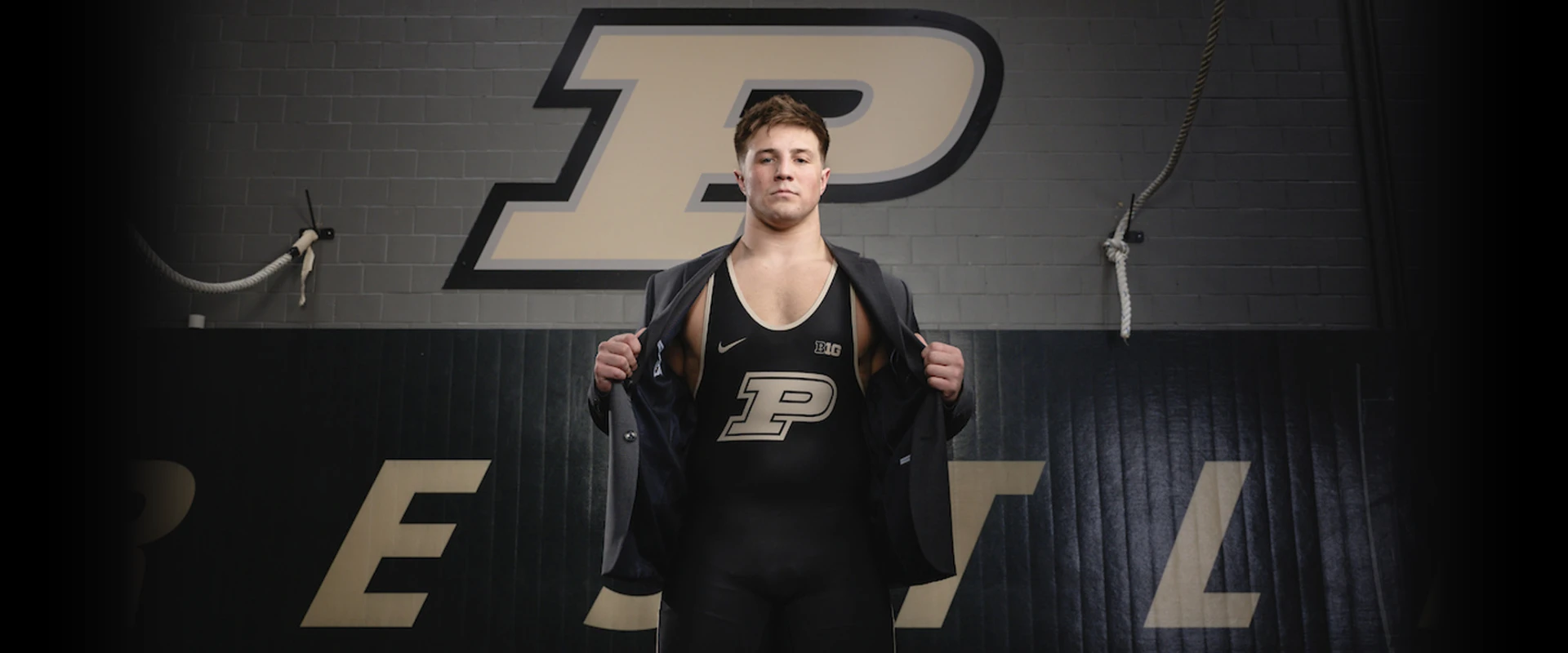
To master anything, most of us have to overcome barriers within ourselves. In many ways, we’re in competition with ourselves with the goal to grow and improve. No one knows that better than an NCAA athlete.
It’s why Purdue wrestler and graduate student Hayden Filipovich talks about competition as a “me versus me” mindset. He has learned that before he can beat anyone else — on the mat or in the classroom — he has to conquer his own doubts, limits and that nagging question in his head: “Have I done enough to prepare?”
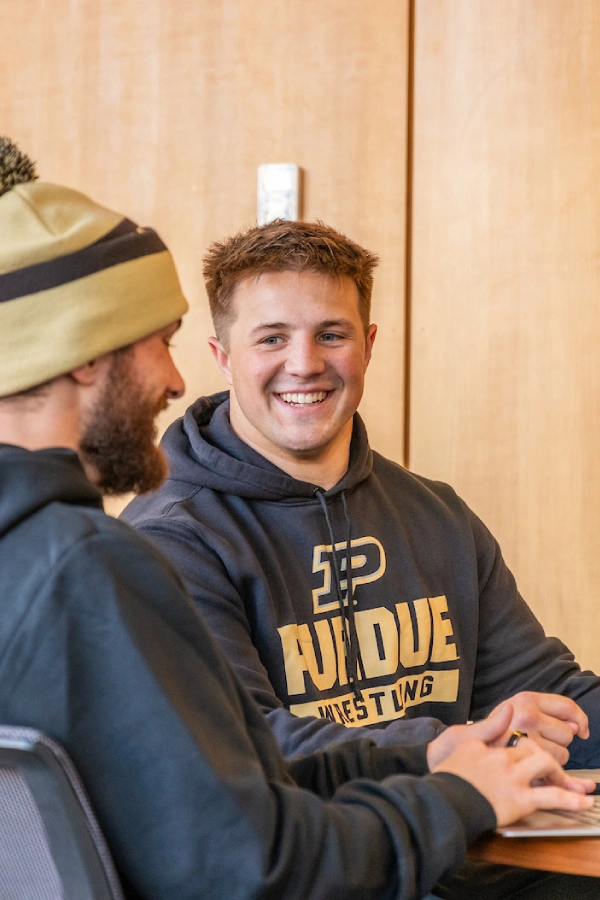
That question followed him through his undergrad years as a wrestler and economics student at the Mitch Daniels School of Business, and it persisted into his fifth year.
Filipovich, who also minored in accounting, had already spent four intense years as an NCAA wrestler and business student, including a redshirt freshman season where he focused on building strength, skills and academic habits. Passionate about being both a great student and wrestler, he chose to stay at Purdue for a fifth year and pursue a master’s in finance while wrestling one last season as a Boilermaker.
The decision was not only about buying more time on the mat. It was about pushing himself to a new level — both as an athlete and as a future business professional. As an undergraduate, Filipovich built a foundation in how markets work and how companies track performance. He gained hands-on business experience with internships at Crowe, Blue & Co., Terra Drive Systems and SDI Innovations.
During his internship in business valuation at Blue & Co., he saw up close how those concepts translate into real decisions and real stakes. He worked with multiple companies, analyzing their financials and learning from mentors who challenged him to think deeper about how value is created. That experience helped clarify his next step: a master’s in finance would give him a more rigorous, technical toolkit and a broader view of how money and strategy move together inside a business.
“I want to understand not just how money moves but also how businesses operate and create value,” he says. For Filipovich, the master’s in finance program is a bridge between his competitive drive and his long-term career goals. Graduate coursework demands a higher level of preparation, precision and time management, all skills he has honed through wrestling. On the mat, he and his team see the results of your preparation; in the classroom, difficult exams and complex group projects offer a similar test. He approaches both the same way: break the problem down, stay disciplined and keep moving forward.
Balancing graduate-level academics with Big Ten wrestling isn’t easy. Practices, lifting sessions, travel and recovery carve large blocks out of his week. The master’s in finance curriculum adds heavier quantitative work, more case-based projects and a faster pace than he experienced as an undergraduate. To make it work, Filipovich leans on the discipline that wrestling has given him and the support systems around him. He schedules his days carefully and treats study sessions like training blocks.
What might surprise outsiders is how much he talks about teamwork in a sport that looks individual from the stands.
“Wrestling may seem like an individual sport, but I’ve never once felt like I’m doing it alone,” he explains. Every grueling practice, every early morning and every setback is shared with teammates who push him to get better. They build trust by practicing together, eating together and showing up for each other through highs and lows. That sense of family has shaped how he thinks about leadership: it’s not about being alone at the top, he says, but about responsibility, trust and helping others rise with you.
Wrestling may seem like an individual sport, but I’ve never once felt like I’m doing it alone.
He sees the same dynamic in the classroom. At the Daniels School, grades may be individual, but learning is often collective. In his finance cohort, classmates collaborate on complex projects and challenge each other. The environment mirrors a wrestling room: the person standing across from you can be both a competitor and a partner in growth. “Just like in wrestling, I may be graded individually, but the lessons, collaboration and encouragement from my classmates make me sharper and more prepared to succeed,” Filipovich says. That combination of “me versus me” and “we’re in this together” has carried him through his undergraduate years and now into graduate school.
As he moves through his final year at the Daniels School, Filipovich is already looking ahead. He wants to carry forward the resilience, analytical skills and team-first mindset that have defined his time at Purdue into a career in finance. Wrestling has given him a framework for handling pressure and uncertainty; his master of finance is equipping him with the technical expertise to add value from day one. When he steps off the mat for the last time, the competition won’t end. It will simply shift arenas — from a wrestling mat to a conference room or client meeting — where he will continue to test himself, one challenge at a time, still driven by the same question: Have I done enough to prepare?
Learn more about the MS Finance experience at the Daniels School of Business.