
08-24-2026
Artificial intelligence is now embedded in classrooms, workplaces and daily life. It is reshaping how students learn, how companies operate and how organizations think about leadership, productivity and ethics.
With the rapid pace of adoption, the challenge is how academia and industry can work together to ensure it is implemented responsibly, strategically and effectively.
For Mohammad Rahman, the inaugural Daniels School Chair in Management at Purdue University’s Mitch Daniels School of Business, AI represents a technological shift on par with electricity, the steam engine and the internet.
“People should not be scared of AI,” Rahman says. “They should be taking it as seriously as any other general-purpose technology that we have seen in the past.”
Tim Coleman agrees with Rahman’s assessment. Coleman is a Daniels School Business Fellow who recently retired as senior vice president and chief technology officer at Eli Lilly and Company after spending his entire career with the pharmaceutical giant.
A Purdue business school alumnus, Coleman has spent years helping lead enterprise technology strategy and AI adoption within one of the world’s largest healthcare companies. He has also collaborated with the Daniels School on an executive education initiative designed to help senior leaders at Lilly better understand how AI could reshape business models, workforce expectations and corporate strategy.
Both Rahman and Coleman agree that institutions that fail to adapt to AI risk falling behind. “Fear is rarely a productive response to transformative technology,” Coleman says. “A better posture is to be informed and fully engaged.”
While public fascination with generative AI tools such as ChatGPT has accelerated over the past few years, Coleman emphasizes that many businesses have been using forms of AI, including machine learning, for decades.
“AI is not new,” Coleman says. “However, I’m not sure that most companies, even industries, have yet seen the inflection point in terms of the shift from experimenting with AI to delivering real bottom-line business value.”
That transition, he believes, will accelerate with the growth of agentic AI — systems capable of independently executing workflows and solving problems alongside human employees.
“AI is already prevalent in society and our everyday lives,” Coleman says. “It is the lighthouse to improving efficiency, increasing speed and agility, and personalizing customer engagement.”
But while industry races ahead, some universities are struggling to determine how education itself should evolve in an AI-driven world.
Rahman believes higher education is at a pivotal moment.
“Academia is at a loss right now,” he says. “The cost of intelligence has gone down.”
Traditional U.S. educational models built around essays, exams and memorization are being challenged by AI systems capable of generating text, code and analysis almost instantly. Universities, he says, must rethink not only what they teach, but how they evaluate learning itself.
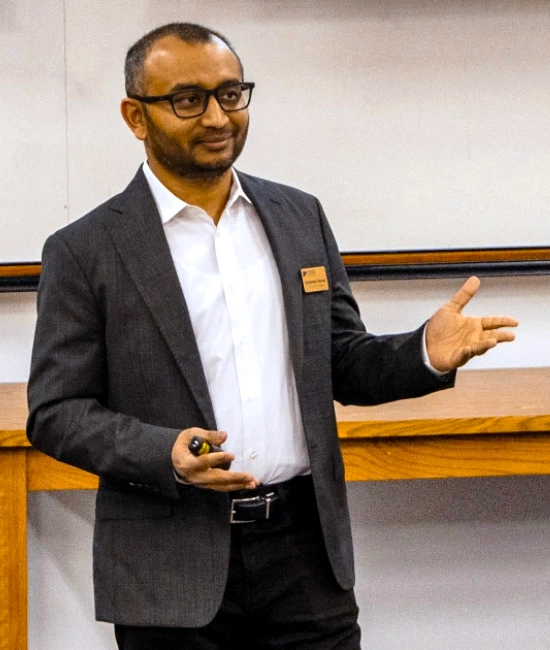
People should not be scared of AI. They should be taking it as seriously as any other general-purpose technology that we have seen in the past.
Mohammad Rahman Daniels School Chair in Management
“We are not at the right place yet to revamp ourselves to actually value augmented learning versus the traditional way of learning,” Rahman says.
Instead of focusing primarily on students’ ability to produce outputs manually, future education may center more heavily on judgment, evaluation and critical thinking.
“If you think about where AI is taking us, it is more along the lines of: can you own an output?” Rahman says. “Do you know whether or not this output is of good quality, best quality, correct?”
Purdue has already begun incorporating AI fluency into its curriculum. Rahman helped design a required Daniels School course intended to expose students to AI concepts early in their education. He also worked with Coleman on developing Lilly’s AI-focused executive education program.
Coleman hopes those efforts go even further, allowing students to trust AI and its ethical applications both personally and professionally.
“AI and technology literacy should be a core competency,” he says. “Just as spreadsheets have become a baseline business skill, learning and understanding AI — how it works and how to manage its limits, biases and dependencies for business use cases— should be non-negotiable for every graduate.”
Despite shared concerns, both Rahman and Coleman believe academia and industry are better positioned than many assume.
“I think academia and industry are more aligned than we all think,” Rahman says.
The larger issue, he says, is that the two sides simply do not collaborate enough. Universities often reward theoretical research more heavily than direct engagement with companies, while businesses may underestimate the value academic institutions can bring to solving real-world operational and strategic problems.
“We need to create forums to enable that interactive discussion and problem solving to happen together,” Coleman says.
Rahman notes that engineering and science disciplines have historically developed tighter industry relationships because their outputs are easier to define and measure. Business challenges, by contrast, often involve organizational culture, economic behavior and shifting business models.
“Business problems are different,” Rahman says. “We work on changing the whole business model. These are much more complicated relationships and the value is not always very clear.”
Still, AI may create a new incentive structure for partnership.
Unlike previous technological revolutions, universities no longer possess the same resource advantages they once held. AI development requires enormous computing infrastructure, vast amounts of data and significant investment — resources often concentrated within major corporations rather than academia.
That imbalance, however, may lead to new forms of collaboration between companies and universities focused on experiential learning, executive education and applied problem-solving.
One of the biggest misconceptions about AI is that widespread personal use automatically translates into enterprise value. In reality, the leap from individual productivity gains to organization-wide transformation is far more complex — a distinction that sits at the heart of Purdue’s new executive education partnership with Eli Lilly.
Coleman reiterates that many organizations have yet to cross the threshold from experimentation to measurable business impact, where human expertise and artificial intelligence work together to redesign workflows and solve business problems.
Rahman sees a similar divide. Employees are already using generative AI to improve their own productivity — often faster than their employers are prepared to govern it. Organizations, however, must move beyond isolated use cases to understand where AI creates value, where it wastes resources and how to deploy it responsibly. He points to examples of organizations using large language models for tasks that conventional computing could perform far more efficiently, underscoring the need for leaders who understand AI's trade-offs rather than simply its capabilities.
According to Coleman, that gap between personal adoption and enterprise transformation is precisely what makes the Lilly executive education program distinctive. Rather than teaching AI as a collection of tools or prompts, the program brings together executives and leaders who have built AI capabilities inside one of the world's largest pharmaceutical companies with researchers studying how organizations generate value from AI.
The combination of academic research and executive experience is rare in executive education. Rather than focusing primarily on AI literacy or personal productivity, the Lilly program is designed to help senior leaders answer the more difficult questions: Which AI initiatives create enterprise value? How should organizations govern adoption? And how can companies redesign work so that human expertise and AI reinforce one another instead of competing?
Another significant concern surrounding AI involves its impact on jobs — especially entry-level roles traditionally used to train young professionals.
Rahman warns that AI agents are increasingly capable of handling many routine tasks once assigned to new hires, potentially disrupting the apprenticeship model that has long shaped workforce development.
“The floor is shifting upward,” Coleman says. “And if we don’t prepare our students for this upward shifting, that’s where the problem is going to be.”
Coleman does not believe entry-level jobs are disappearing entirely, but he says expectations for those roles are rapidly changing.
“Companies that compete and win in the AI economy will combine the best of both human intelligence and artificial intelligence. As human-in-the-loop with AI emerges as common practice, the talent standard for entry-level jobs will continue changing,” Coleman says. “Industry and academia need to work together on what is that target.”
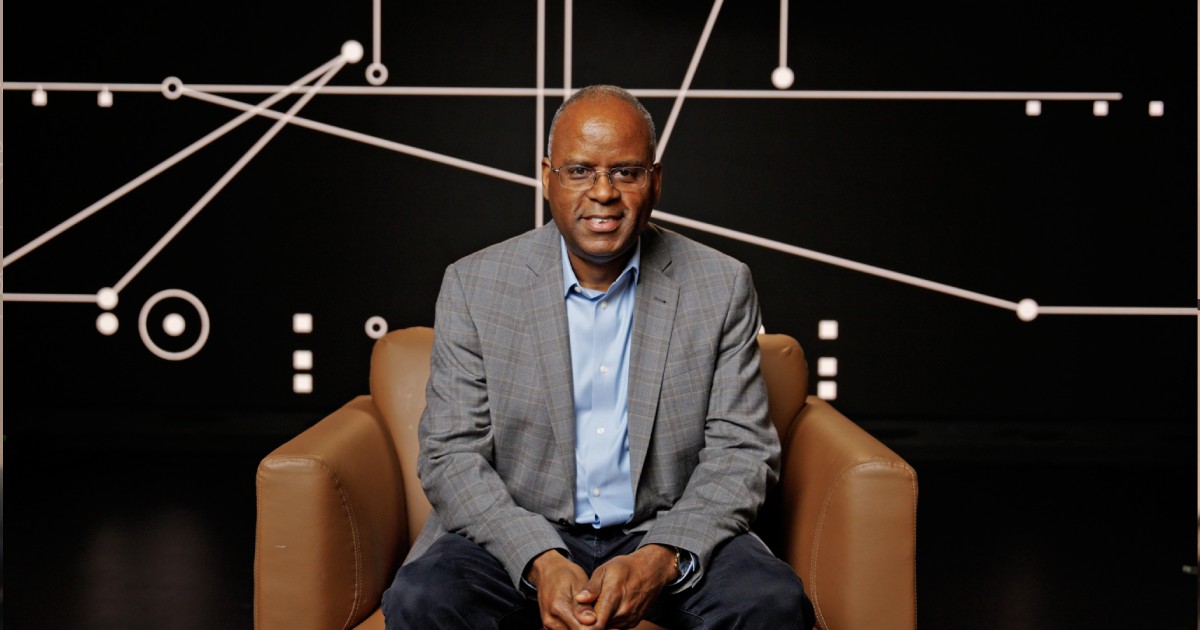
The greatest ethical challenge isn’t about AI hallucination. It isn’t about bias or even job displacement. It’s the silence of business leaders who know better and say nothing.
Tim Coleman former Senior Vice President and Chief Technology Officer, Eli Lilly and Company
That means universities may need to place greater emphasis on experiential learning, interdisciplinary collaboration and business problem-solving rather than rote technical tasks.
Rahman compares the current AI transformation to the introduction of electric motors in factories more than a century ago. Early manufacturers initially used electric motors to replicate old steam-powered systems before eventually redesigning entire workflows around the new technology.
“That same thing applies to AI today,” Rahman says. “The value will come once we actually put in AI and redesign a more efficient way of doing things.”
As AI adoption accelerates, both leaders say ethical leadership will become increasingly important.
Coleman believes organizations must address concerns surrounding bias, misinformation, privacy, environmental impact and workforce disruption without slowing innovation itself.
“The ethical response should not be to slow everything down but to build guardrails proportional to the risks,” he says. “We must embrace transformative technology's benefits while demanding transparency of the impact, holding companies accountable, advocating for smart regulation and insisting that the costs not be quietly offloaded onto communities.”
He also warns that ethical failures often stem not from technology itself, but from leadership silence.
“The greatest ethical challenge isn’t about AI hallucination. It isn’t about bias or even job displacement,” Coleman says. “It’s the silence of business leaders who know better and say nothing.”
Rahman similarly cautions students and professionals against blindly trusting AI-generated information.
“Students should not be giving in to AI slop,” he says. “They must build their skills of judgment and their value proposition in the world of AI.”
Ultimately, both believe AI’s future will depend less on the technology itself and more on how people choose to lead, adapt and collaborate around it.
“I don’t think it’s about ‘if’ AI,” Coleman says. “It’s all about ‘how’ AI.”