02-19-2026
Knowledge work is undergoing a quiet but profound reset. The real story is not just about smarter tools. It is about how humans choose to grow alongside them.
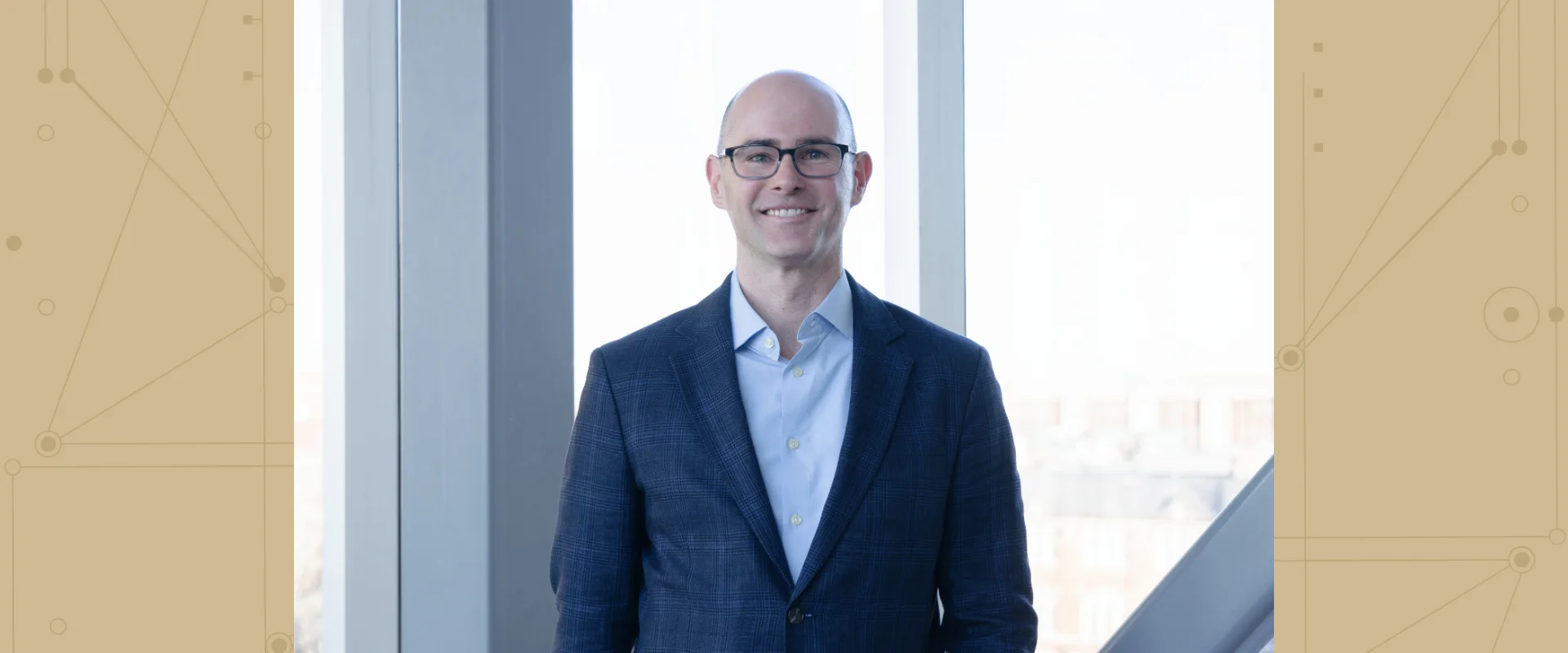
Patrick Lenihan, associate vice president of strategy & transformation at Eli Lilly & Company, who previously developed Lilly’s enterprise AI strategy and led Business Transformation for the company, sat down with Purdue University’s Daniels School of Business to share his perspective on where AI is taking the workforce, what it means for the next generation of leaders and what students and business leaders alike can do about it right now. Lenihan also spoke to students as part of the Daniels School's Executive Forum.
Lenihan starts most days early (“farmer hours” as he calls it), coffee in hand, working directly with company-approved large language models to research, brainstorm, ideate and draft thinking before meetings begin. These early morning interactions with AI have reshaped his view on how work will continue to evolve. What once took days and weeks requesting, extracting, drafting and revising can now be done in minutes and seconds thanks to AI.
This pattern is showing up everywhere. In medicine, doctors are now using AI to capture real-time clinical notes and link them to reimbursement codes, freeing physicians to focus on what matters most: the patient in front of them. In finance, research that once consumed an entire week can be assembled and synthesized in a few hours. Presentations that once took herculean efforts to create are now done in minutes.
The data backs up what practitioners are experiencing. A 2024 study from the National Bureau of Economic Research found that generative AI has been adopted faster than both PCs and the internet, with nearly 40% of respondents already using it at work or at home. And a Microsoft Research analysis of 200,000 Bing Copilot conversations revealed what people are actually asking AI to do: overwhelmingly, they are gathering information, processing it and disseminating it, the very activities that define “responding.”
At its core, Lenihan says, “responding” has changed forever. The time from “ask” to “answer” is collapsing, and AI is increasingly the first stop in that chain. These are not theoretical. They are happening now, in clinics, in customer support and in corporate offices around the world.
So, what does this mean for the people inside organizations today?
To make the shift tangible, Lenihan presents two personas that every organization should be thinking about.
The AI persona lacks lived experience and environmental context. It cannot sense when a team is losing confidence or read the room in a tense meeting. Yet on information tasks, it delivers at a speed, quality and cost that no individual can match. This is the reality that professionals at every level, and the leaders who develop them, must reckon with.
In this environment, Lenihan believes the differentiators are no longer raw IQ but three deeply human capacities:
Underneath all three sits something even more foundational: dependability and operational discipline. Lenihan is emphatic on this point. In a world where AI is always on, always ready and always consistent, the bar for human reliability goes up. Doing what you said you would do, when you said you would do it, day in and day out. Not just showing up but being prepared and ready to contribute. These basics have always mattered, but in an era where your AI counterpart never misses a deadline and never arrives unprepared, they become essential.
Reflection Friday: Before a big meeting or decision, write down what you think will happen and why. A week later, revisit it. Where were you right? Where did you miss? Over time, this builds a personal track record of calibrating your own thinking and sharpens judgment.
Focus on the “how”: When you observe an effective leader, watch not just what they do but how they get there. This is a practice in building discernment.
Peer Feedback: Ask trusted colleagues, “How do I show up in group settings? What is one thing I could do better?” This is a direct path to developing emotional intelligence.
Organizationally, Lenihan sees companies evolving from the classic pyramid to a diamond-shaped structure. As AI absorbs much of the routine responding work, the base of the pyramid thins and more value shifts toward roles that integrate, interpret and lead both people and AI agents.
The World Economic Forum’s Future of Jobs Report 2025, drawing on perspectives from over 1,000 employers representing more than 14 million workers across 55 economies, underscores the urgency. Nearly 40% of workers can expect their existing skill sets to be transformed or outdated during the 2025 to 2030 period. Managers will increasingly supervise portfolios of human contributors and AI agents, requiring new skills in oversight, quality control and trust building with tools they can no longer walk by a desk to check on.
The question for organizations is how to bridge the gap. If AI absorbs the work that used to train junior talent, how do those future leaders build the experience they will need to lead?
Lenihan emphasizes that people still need to “cut their teeth” by initially doing the work themselves: writing first drafts, building models. Only then can they develop the internal compass to discern what good looks like. “If you have never built a financial model by hand,” he argues, “you will not know whether the one AI just built for you is any good.”
For individuals and organizations alike, this creates an opportunity. AI can free time from the mundane so people can step into higher value, more rewarding work, if they actively use that time to strengthen their human capabilities around judgment, discernment and EQ. From spending hours on data entry to having more time for creative problem solving. From being bogged down by routine emails to building deeper, more meaningful relationships. From constant multitasking to being truly present with the people around you.
Lenihan’s challenge is deceptively simple, and it applies as much to the C-suite as it does to the classroom. If AI can automate the routine, how will you use that reclaimed time? Will you use it to accelerate your judgment, deepen your discernment and grow your emotional intelligence? How can you use AI to “automate the routine” to “awaken your soul”? And ultimately, how will you use this additional time to have a more enriching, more deeply human life?
The tools are here. The question is what you will build with them, and who you will become in the process.
Patrick Lenihan is associate vice president of strategy & transformation at Eli Lilly & Company. He previously developed Lilly’s enterprise AI strategy and led Business Transformation for the company.
The views expressed here are his own and do not represent the views of Eli Lilly and Company.
Lenihan spoke to students at the January 23, 2026, Executive Forum, held in person on the West Lafayette campus and open to the public, as seating permits. Follow the business school on LinkedIn to learn about upcoming Forum speakers.