10-27-2025
When Vernon Smith conducted his groundbreaking experiments in our classrooms in the 1950s, he laid the foundation for what would later earn him a Nobel Prize and transform how we understand economic decision-making. Today, that same spirit of innovation continues to drive the Daniels School of Business's Department of Economics, where we're not just teaching economics — we're extending its frontiers.
The formation of the School of Industrial Management in 1958, through the merger of Purdue's Department of Economics with its Department of Industrial Management and Transportation, marked a milestone, and founding Dean Emanuel Weiler set a vision for excellence that still inspires us today. From these beginnings, our journey over the last 67 years has been defined by continuous evolution and impact as we've consistently pushed the boundaries of economic thought and education.
Think of economics as the lens through which we decode the complexities of our modern world. Our graduates don't just understand supply and demand curves — they're equipped to navigate global market challenges, conduct quantitative economic analysis and shape public policy. Through our cutting-edge programs, we're preparing the next generation of economic leaders:
But what truly sets us apart is our research ecosystem. Through our network of economics-linked research centers — including the Purdue University Research Center in Economics (PURCE); the Center for Behavioral Economics, Experiments and Public Policy (BEEP); the Vernon Smith Experimental Economics Laboratory (VSEEL); the Purdue Center for Economic Education (PCEE); the Center for International Price Research (CIPR); and the Dean V. White Real Estate Finance Program — we're tackling real-world challenges head-on. Our faculty's research drives real-world impact, informing policy decisions, improving market mechanisms and finding solutions to pressing global challenges.
Consider BEEP, where researchers merge economic theory with controlled experiments to unravel the psychological factors that influence economic decisions and shape policy outcomes, or PURCE, where we're creating data-driven insights into how laws, regulations and government programs affect markets and societal well-being. Through events such as PURCE's economic policy luncheons, our faculty directly engage with policymakers and business leaders, ensuring that our research translates into real-world impact. These aren't just academic exercises — they're roadmaps for better economic policy and business practice.
The impact of our work extends far beyond our campus. Our graduates have served in leadership roles ranging from chief economist at Microsoft to president of the University of Chicago and CEO of a Fortune 100 company. They shape national and international economic policy and drive innovation in fields from tech to finance. And through PCEE, we're ensuring that economic literacy reaches into classrooms across Indiana and beyond.
As we look toward the future, we're not just maintaining our legacy of excellence — we're relentlessly pursuing it with vigor and purpose. In a world where economic challenges grow more complex by the day, our department stands ready to provide the insights, leadership and innovation needed to address them.
This isn't just about economics education and research. It's about shaping the future of our global economy, one student, one discovery, one breakthrough at a time. And we're just getting started.
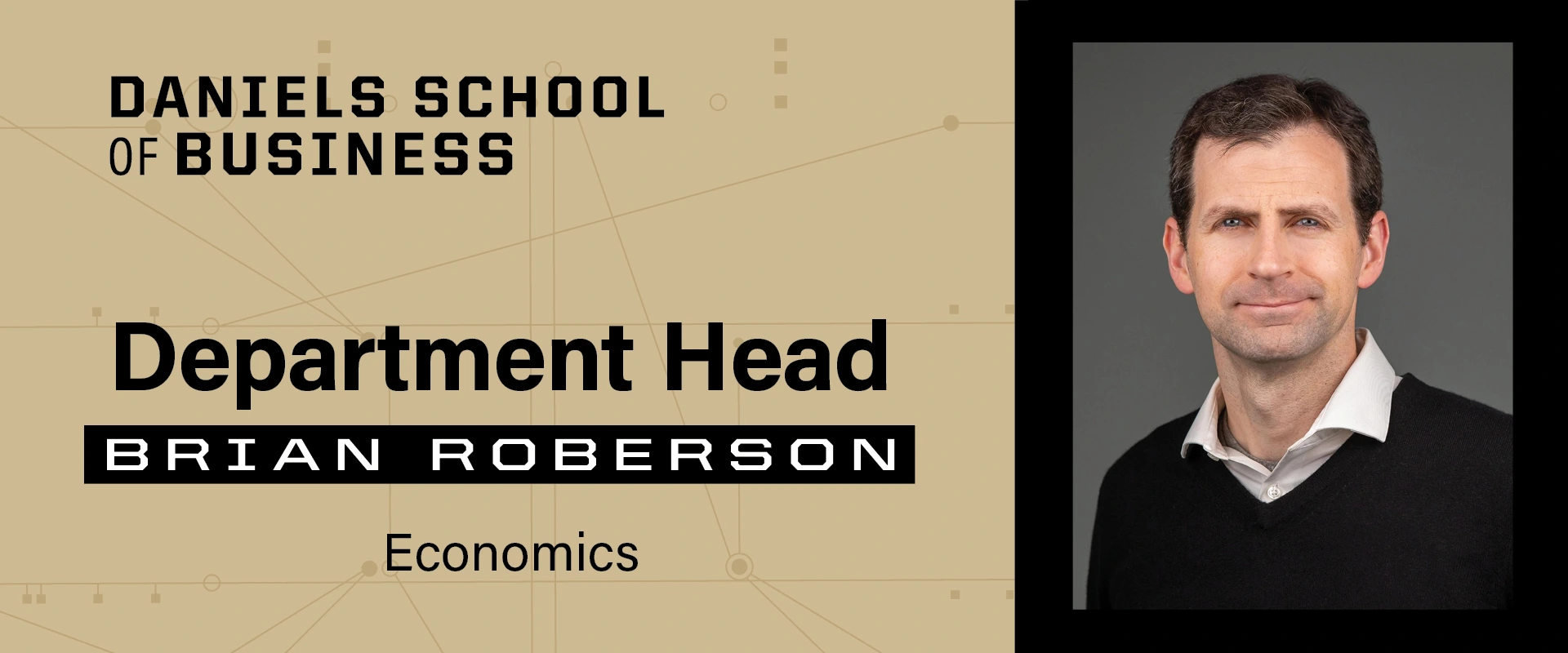
Brian Roberson is a Professor of Economics and serves as Department head of Economics at the Daniels School of Business. A Purdue alum, his research in economic theory and game theory explores strategic decision-making and competitive behavior.