
06-12-2026
In the U.S., the forces driving prescription drug prices have long been opaque, and some drugs have seen their prices climb by hundreds or even thousands of percent. For example, Humira, a drug that treats rheumatoid arthritis and other autoimmune conditions, saw its annual list price increase by 470% between its launch in 2003 to 2021, as noted in a May 2021 U.S. House of Representatives Committee on Oversight and Reform staff report.
Drug manufacturers argue they are forced to raise list prices to offset the steep discounts and rebates demanded by powerful buyers, who in turn blame manufacturers for the increases.
To understand what is actually happening at the negotiating table, Purdue Professor of Economics Ralph Siebert and coauthors turned to Brazil, where health policy reforms mandate a level of price transparency that offers a rare window into the true mechanics of drug price negotiation. Siebert, alongside coauthors Sebastian Linde and Brandon Norton — both Purdue PhD alums — detail their findings in a paper entitled "The Determinants of Negotiated Pharmaceutical Prices," published in The Journal of Industrial Economics.
Using a dataset of nearly two years of wholesale generic drug transactions between hundreds of Brazilian city governments (the buyer) and drug manufacturers (the seller), Siebert and coauthors were able to look inside the black box of a real negotiation.
They found that the final price a buyer pays is significantly impacted by the dynamics of the relationship between the buyer and seller, as measured by factors such as how much a buyer purchases in a single transaction, how consistently they buy from the same supplier, and whether they source multiple drugs from that same supplier. Differences in negotiating strength between buyer and seller alone account for more than 40% of the price variation observed across transactions.
“Until now, little was known about the extent that negotiation determinants — such as transaction-specific characteristics and business relationships between buyers and sellers — affect negotiated prices,” says Siebert. “We show that transaction-specific determinants, such as quantity purchased, buyer loyalty, and multiple drug purchases made from the same seller, have strong effects on negotiation strengths and prices. For instance, a 10% increase in quantity purchased in a transaction can increase buyer negotiation strength and result in a price reduction of over 6%.”
Siebert and coauthors’ research also reveals that some buyers are simply better at the bargaining table than others, and that advantage tends to be consistent regardless of which type of drug is being negotiated. Put simply, a city government that secures favorable prices for one type of drug is likely to do the same across drug classes.
In Brazil, city governments serve as centralized buyers negotiating drug prices on behalf of the hospitals within their borders. In contrast, U.S. hospitals typically band together through Group Purchasing Organizations (GPOs), which represent multiple hospitals at once to seek the kind of leverage a large buyer would have. To examine the impact of GPO membership on negotiating leverage and drug prices, Siebert and coauthors designed an experiment in which city governments mimic the role that GPOs often play in negotiations. Their findings suggest that being a member of a GPO increases the buyer’s negotiation strength and reduces prices for all drug classes.
The magnitude of those savings, however, varied dramatically depending on the drug. For example, if a hospital was not a member of a GPO, it would have paid just 6% more for beta blockers, but a striking 124% more for calcium channel blockers. The researchers found that the driving factor behind that variation was how price-sensitive buyers were for that particular drug class. In other words, GPOs tended to deliver the greatest savings for drug classes where buyers had less flexibility to change purchasing behavior in response to price fluctuations.
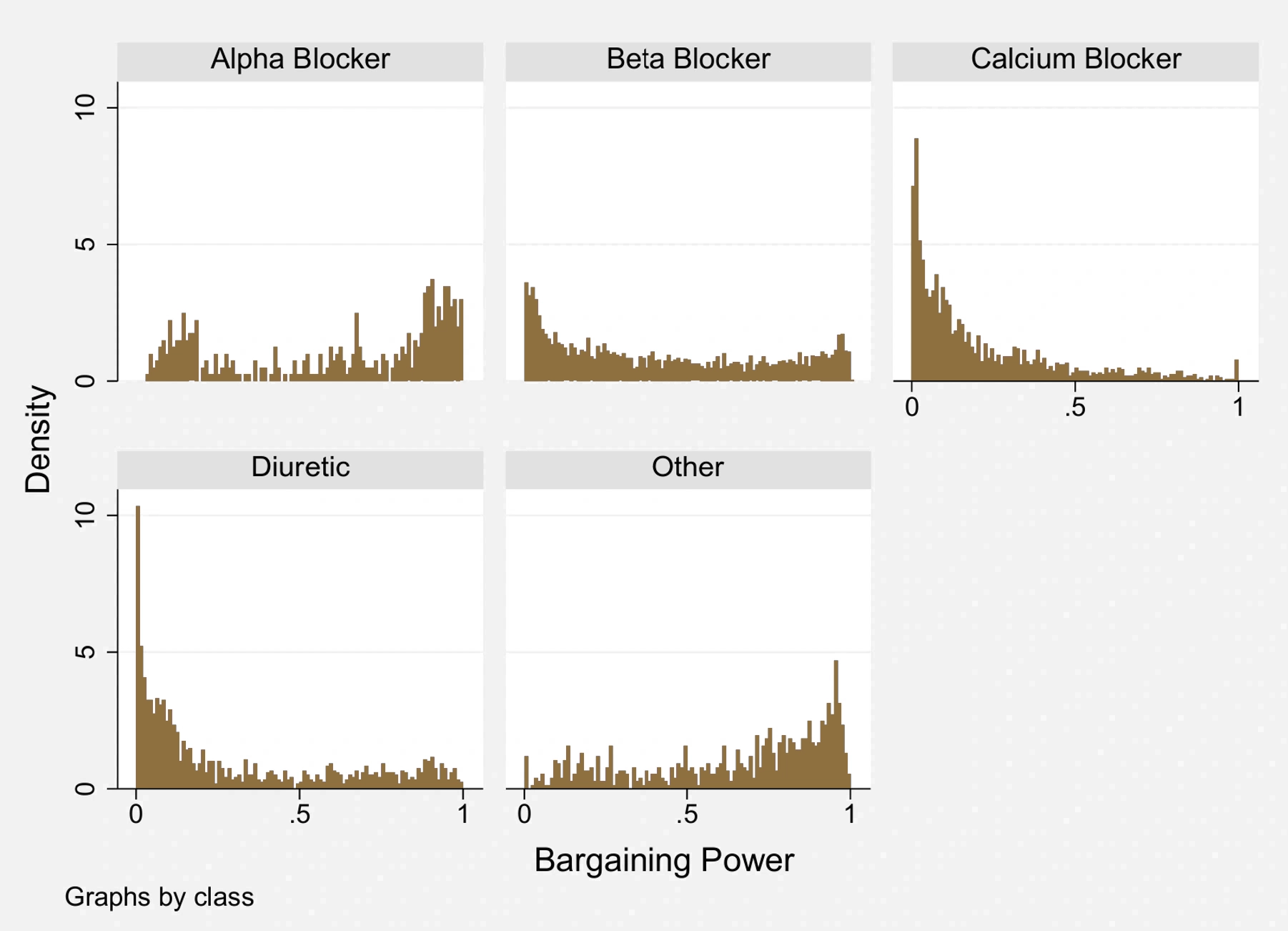
The research makes it clear that collective bargaining works, but its power is not felt equally across all drug classes. According to Siebert, “this is the biggest takeaway for U.S. markets.” Siebert and coauthors’ findings offer a better understanding of the dynamics of pharmaceutical price negotiation, which stands to inform policymakers and open new avenues for future research.