06-29-2026
In February 2020, Professor David Simchi‑Levi, then director of the MIT Data Science Lab, and a colleague published an early analysis in Harvard Business Review predicting that the peak impact of COVID‑19 on global supply chains would occur in mid‑March 2020, forcing thousands of companies to throttle down or temporarily shut assembly and manufacturing plants across the U.S. and Europe. The prediction was born out in media reports during the week of March 16, 2020, documenting widespread production slowdowns and shutdowns.
In making that prediction, Simchi-Levi applied the framework and concepts developed in his prior research (2013-2014), including Time to Survive (TTS), Time to Recover (TTR) and Performance Impact (PI), to estimate when typical companies will run out of inventory and will be forced to shut down production.
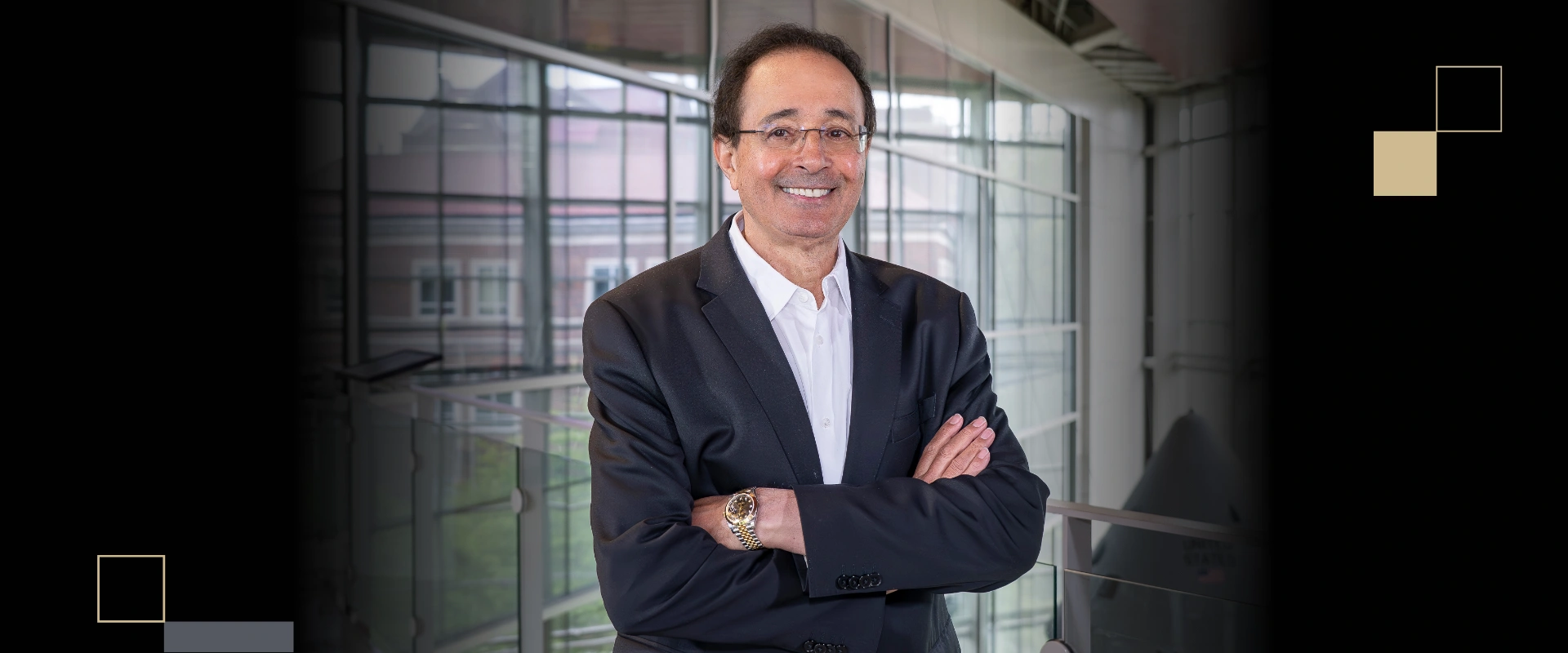
Simchi-Levi joined Purdue in January 2026 and directs the Data Science Center for Decision Making, which integrates predictive (AI and Machine Learning), prescriptive (Optimization and Simulation) and generative (Large Language Models) technologies to achieve three business objectives: transform processes, drive automation and enable autonomy. This helps companies improve efficiency and resiliency while significantly increasing productivity.
Simchi-Levi and the center’s Executive Director Michelle Xiao Wu provide on the Data Science Center for Decision Making website a few implementation case studies — try the center’s testbed to understand the impact of these technologies on supply chain performance.
TTR measures how long it takes a supply‑chain node (a factory, port or supplier) to return to full capacity after a disruption. PI determines the impact of a disruption on the firm’s financial or operational performance during TTR. Finally, TTS estimates how long a company can continue to meet demand while that disruption persists.
“These metrics help explain why brief disruptions can create disproportionately large consequences across a supply chain,” says Simchi-Levi. “For example, in collaboration with Denso, a leading automotive supplier, we discovered that a 10-day interruption at a semiconductor wafer facility could result in six to twelve months of recovery time. The finding was eye-opening for executives — it demonstrated that what appears to be a short-lived operational issue can ripple through the network and create prolonged business impacts.”
Beyond explaining past shocks, the lab’s analytical framework helps companies predict how missed shipments, power outages, or supplier closures will propagate through inventories, logistics and supplier networks. That predictive capability enables leaders to quantify “value at risk” across their supply chains and make informed investments in inventory, redundancy, alternate sourcing or targeted capacity.
“Most companies wait until there’s a problem before they call in experts,” Simchi-Levi adds. “Our work shows you can — and should — assess hidden risks ahead of time, develop mitigation strategies and respond effectively when disruption hits.”
The research proved especially illuminating during the global semiconductor shortage, when halted chip production left automakers shipping incomplete vehicles and recovering long after factories reopened. Simchi‑Levi’s models show why restoring one node doesn’t instantly restore an entire, interdependent system — and how identifying critical interdependencies guides smarter resilience spending.
“Resilient companies don’t just bounce back,” Simchi-Levi says. “They anticipate, adapt and reconfigure faster than the competition. Recovery isn’t just endurance — it’s strategic agility.”
Organizations interested in working with the Data Science Center for Decision Making can reach out to Michelle Xiao Wu.
Anchored at Purdue University — an R1 institution renowned for engineering excellence, manufacturing leadership and deep industry engagement — the Data Science Center for Decision Making sits at the intersection of analytic innovation and operational reality. It serves as a bridge between academia and industry, and between engineering and business, producing research that is both theoretically rigorous and practically transformative.