06-22-2026
G.W.F. Hegel (1770-1831) was one of the most important thinkers of modernity, and particularly its economic and social aspects. He is the originator of the concept of Civil Society, which he conceived as a realm of voluntary associations distinct from both the family and the state. He was heavily influenced on this topic both by Scottish Enlightenment authors such as Adam Smith as well as by his interpretation of the history of Rome, which he characterizes as a society founded on property and contract rights.
For someone writing before the advent of full-fledged industrialization and the adoption of fiat currencies, Hegel is remarkably prescient about many features of our modern economies. In this post I focus on one of those features, namely the surprising way in which monetary economies with a substantial division of labor increase both the extent to which we are dependent on others and the number of others on whom we are dependent.
Hegel’s theorization of this system is in very strong terms which are challenging to any conception of freedom, whether republican, liberal or even traditionalist: He describes civil society as “a system of omnilateral dependence” and as “the omnilateral entanglement of dependence.” The division of labor in particular “makes the dependence and interrelation of human beings in the satisfaction of their other needs into a complete necessity” and we make ourselves “links in the chain of connections” of the economy.
For Hegel, dependence is not something that crops up at the edges of our interactions or an occasional pathology, but rather the essence of modern economic relations. In transcripts of his lectures, Hegel makes these points in striking terms:
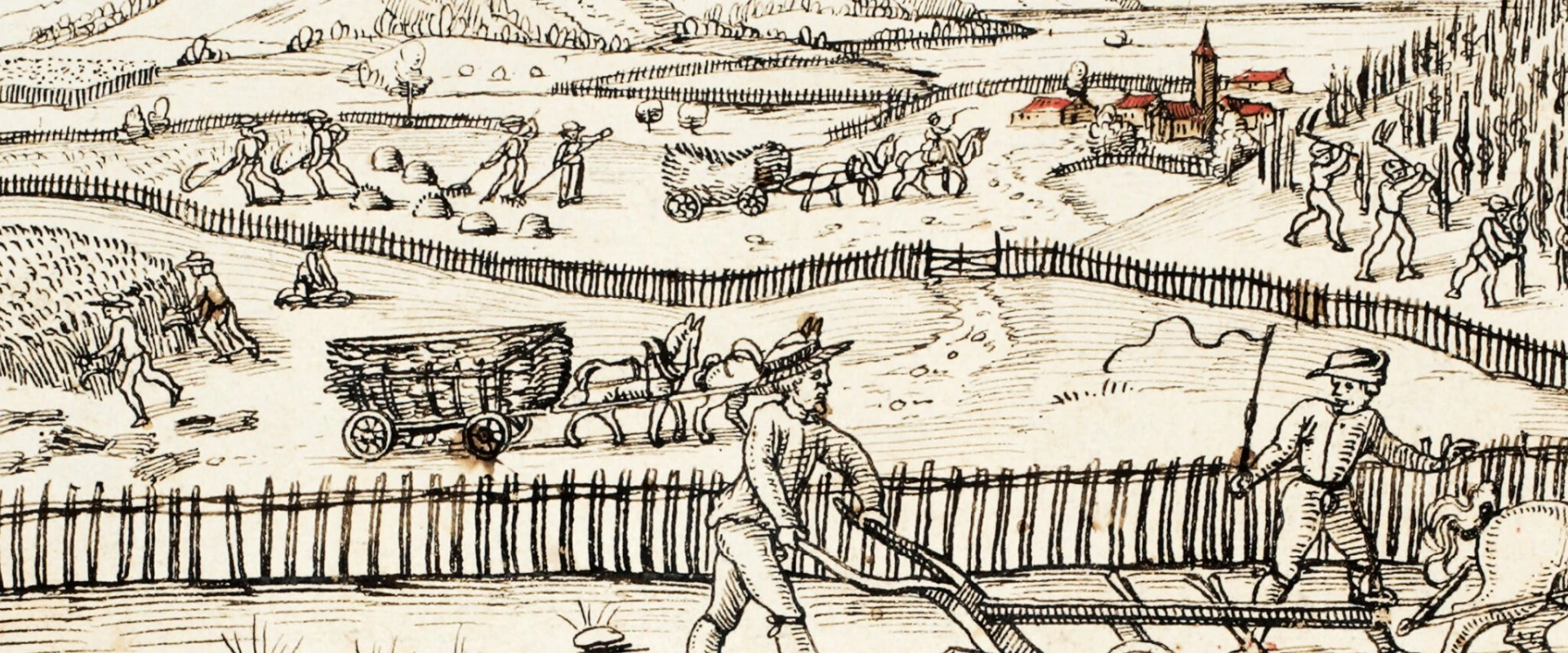
The farming estate also requires the other, but less so, for needs are mainly satisfied through this estate itself: Ulysses and the ancient heroes wear clothes that their wives had woven, and so in the farming estate every family acquires for itself the means of its satisfaction . . . The estate of trade however is essentially directed to the help of others, and what the individual himself achieves serves him to obtain this help, and only a lesser part of what he needs, or even nothing, does he achieve himself, because what is achieved is a means of exchange. Here there is thus reciprocal dependence . . .
But in an even more striking move, Hegel turns not against modern economic relations but rather against the conception of freedom as independence. Instead of independence, freedom is the right kind of cooperation, what Hegel describes somewhat metaphorically as “being at home with oneself in the other.” In this respect Hegel anticipates certain aspects of Georg Simmel’s later view, which is that the monetary economy both demands greater dependence on others and yet makes that dependence less objectionable because it makes it less personal. We are dependent not so much on others’ whims or personal preferences, but rather on their and our abilities to play functional roles within a larger enterprise. In Hegel’s view, this is a fundamentally new form of sociality which is induced by markets, firms and money.
Christopher Yeomans is the Justin S. Morrill Dean of the College of Liberal Arts. He teaches a study abroad course on the philosophy of money and is the author of four monographs on the history of German philosophy. The thoughts in this post come from his most recent, Hegel and Republicanism: Non-Domination, Economics, and Political Participation (Cambridge University Press, 2026).