
09-23-2026
If you’ve read a headline in the past two years, you’ve absorbed the same message on repeat: AI is coming for your job. It’s a convenient story for media coverage, and an even easier one that creates fear. But fear is not a strategy, and it’s the wrong starting point for this conversation. As business leaders, our responsibility isn’t to manage that fear. It is to replace it with a clearer, more accurate story, and then act on it.
Electricity, computing, the internet, mobile… each major technology shift triggered the same anxiety cycle inside organizations. Displacement dominated the headlines while creation happened quietly in the background. Each time, entirely new categories of work emerged that hadn’t existed a decade earlier.
AI is no different in kind, only in speed. That speed is exactly why fear is an unproductive response. It compresses the window leaders have to close the skills gap before it becomes a competitive one. History suggests the leaders who came out ahead weren’t the ones who managed layoffs most gracefully. They were the ones who built capability ahead of the curve. The real challenge in front of us isn’t a jobs problem. It’s a skills problem — and closing it is a leadership responsibility.
Let’s start with the headline numbers. Rather than eliminating jobs, AI added roughly 1.3 million new roles globally and more than 600,000 AI-enabled data center jobs, according to a World Economic Forum analysis of LinkedIn data released in January 2026. AI Engineer has been one of the fastest-growing job titles on LinkedIn for three straight years.
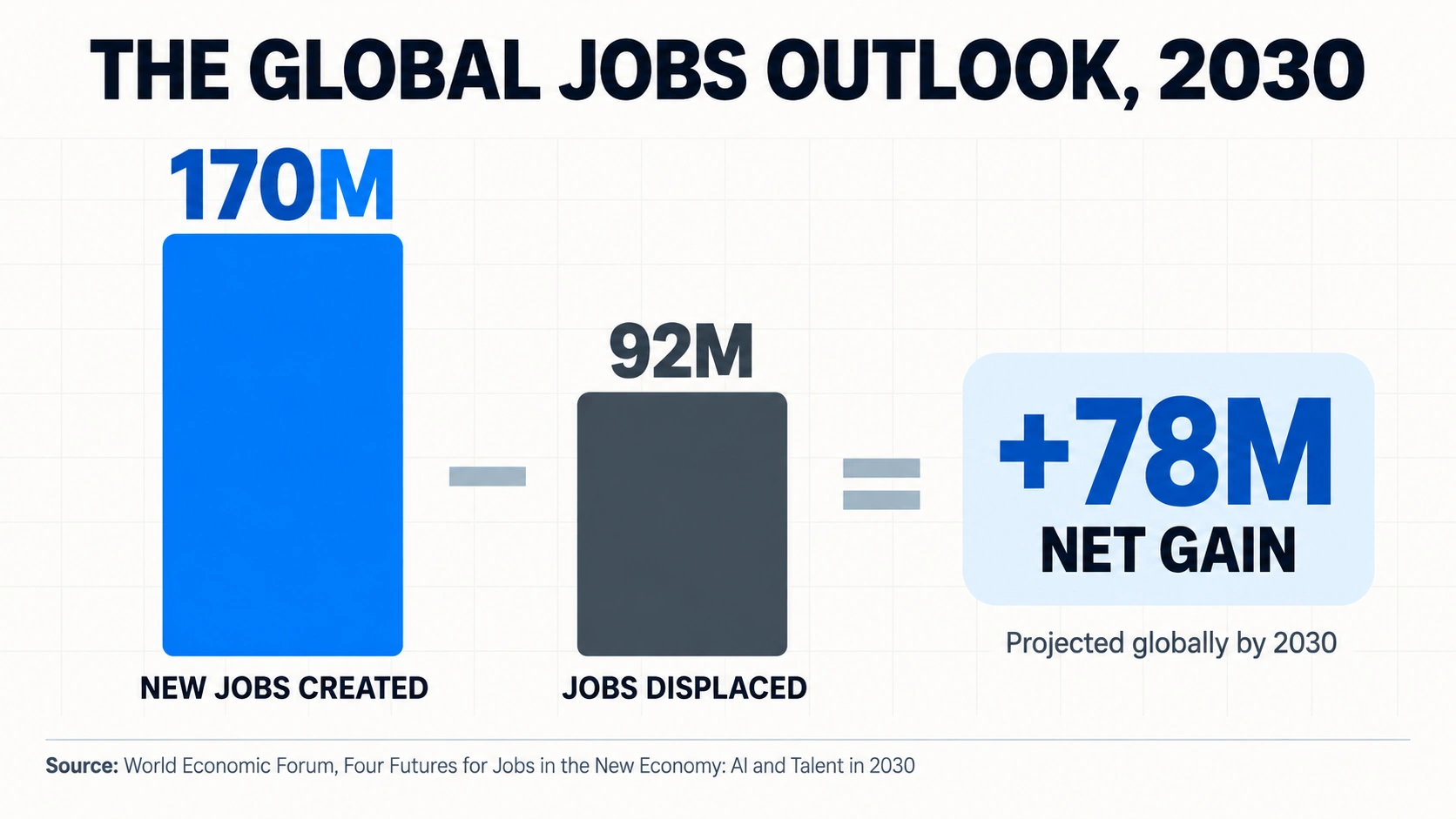
The Forum’s Future of Jobs Report 2026 projects that AI and related technologies will create roughly 170 million new roles globally by 2030, against 92 million displaced. That’s a meaningful net gain, but one that will only reach your organization if you’re building toward it rather than waiting for it to arrive.
PwC’s 2026 Global AI Jobs Barometer, an analysis of more than a billion job postings worldwide, adds a sharper leadership signal. Companies most exposed to AI show 40% higher productivity growth than those least exposed and are growing headcount rather than cutting it. The gains are going to organizations that lean in. That same data also shows entry-level roles shifting rapidly. The most AI-exposed junior positions are now seven times more likely to demand skills once reserved for senior staff, like judgment and independent decision-making. If your organization isn’t rethinking how it develops junior talent, a competitor already is.
This is not theoretical. Bank of America built an internal Academy for AI reskilling, with pathways ranging from basic prompt engineering to AI design and development, an investment that has helped the bank fill 44% of open roles through internal mobility. Walmart, the country’s largest private employer, partnered with OpenAI and Google to deliver free AI training, including certification programs reaching frontline and corporate staff. John Deere converted non-technical employees into software engineers through a structured upskilling pathway, treating this as a talent-strategy problem rather than a training checkbox.
The lesson is consistent across all three: the organizations moving fastest on AI are not simply deploying technology. They are building internal talent pipelines to move their own people into the roles they create.
Closing the gap between displacement and creation starts with fluency, not fear, and this starts with the story leaders choose to tell. Four moves are worth making now:
And perhaps most important as a leader, model the AI learning behaviors visibly for your team. “I don’t really use AI” will soon sound the way “I don’t use email” sounds today. Organizations that treat AI upskilling as a leadership mandate now will be the ones competing for, and winning, talent five years from now. The question isn’t whether the AI economy is coming. It’s whether you are ready to lead in it.
Tim Coleman is a Business Fellow specializing in AI at the Daniels School. He retired as Chief Technology Officer and Senior Vice President, Digital Core, at Eli Lilly and Company where he was responsible for technology strategy, global tech enterprise capabilities, and the Lilly Tech Innovation Centers based in India. In this role, he directed a global portfolio of AI and tech initiatives in partnership with Lilly senior executives to achieve strategic business objectives.