09-28-2026
The AI conversation often centers on what the latest technology can do and how soon it will generate a positive ROI. But research by Zhiwei Zhu, a clinical associate professor in the Quantitative Methods Department at Purdue University’s Daniels School of Business, suggests leaders should also rethink their data-driven strategies by asking a more fundamental question: How is AI changing what we consider data — and how should organizations redesign their data, talent, governance and decision systems as humans and machines increasingly share the work of generating insights and making decisions?
In his recent Harvard Data Science Review article, “Data Science at a Fork in the Age of AI,” Zhu argues that one of AI’s most consequential changes is the expanding scope of data and the ways organizations can capture, analyze and utilize it. This expansion creates new opportunities — and new risks — for turning data into business value.
Traditional analytics has largely relied on structured, relational data: rows, columns and clearly defined variables. Generative AI expands that territory. Large language and multimodal models work directly with what Zhu calls expression-based data — language, imagery, audio, video, code and other forms of expression.
The frontier is moving farther still. Developments in spatial intelligence, embodied AI and world models increasingly involve what Zhu describes as world-grounded data — data rooted in perception, movement, environments and interactions over time — potentially providing foundations for more general forms of artificial intelligence.
Zhu uses a geographic metaphor to illustrate the change. Structured data is like land. Businesses have spent decades building infrastructure to navigate it: databases, statistical methods, standards and governance systems. Expression-based data is more like an ocean — vast, fluid, multidimensional and harder to map and govern. AI provides powerful new “watercraft,” but organizations still need the equivalent of ports, charts and navigation standards.
Discovering the ocean does not make land obsolete. It makes the analytical world much larger.
For leaders, these changes call for action in areas organizations already manage.
AI strategy should begin with strategic use of data, not simply technology acquisition. Leaders should ask: What valuable information have we historically ignored because our analytical tools could not effectively use it?
Customer conversations, service records, employee knowledge, images and documents can contain valuable signals alongside conventional transaction data. AI makes much of this information increasingly accessible, but more usable data does not automatically mean better decisions. Organizations must also understand provenance, context, representativeness, ownership and relevance before turning newly accessible information into action.
AI also changes what expertise means. When machines can retrieve knowledge, generate analysis, write code and produce polished outputs quickly, employee value cannot be judged primarily by the speed or sophistication of those outputs.
Organizations should increasingly develop and reward problem framing, interpretation, validation, synthesis and judgment. The question shifts from “How much can this person produce?” toward “How effectively can this person combine human and machine intelligence to solve the right problem and make a better decision?”
Rather than an after-the-fact compliance exercise, AI governance should look at performance and its dependents: data, models, prompts, users and deployment environments. Leaders need clear responsibility for what gets validated, what gets monitored, when humans intervene and who remains accountable for outcomes.
The strategic challenge is bigger than deciding where to deploy another AI tool. Organizations need to determine what machines should do, what humans should own and how the two should work together.
Zhu describes this as a dual-intelligence system. AI increasingly excels at searching, generating, comparing, synthesizing and scaling analytical execution. Humans remain essential for purpose, context, judgment and accountability. Leaders need to intentionally design that division of responsibility into workflows, decision rights and organizational culture.
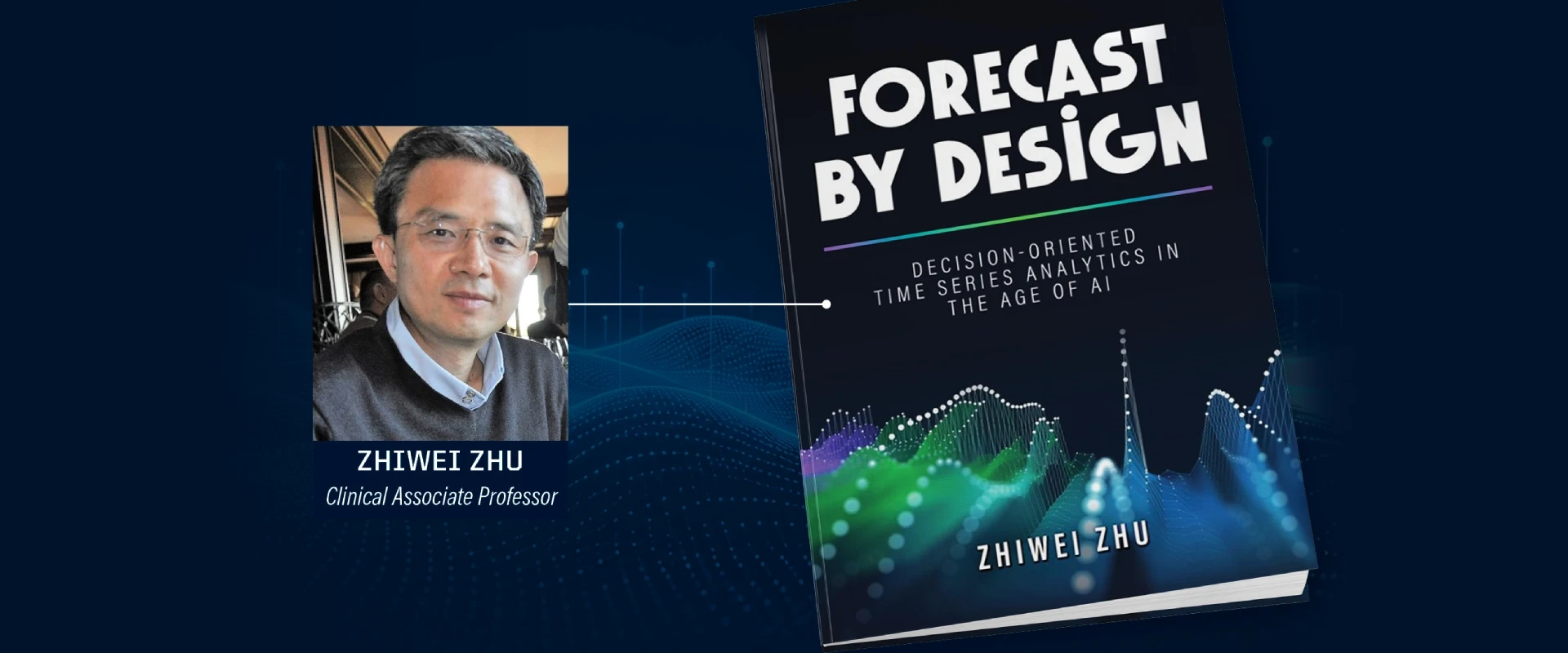
Zhu’s recently published textbook, Forecast by Design: Decision-Oriented Time Series Analytics in the Age of AI, demonstrates how this philosophy can be applied to an established business function.
Instead of treating forecasting primarily as a model-selection and accuracy exercise, the book reframes it as a decision-design process: understand the business purpose and data, develop and validate the analysis, monitor reliability after deployment, and connect forecasts to actions. AI becomes both a learning and thinking partner, while humans retain responsibility for judgment and decisions.
The lesson extends beyond forecasting: As AI makes analytical execution easier and more abundant, advantage increasingly depends on how well organizations design the system around the analytics.
AI capabilities will increasingly be available to everyone. Competitive advantage will remain dependent on higher value judgments. Organizations that expand their data strategies, develop people for those higher-value judgments, embed governance into operations and intentionally combine human and machine intelligence will be better positioned to turn widely available AI into proprietary organizational intelligence — and thus better business performance.