10-29-2026
Purdue University’s Mitch Daniels School of Business has launched a new Business AI Fellows Program designed to help students develop the skills and experience needed to lead in an increasingly AI-driven business environment.
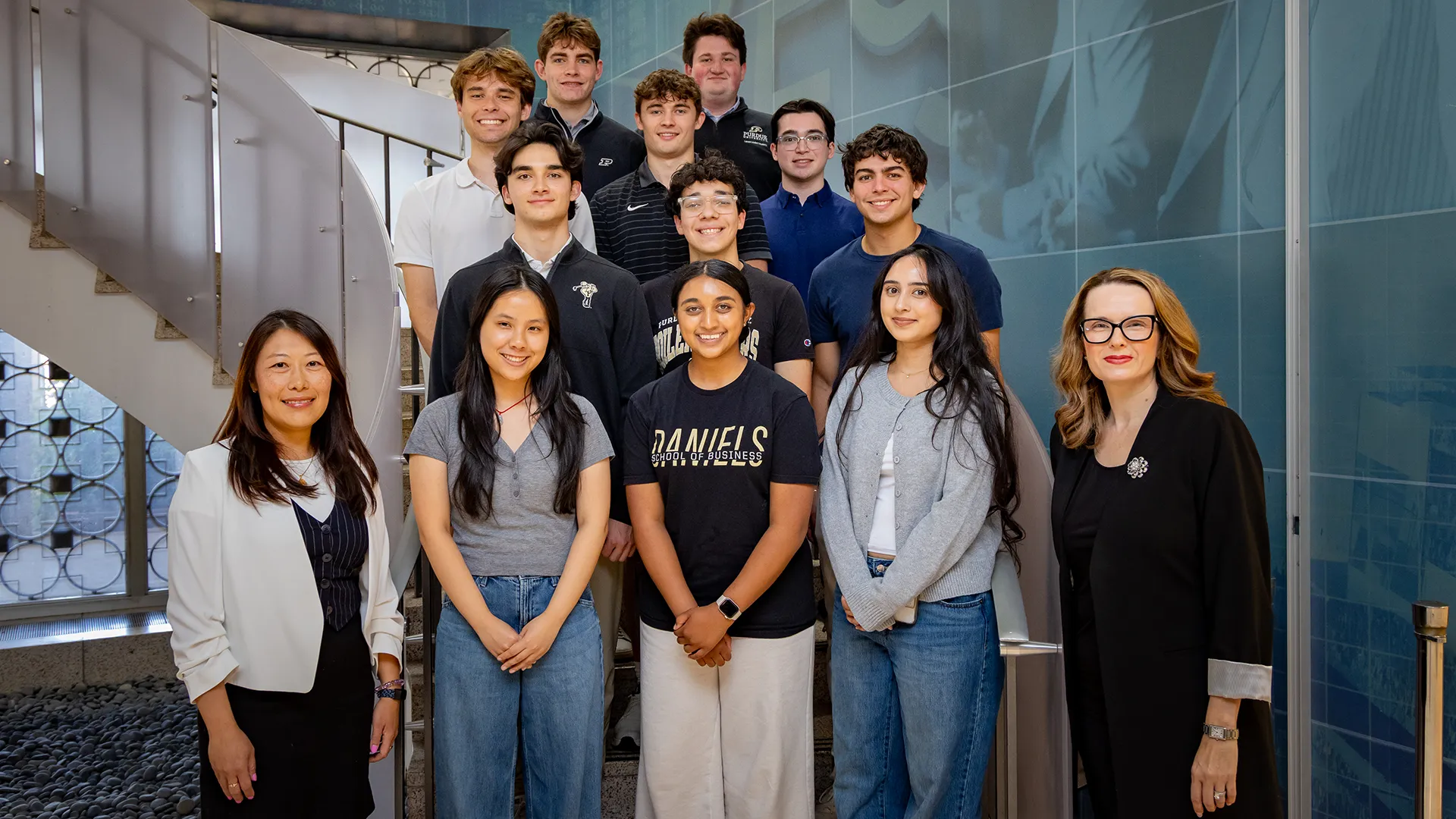
The program brings together an inaugural cohort of 12 business students for the 2026–27 academic year. Through a combination of structured learning, mentorship and hands-on projects, the Business AI Fellows will learn to apply artificial intelligence in practical business settings while developing a deeper understanding of its ethical and strategic implications.
“Experiential learning lies at the heart of the Business AI Fellows Program’s design. Rather than treating AI as a topic to be studied in the abstract, the fellowship immerses students in the practical, iterative work of applying AI tools to real organizational problems, building judgment and confidence in ways that lectures and readings alone cannot,” says Cecilia Ying, co-director and a clinical assistant professor in the Management Information Systems Department.
Employers increasingly report that new graduates understand AI concepts in theory but struggle to apply them productively on the job. Ying has seen that shortfall firsthand in the classroom. “I designed DSB 187: Introduction to AI in Business around the same principle and launched it last fall as the first approved AI competency course at the Daniels School,” she says.
“Students don’t really understand AI until they use it to solve a real problem. The course is open to students across all departments at the university, and it gave us an early, practical foundation to build on. The Business AI Fellows Program takes that same philosophy and extends it into a full year of hands-on work.”
By pairing structured learning with sustained, hands-on project work, the fellowship is designed to close that gap and produce graduates who can translate AI knowledge into real business value from day one.
“The Business AI Fellows Program gives students a chance to experiment with AI, explore different tools and approaches, and apply what they are learning to challenges that organizations are actually facing,” says Kasie Roberson, co-director and a clinical associate professor in the Organizational Behavior and Human Resources Department.
“That experience is important because students are not simply learning how AI works; they are learning how to think about where it can create value, how to work with others to develop solutions, and how to approach AI responsibly with creativity and critical thinking while maintaining their authentic voice.”
The program is intended to develop students into “fluent, ethical and creative practitioners of AI” while helping establish a culture of AI literacy within the Daniels School. Fellows will work across business disciplines, with potential focus areas including finance, marketing, management and accounting.
“AI continues to transform how organizations compete,” says Kelly Blanchard, senior associate dean of undergraduate programs and Indianapolis and a clinical professor of economics. “Understanding, evaluating and leveraging AI is a foundational capability for business professionals in every discipline. The Business AI Fellows Program builds on our commitment to prepare students to lead AI transformation with technical competence, strategic application, and adaptability as AI and work evolve.”
The fellowship is structured across two semesters. During the first semester, students participate in an onboarding boot camp, meet as a cohort every other week and explore how AI can be applied within their selected business focus areas. In the second semester, students will transition from learning and exploration to application and delivery, working in teams on projects for real clients or faculty partners.
The project-based approach is a central feature of the fellowship. Teams work on projects with real organizational needs, with potential projects coming from Purdue departments, centers and student organizations, industry partners or faculty research initiatives. Internal Purdue projects are the primary focus for the first year, with industry partnerships envisioned as the program grows.
One planned project illustrates how that model could work. Through a 32-week Business AI Fellows project, student teams will partner with Purdue Innovates and Purdue Connected stakeholders to develop an AI-assisted tool that makes it easier for members of the Purdue community to discover, follow and engage with entrepreneurship and innovation events across campus.
Students working on the project will be organized into teams of six and will own the full lifecycle of their tool, from ideation and design through development, testing and final presentation. Business advisors from Purdue Innovates or other innovation and entrepreneurship partners will provide guidance throughout the process.
The experience will culminate in a public end-of-year showcase where Fellows present their work and demonstrate the impact of their projects. Students also will have access to industry speakers, mentors and recruiting events, along with a verified “Purdue Daniels Student AI Fellow” digital credential for LinkedIn.
The Business AI Fellows Program is designed to advance several priorities of the Daniels School, including transformative student experiences, academic prowess, integration of STEM and business, and stronger business partnerships. In particular, the fellowship aims to prepare students to work confidently with data scientists and engineers and to lead the use of AI across functions such as finance, marketing, operations, human resources and strategy.
“AI is rapidly reshaping the way organizations create value, and our responsibility is to ensure Daniels School students are prepared not only to use these technologies, but to lead with them,” says Jim Bullard, the Dr. Samuel R. Allen Dean of Purdue's Daniels School. “The Business AI Fellows Program gives students the opportunity to move beyond theory and develop the judgment, creativity and practical experience needed to apply AI responsibly to real business challenges. By combining business expertise with hands-on AI experience, we are preparing graduates to be thoughtful, effective leaders in an increasingly AI-driven economy.”
The first-year cohort will serve as a foundation for future growth. Plans call for expanding to 15–20 Fellows in its second year, adding industry partners and exploring opportunities to connect the program with other Purdue colleges and K-12 education.
The program complements the university’s commitment to AI learning. Beginning with the fall 2026 class, Purdue requires all undergraduate students to complete AI-focused coursework, positioning it among the first universities in the nation to embed AI competency into every degree program. The new foundational learning outcome is designed to help graduates use AI tools effectively in their fields, understand the technology’s limitations and adapt to future developments in a rapidly evolving workforce.
Purdue’s leadership has been clear about what is at stake in embedding AI competency across every degree program.
“Artificial intelligence is transforming every sector of the economy, and Purdue has a responsibility to prepare our students for that reality,” says Lucy Flesch, Frederick L. Hovde Dean of the College of Science. “As one of the first institutions in the nation to embed AI competency into every undergraduate degree program, Purdue is helping define what it means to be truly AI-ready.”
Flesch added that the goal is not mastery of any single tool but durable, adaptable skills: “Our focus is on developing graduates who can thoughtfully evaluate, responsibly apply and confidently adapt AI technologies as they evolve throughout their careers.”

