09-24-2026
As an expert on well-being and performance at work, I’m always on the lookout for ideas and people who share this understanding — that being well and doing well at work do not have to be two forces pulling at each other. Yet, this tension is often the center of many people’s relationship with work. The idea that being exceptional at your job inherently means less sleep, fewer breaks and vacations, less time with friends, or candidly, less you.
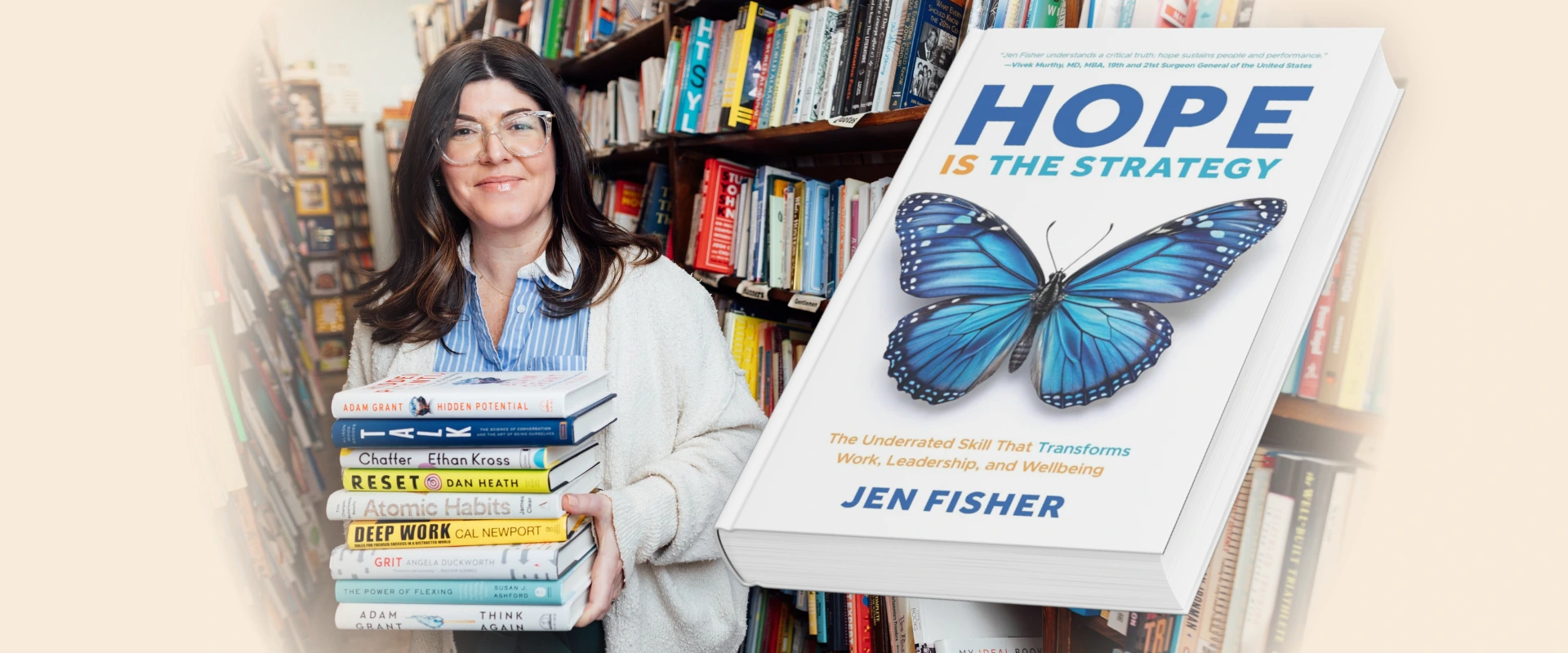
Jen Fisher, the first Chief Well-being Officer in professional services and author of Hope is the Strategy, lived this tension, understands its harmful impact, and now shares her candid and relatable story to help leaders embrace hope as a critical strategy that brings well-being and performance in alignment.
The book opens with a familiar scene for many high performers: a late night of work illuminated by the glow of a laptop screen in a quiet house. Jen narrates her addictive work habits that led to a type of burnout that no self-care moment, meditation app, or weekend off was going to resolve. The opening chapter was raw in a way most leadership books fail to be. It was almost like sitting with a friend and a cup of coffee, diving into a meaningful and overdue conversation. Except this friend was also ready to offer tangible, evidence-based advice to help us all get on a healthier path.
You might be asking, “Wait, how can hope be a strategy?”
However, this did not surprise me. Decades of research on the power of positive emotions lay the groundwork for this possibility. Foundational research known as Broaden-and-Build Theory shows that positive emotions are expansive: they broaden how we see and interpret our environment and, over time, build our capacity to see more possibilities and to adapt how we relate to ourselves, others, and the world around us. And emotions aren’t just feelings we sit with — they activate behavior, shaping what researchers call action tendencies, or the ways particular emotions move us to act.
In this way, hope is an ideal starting point for a healthier relationship with work. It is positive, future-oriented, long-term, and filled with possibilities. And from that perspective, it is the type of strategic positioning leaders should be able to easily get behind. Leaders often think strategy begins with deciding what to do. Hope suggests that strategy may begin one step earlier — with helping people believe that a different future is possible.
Hope isn't optimism that things will magically improve; it creates room to imagine alternatives and act toward them. Jen Fisher calls on high performers and organizational leaders to embrace hope as a practical strategy for managing well-being and performance that cultivates new skills, ways of relating, and measurable outcomes. Jen also offers endless resources, reflections, and exercises to reinforce that hope isn’t just an idea — it’s something you cultivate. Something you do.
Last week, a former student and mentee visited campus as part of her work. We found an hour at the end of our busy day to reconnect. During our time, I mostly listened as she recounted the challenges of work, the time pressure, and the ambiguity of expectations. I had a familiar recognition — not unusual to our early alumnae — of burnout, workaholic tendencies, and a sense of hopelessness. I listened and, in the moments it made sense, I offered suggestions to rethink how work could feel. I couldn't resolve the demands of her job or remove its ambiguity. But I could help her imagine that work didn't have to keep feeling this way — that there were other ways to approach it. So, we made a little room for hope. And sometimes, that is exactly where change begins.
Kate Zipay is an associate professor of management in organizational behavior and human resources at Purdue’s Mitch Daniels School of Business and associate director of research and impact at Purdue’s Center for Working Well. Her research examines the ways life at — and outside of — work influences our relationship with work and each other. In 2025, she was selected, alongside Dr. Allison Gabriel, to Thinkers50 Radar as a leading management Thinker. In 2026, she received the Teaching Excellence at Daniels Award — the college’s top teaching innovation award for faculty.