08-12-2026
Chair Kevin Warsh wants to evaluate and potentially reform how the Federal Reserve communicates with the markets and the public. One item on his list to review is the Federal Open Market Committee’s (FOMC) quarterly Survey of Economic Projections (SEP). My July Daniels Insights post suggested that the SEP could be enhanced by switching from reporting point forecasts to density forecasts. Speeches by Board Governors and Federal Reserve Bank presidents are also important ways for the Fed to communicate with the markets and the public. This is especially true for the leadership of the Fed — known as the “troika” — the chair, board vice-chair and FOMC vice-chair.
It is instructive to examine what the Fed leadership has been saying over time about the current inflation overshoot — what I will call Inflation Airline Flight 2021. The Figure below shows the flight path from its takeoff in March 2021. The flight experienced a steep ascent after takeoff and in mid-Summer of 2022 reached its maximum altitude with an inflation rate above 7 percent. The flight then descended at a similar rapid rate for the next 12 months. By November 2023, its “price stability” destination was in sight as inflation descended below 3 percent. However, subsequently the plane stopped descending and instead began circling its destination.
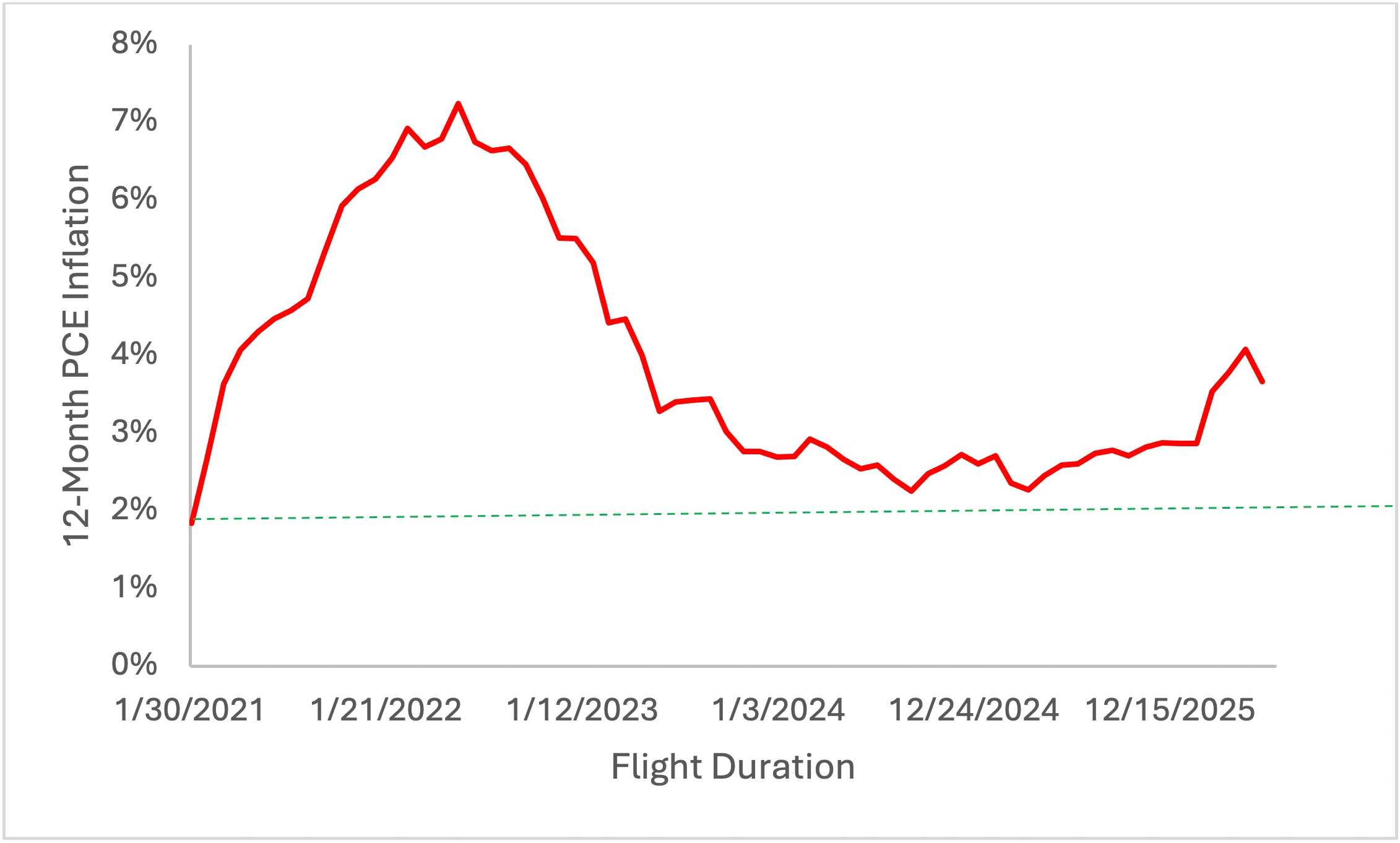
On March 7, 2025, after a year and a half of circling, the plane’s captain, Chair Powell, made the following announcement to the passengers.
“Inflation has come down a long way from its mid-2022 peak of 7 percent without a sharp increase in unemployment — a historically unusual and most welcomed outcome.”
A month later on April 16, 2025, the captain reiterated this message to the passengers.
“As for our price stability mandate, inflation has significantly eased from its pandemic highs of mid-2022 without the kind of painful rise in unemployment that has frequently accompanied efforts to bring down high inflation.”
That is, the captain explained that the circling was due to the intention of the pilot and his crew to arrive at the destination of price stability with a “soft landing.” This would be an accomplishment in that the last time the Fed achieved this type of landing from high inflation was under Chair Greenspan in 1994-1995. However, the problem with trying to achieve a soft landing is there is a risk of no landing at all.
In the fall of 2025, the flight crew became worried that their intended soft landing might be in danger. They adjusted course by leveling the wing flaps with three 25-basis point cuts in successive meetings in September, November and December of 2025. To provide insurance for the soft landing, they gave up on actively trying to land the plane.
Nearly a year later two more announcements were made. On July 16, 2026, the co-captain — Vice Chair Jefferson — perhaps to try and cheer up the weary passengers, announced
“… this policy stance should continue to support the labor market while allowing inflation to resume its decline toward our 2 percent target as the effects of past tariffs and energy prices pass through completely.”
The co-captain was saying that the difficulty with attempting a landing at that time was that there was still economic and policy turbulence in the area that might make for a difficult touchdown. So, the flight crew thought it better to continue to circle and wait for the forecast to improve. In other words, they still believed that inflation was “transitory” even though they had stopped using this phrase in public.
Rounding out the communications to the restless passengers, the flight engineer — FOMC Vice-Chair Williams — a day earlier on July 15, 2026, updated everyone on the latest outlook for their arrival.
“… I expect overall inflation to decline to around 3 ¼ percent by year-end, then continue on a glide path toward our 2 percent goal in 2027 and land on target in 2028.”
You can only imagine the relief the passengers felt with this update. The plane has been circling the price stability destination for two-and-a-half years and now they are told not to worry because a soft landing is still in the cards, but that they will have to wait another two years to arrive at their destination. Importantly, this will be accomplished without any real effort by the flight crew as the plane will simply follow a “glide path” to price stability.
The recent good news is that due to the very long duration of Flight 2021, a new captain has taken over the controls of the plane. Chair Warsh has publicly committed to landing the plane. At the June FOMC meeting, three presidents dissented on the decision not to tighten the policy rate. An important question is whether Chair Warsh follows his predecessor’s approach, which is to do everything to bring about a soft landing even if this risks further delays, or, if he decides that a bumpy landing beats no landing.
In thinking about this choice, it is useful to keep in mind the advice of basketball great Michael Jordan. “Some people want it to happen, some wish it would happen, others make it happen.” The market wants price stability and the public definitely wishes for price stability — the question is whether the FOMC will make it happen.
Joseph Tracy is a Distinguished Fellow at Purdue University’s Daniels School of Business and a nonresident senior fellow at the American Enterprise Institute. Previously he was executive vice president and senior advisor to the president at the Federal Reserve Bank of Dallas. He regularly contributes insightful posts about financial markets to Daniels Insights.