10-28-2026
“Our heritage is not a disposable commodity. The ideals of 1776 are not single-use products, but living principles.”
With those words, Melinda Zook, the Germaine Seelye Oesterle Professor of History and director of Cornerstone Integrated Liberal Arts, opened Purdue University’s 2026 Cornerstone for Business conference.
As the United States celebrates its 250th anniversary, the conference, held September 29-30 on Purdue’s West Lafayette campus, centered on the theme “Spirit of 1776: Advancing Opportunity, Innovation, and Free Markets.” Faculty, students and business leaders examined the philosophical, historical and economic foundations of free enterprise, with sessions on corporate governance, artificial intelligence, infrastructure investment and constitutional civics.
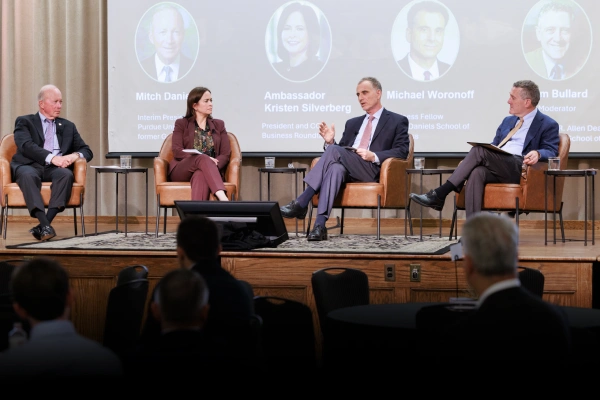
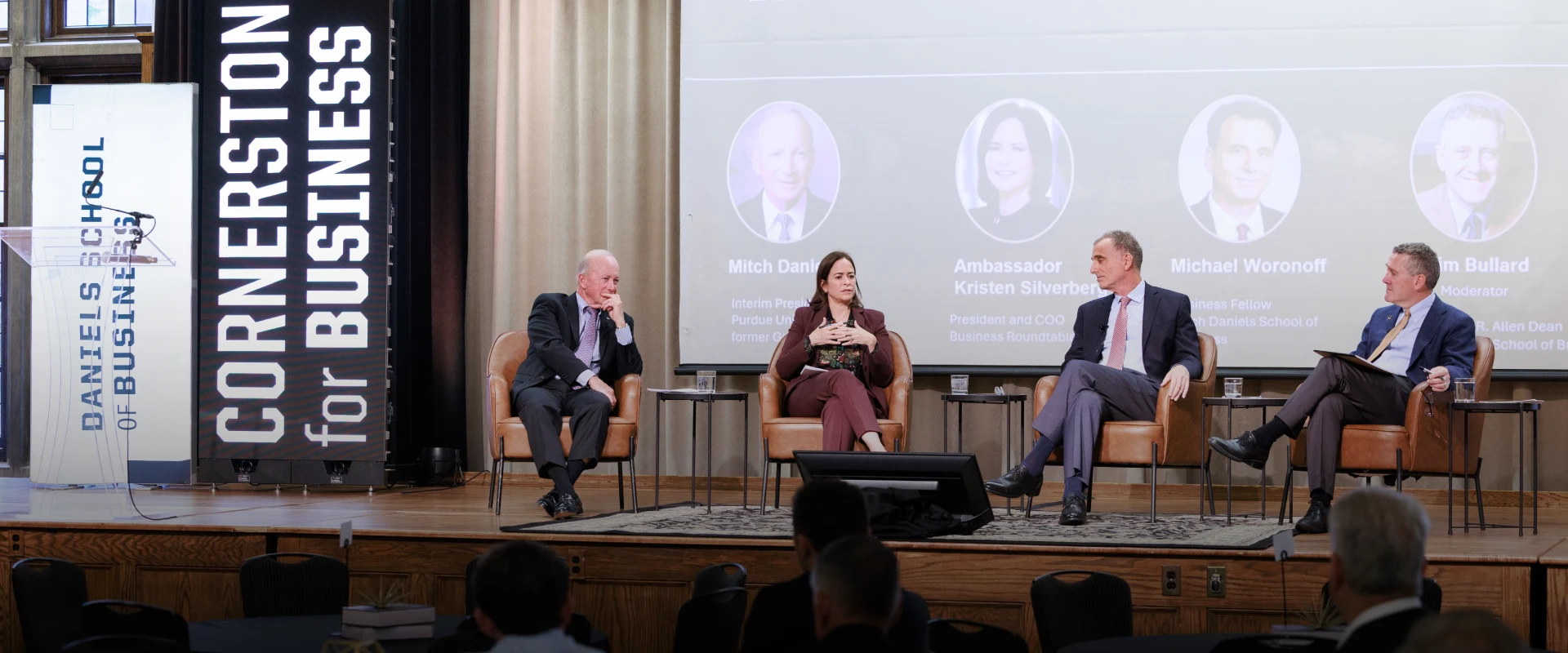
Questions of corporate purpose and responsibility shaped a panel on the evolution of the corporation in America, moderated by Jim Bullard, the Dr. Samuel R. Allen Dean of the Mitch Daniels School of Business.
Purdue interim President Mitch Daniels joined Kristen Silverberg, Business Roundtable president and chief operating officer, and Michael Woronoff, Daniels School Business Fellow, to discuss corporate leadership and the broader mission of business education.
Reflecting on the creation of Cornerstone for Business, Daniels noted that university leaders wanted “to add a dimension that’s not always present in business education elsewhere.” Beyond learning to read a spreadsheet or build quantitative models, he said, students must understand “why it is that a system of free exchange leads to upward mobility and opportunity and the blessings of liberty that flow from that.”
Daniels also praised the societal role of business, urging students to enter their careers “with a sense of the nobility of the profession they’ve chosen.” He described wealth creation as a fundamental civic contribution and said, “the first duty of corporate citizenship is to succeed in the marketplace,” enabling businesses to create jobs, serve customers and “create opportunity for others in a way that only a system of free enterprise can.”
Bullard echoed that view, describing business as “a noble enterprise,” and said the economy’s supply side deserves as much attention as its consumers. Businesses, he said, should offer a great product at a fair price, operate ethically and stay profitable over the long run. When that works, companies are better positioned to support their communities and meet what stakeholders are asking of them.
Woronoff highlighted the importance of mutually beneficial exchange, where “both parties are saying thank you.”
Silverberg addressed the delicate balancing act executives manage among employees, suppliers, communities and shareholders, noting, “There’s no algorithm for smart corporate board decisions.”
Exercising sound judgment becomes even more important as technological disruption reshapes the workplace.
Victoria Prowse, the Marge Magner Chair and Professor of Economics at the Daniels School, traced 250 years of technological transformation, from farm mechanization to robotics. While automation displaces specific tasks, she explained, technological progress can expand an economy’s productive capacity. The challenge is how people and institutions adapt and share in those gains.
For students preparing for an AI-driven workforce, Prowse emphasized that human capabilities such as judgment, decision-making, teamwork and social skills can help workers adapt and complement emerging technologies.
Students put those skills into practice in student-led panels on AI, work-life balance, career aspirations, leadership, resilience, ethics and teamwork, as well as a business case competition and the Daniels School’s inaugural undergraduate research symposium.
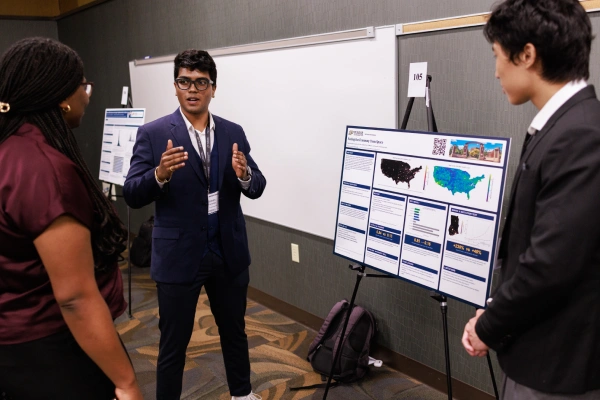
Rohan Fernando, a senior in economics and finance, participated in the Daniels School Undergraduate Research Symposium. He presented his research on return-to-office mandates and the supply of neighborhood retail with symposium attendees.
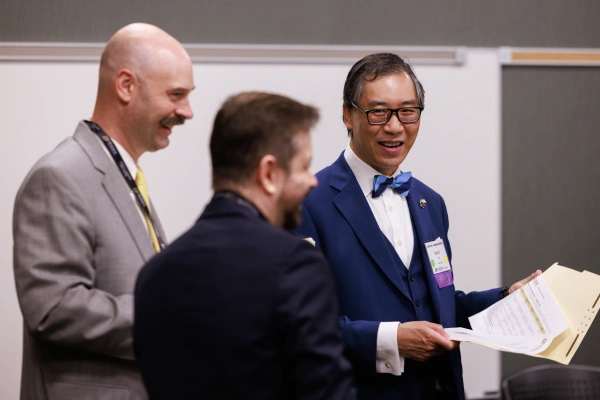
Daniels Undergraduate Research Symposium judges Benjamin Van Kammen, associate director of the Purdue University Research Center in Economics and senior lecturer of economics, and Aaron Lai, director of data and analytics for Manifest MedEx and senior fellow at the Krenicki Center for Business Analytics and Machine Learning, discuss the symposium scoring rubric with Davi Moreira, director of the Undergraduate Business Honors Program and clinical assistant professor.
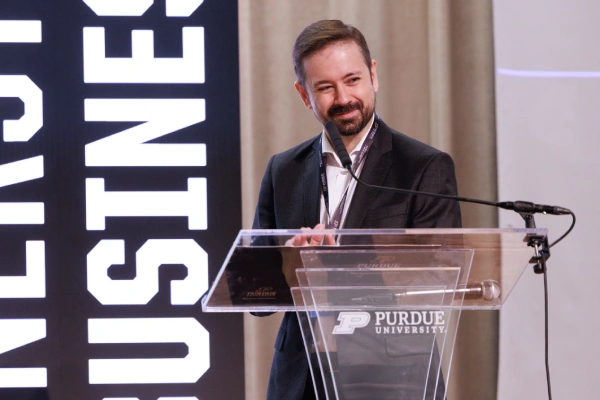
Davi Moreira, director of the Undergraduate Business Honors Program and clinical assistant professor, presents awards to the winners of the Daniels Undergraduate Research Symposium.
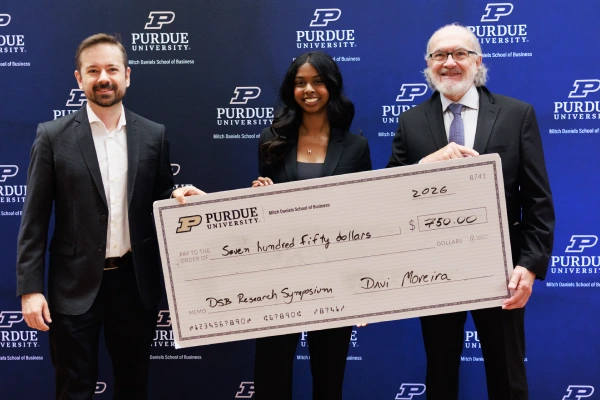
Einsteinia Socrates, a junior studying business analytics and information management, won first place at the Daniels Undergraduate Research Symposium for her research on how task complexity and emotion shape customer service preferences.
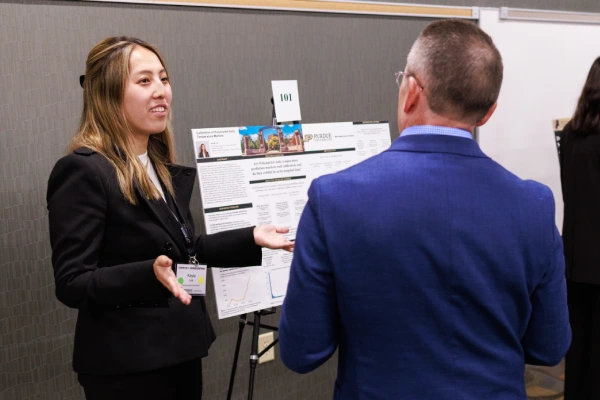
Kayla Lee, a junior studying statistics and finance, won second place at the Daniels Undergraduate Research Symposium for her research on the calibration of Polymarket daily temperature markets.
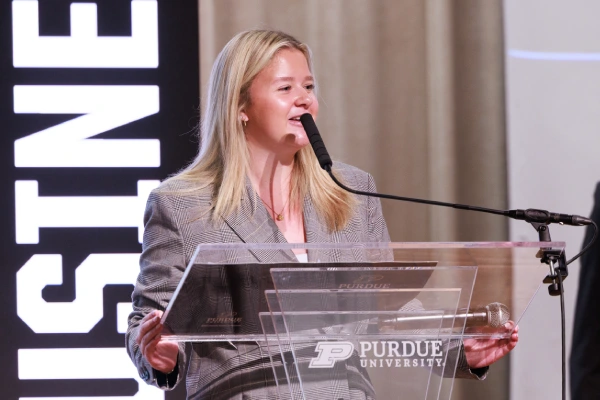
Brooke Evans, a senior studying marketing, won third place at the Daniels Undergraduate Research Symposium for her research on the emotional and rational drivers of nonprofit engagement.
Alok Chaturvedi, professor in management information systems at the Daniels School and author of “The Dharma of AI,” addressed another challenge of an AI-driven economy: whether the data AI relies on truly reflects reality.
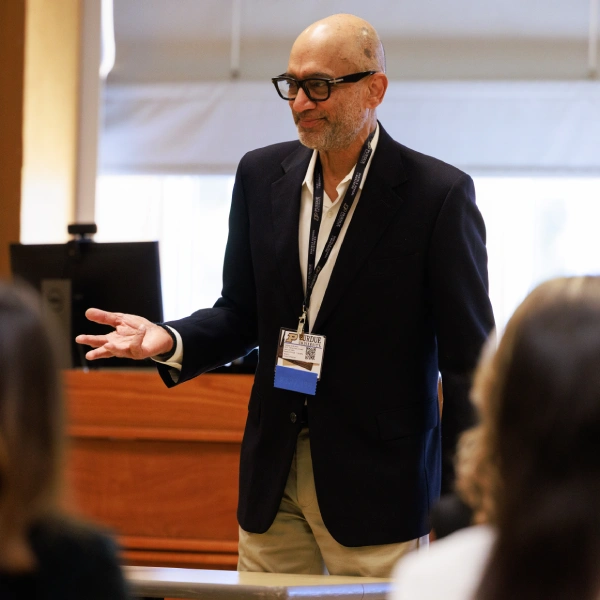
Chaturvedi compared AI to a flashlight in a dark room: its beam illuminates one area while leaving the rest in shadow. “The world does not begin at measurement. Records do,” he said.
Every dataset reflects choices about what to measure and what to overlook. The danger, he argued, comes when organizations mistake the lit portion for the whole room. And the problem is compounding: AI systems have already consumed most of the human-generated text available to them, so future AIs will increasingly be built from data generated by earlier AIs.
Rich Sikora, executive advisor for innovation and entrepreneurship at the Daniels School, stressed that innovation is “technology agnostic.”
“Innovation doesn’t have to be technology or a product,” Sikora said. “It could be a process or a business model.”
Sikora explained that this work is driven by people fulfilling distinct roles: inventors who make new discoveries, founders who turn ideas into viable products, entrepreneurs who take smart risks to reach the market and intrapreneurs who innovate from within established organizations.
Yet ambitious investments also carry risk. In a session exploring American infrastructure from westward expansion to the digital frontier, historian and author John Butler recounted how Indiana borrowed 10 times its state budget to chase the canal boom, a bet that collapsed by 1839 and left the state in debt.
Connecting that history to modern AI data centers, David Hummels, Distinguished Professor of Economics, the Marshall and Susan Larsen Chair, and dean emeritus of the Daniels School, warned that “the geography of benefits has been inverted.” Canals and rail lines enriched nearby landowners, he said, but data center computing power spreads globally while local communities shoulder grid congestion and heavy energy demands.
Whether financing canals or data centers, Hummels said, “What really matters is who holds the bag if demand comes in at half the forecast levels.”
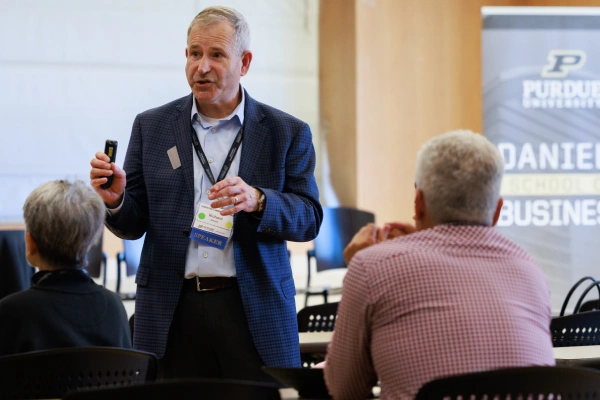
Rich Sikora, executive adviser for innovation and entrepreneurship at the Daniels School, describes the inventors, founders, entrepreneurs and intrapreneurs who drive innovation.
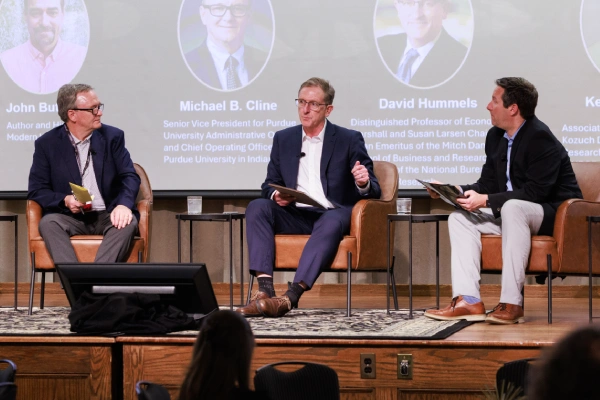
David Hummels, center, speaks with Michael Cline, executive vice president and chief executive officer for Indianapolis, left, and moderator Kevin Mumford, associate dean of graduate programs and professor of economics.
Discussions also addressed the institutions and policies that support free enterprise.
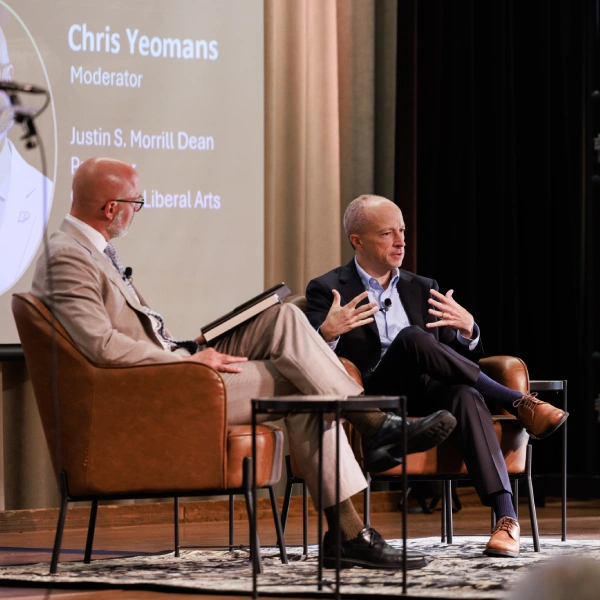
Matt Miller, senior vice president of government relations at Business Roundtable, emphasized the importance of policy durability on free markets and the foundations of American success. He spoke during a fireside chat with Kelly Blanchard, clinical professor of economics and senior associate dean of undergraduate programs and Indianapolis. Businesses, Miller said, need predictable policies that balance free-market opportunity with appropriate government safeguards. Policies that are “too business friendly,” he said, can undermine investment when companies expect the next administration to reverse them.
“Durability is one of the biggest issues we have,” Miller said. “That’s why we [the Business Roundtable] advocate for legislation whenever possible — something that’s durable.”
That emphasis on durable institutions carried into a conversation about the foundations of American self-government. Author Yuval Levin, discussing his book "American Covenant: How the Constitution Unified Our Nation — And Could Again," explained that the U.S. Constitution was designed specifically for people who disagree.
Describing James Madison’s approach, he said, “Unity in a free society doesn’t mean thinking alike. Unity means acting together.” Free self-government, Levin argued, depends on negotiation, constructive disagreement and shared rules.
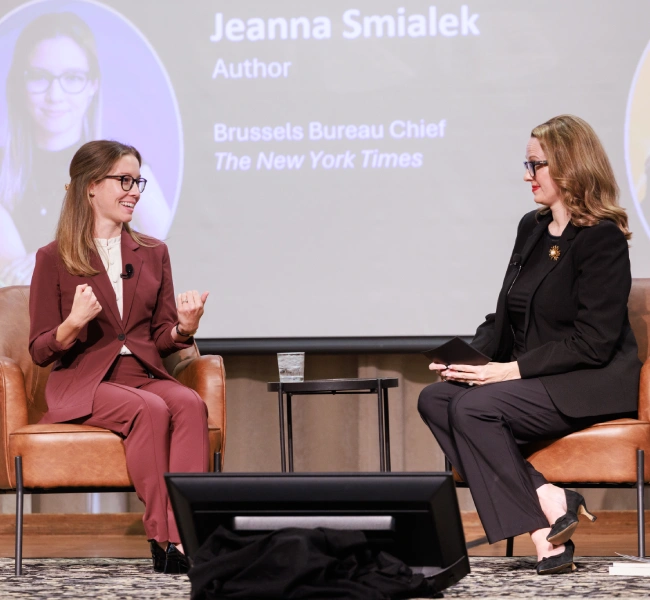
Ideas also need messengers. Jeanna Smialek, Brussels bureau chief for The New York Times and author of "The Invisible Hand of Maria Edgeworth: How a Nineteenth-Century Novelist Taught the World Economics," spoke with Kasie Roberson, clinical associate professor in the Department of Organizational Behavior and Human Resource Management and head of the Center for Working Well’s Hayes Leadership Coaching Institute at the Daniels School. They discussed how 19th-century author and thinker Edgeworth used fiction to make ideas from Adam Smith and other economic thinkers accessible to broad audiences. “She used fiction to teach the world economics,” Smialek said. Edgeworth also revised her views when new evidence challenged her assumptions, Smialek noted.
During his remarks, Levin told attendees, “I hope you all know that Purdue and Cornerstone are really a national model. People look to this place as a place that’s doing it right.”
Bullard closed the conference by thanking attendees, speakers, donors Doug and Maria DeVos, and Purdue's College of Liberal Arts for supporting the program. He also recognized the conference steering and planning committee: Blanchard, Andrea Langrish, Tim Lemper and Zook.
“Through Cornerstone for Business,” Bullard said, “we are committed to developing future leaders who understand how to create value responsibly and with integrity. We look forward to continuing these conversations.”

Cornerstone for Business is a collaborative initiative between the Mitch Daniels School of Business and Purdue’s Cornerstone Integrated Liberal Arts program. The program connects business education with enduring ideas, ethical leadership, and human-centered thinking to prepare students to lead with both competence and character.
Learn more about Cornerstone for Business

