11-18-2026
Both in business and civic life, bring people together to solve a problem and there’ll likely be as many opinions on the solution as there are people. Founding Father James Madison was pragmatic about this age-old reality. In Federalist Paper 10 he wrote, “as long as the reason of man continues fallible, and he is at liberty to exercise it, different opinions will be formed.”
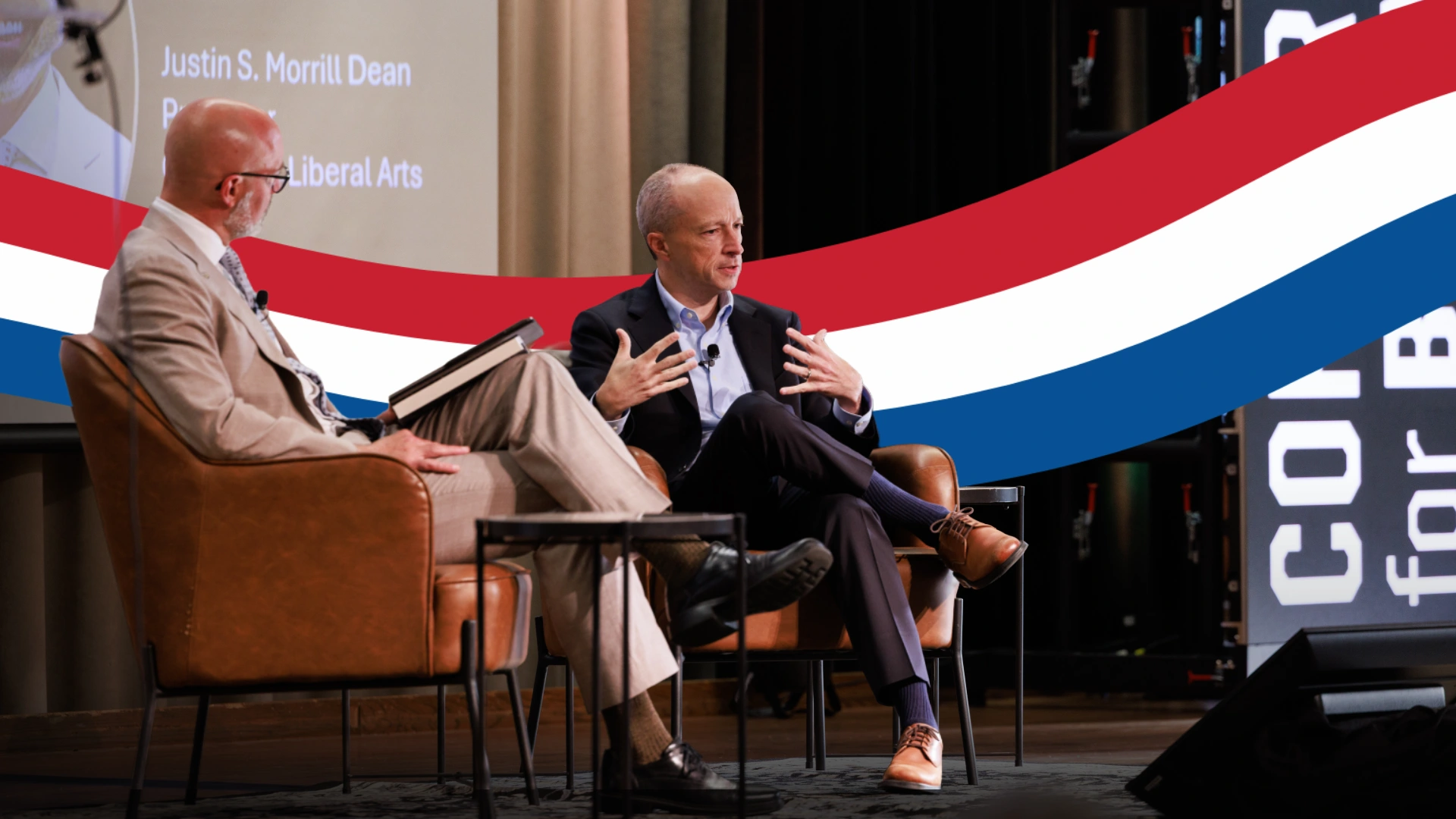
Author and constitutional scholar Yuval Levin embraces the tension that exists when democracy binds together people who disagree. The Cornerstone Institute for Civic Thought sponsored Levin, who is director of Social, Cultural, and Constitutional Studies and Beth and Ravenel Curry Chair in Public Policy at the American Enterprise Institute, as the conference keynote guest. In a fireside chat with Christopher Yeomans, dean of the College of Liberal Arts, Levin explained the value and realities of that tension at the 2026 Cornerstone for Business conference.
Madison understood that disagreement cannot be divorced from freedom, noted Levin. The task is to build institutions and habits that make cooperation possible without requiring everyone to share the same convictions.
“Unity in a free society doesn’t mean thinking alike. Unity means acting together,” said Levin.
Levin’s distinction offers a way to reconsider what Americans should expect from their institutions. If unity requires unanimity, every disagreement becomes evidence of failure. If unity means common action, disagreement becomes a condition people must learn to navigate.
“You can act together when you don’t think alike,” Levin said.
That does not make cooperation easy. The goal moves away from overcoming differences to working through them.
In Levin’s reading, the Constitution supplies mechanisms for that work. Negotiation, competition and institutional friction force people to deal with one another. What can look like unnecessary slowness may instead reflect the difficulty of producing decisions among people who remain free to disagree.
Levin proposed another critical tension that is key to the success of the United States: democracy, which is fundamentally about majority rule; liberalism, which is about individual rights; and republicanism, which Levin defines as “the common good.” He believes they “must be understood in relation to the others.”
“You would think majority rule and minority rights are in tension all the time. The ways in which those tensions are resolved have to do with a sense of the common good, with a sense of what we owe our society as a whole,” said Levin.
Levin sat down for an interview with the business school, in which he connected that political challenge to everyday economic life. Businesses bring together customers, employees and partners whose beliefs may differ but whose interests overlap.
“I think having the experience of working in a free economy means you learn to tolerate disagreement,” he said. That experience can help people recognize mutual benefit. The same principle of cooperation amid disagreement shapes the relationship between free markets and democracy. Levin sees them as compatible, but not interchangeable.
“They both assume free people, making choices and judgments for themselves,” he said. Both turn differences into sources of strength, using competition to drive improvement.
Their tension, however, is necessary. “The tension keeps them both from falling into their worst excesses,” Levin said. A civic culture that neglects obligation and responsibility, for example, leaves markets more vulnerable to the excesses of consumerism. Economic freedom needs a culture of civic commitment not simply permission to pursue individual wants.
That relationship also places responsibility on institutions facing public distrust. In Levin’s account, Americans’ suspicion increasingly extends across both business and government. Institutions cannot respond merely by asking people to have more confidence in them.
“It’s not just a failure to trust; it’s a failure to be trustworthy,” he said.
Rebuilding trust in business begins with doing their work well rather than making themselves participants in every political or cultural dispute.
“It’s doing what you do as a business and not trying to be a player in the culture wars and politics,” Levin said. Business leaders can hold convictions as citizens without making agreement with those convictions a condition of their company’s relationship with customers.
This brings Levin’s argument back to Madison’s understanding of unity. Businesses can serve people who disagree. Democratic institutions can help those same people make common decisions. Neither requires unanimity; both depend on institutions worthy of trust and people willing to work together.
Cornerstone for Business is a collaborative initiative between the Mitch Daniels School of Business and Purdue’s Cornerstone Integrated Liberal Arts program. The program connects business education with enduring ideas, ethical leadership, and human-centered thinking to prepare students to lead with both competence and character.

