07-21-2026
Americans have much to celebrate about the 250th anniversary of our nation’s birth. Particularly central are our Founders’ bold claims about the rights of human beings. Humankind, they claimed, necessarily has a series of “unalienable” rights, all of which precede government and are ours by birthright. “Among these” — importantly, Jefferson made clear this was not an exhaustive list — are “life, liberty, and the pursuit of happiness.”
Although scholars differ on precisely what “the pursuit of happiness” entailed to the signatories of the Declaration, this short list bears close resemblance to one articulated by John Locke in his famed Second Treatise of Government (1689): “life, liberty, and estate.” Much like the roots of the American Revolution, liberty to Locke entailed a clear and inextricable interplay between economic self-preservation and political self-determination.
What was “self-evident” to thinkers like Jefferson and Locke, though, seemingly strikes the modern ear as less so. Even in business schools, spirited discussion — and instruction — on the relationship between economic freedom, political freedom and societal prosperity are conspicuously absent.
Not so at the Daniels School.
A few years ago, I was pleased to partner with the Daniels School to create a course, The Good Business of a Healthy Democracy, that addresses precisely this gap: a course that would explore how free governments, free markets and the liberties that undergird them reinforce, balance and ultimately strengthen one another. Today, we are proud to have successfully offered the course twice, and we are even prouder of the results.
Perhaps the most common refrain from our students, many of whom already work in top corporations from across the country, is one related to the novelty of the content in their education. Indeed, even among students with a strong undergraduate and business education, our course offered students their first real opportunity for discussion about the strengths and vulnerabilities of free markets and free governments — and how the two relate to one another. In fact, our course represented the first time that many students seriously engaged with ideas from foundational thinkers, from Plato to Madison to Hayek. Importantly, students also had the opportunity to hear from business leaders, like Susan Brock Williams of Eli Lilly, about how businesses can and do benefit from a healthy republic.
The importance of such experiences and conversations are evident in poll after poll, particularly of younger Americans. In a recent Cato poll, for instance, 53 percent of those aged 18 to 29 reported a favorable impression toward socialism, compared to just 45 percent reporting a similarly favorable assessment of capitalism. Understanding the importance of economic freedoms and the institutions protecting them thus remains crucial, both at home and abroad.
For these reasons, my center, the Program on American Institutional Renewal (PAIR) and leaders at Daniels School are exploring ways to expand offerings like The Good Business of a Healthy Democracy to a new generation of business and societal leaders. Doing so, we think, aligns closely with the vision articulated by the Daniels School for a “well-rounded education, including the history, philosophy, and economic theory of free market systems and a firm grounding in the liberal arts.”
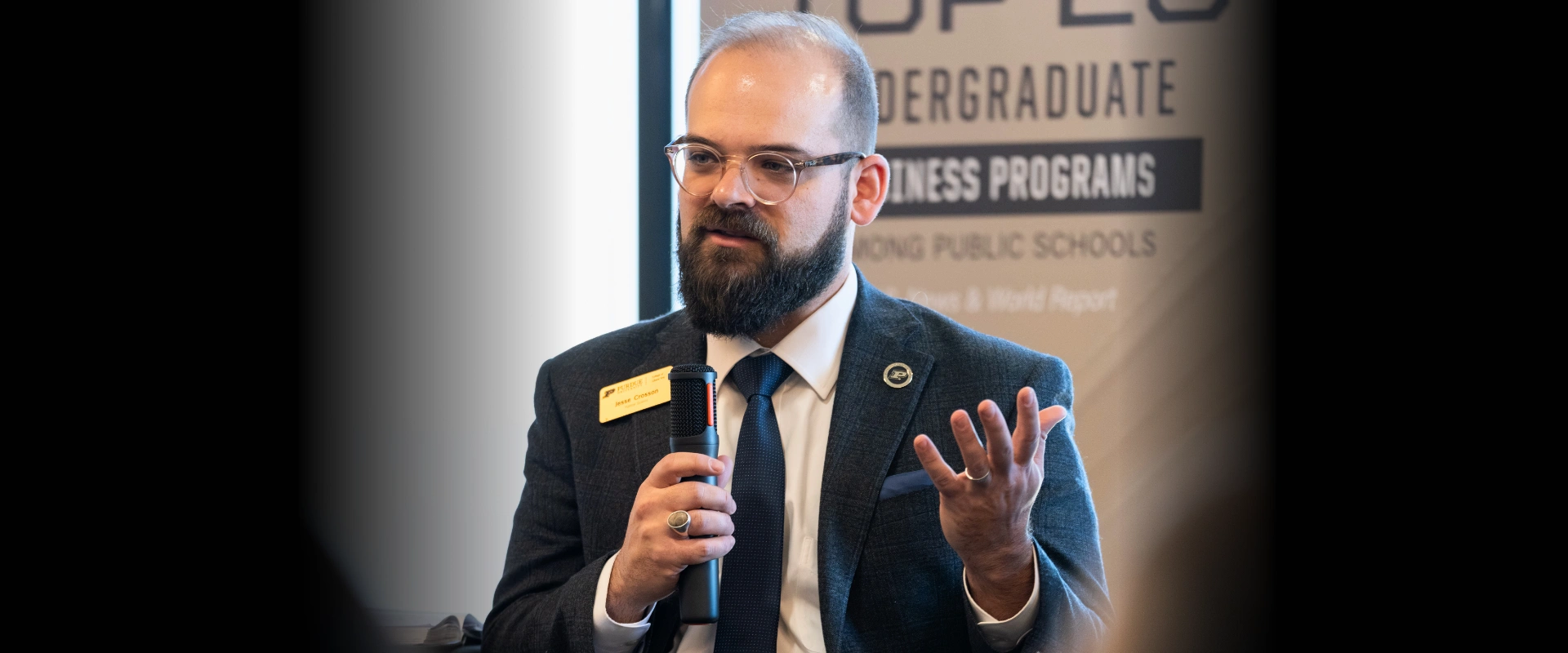
Jesse Crosson is an associate professor of political science in Purdue’s College of Liberal Arts and teaches in the Cornerstone Integrated Liberal Arts program. He is codirector of the Program on American Institutional Renewal (PAIR), which seeks to advance the capacity and function of American governing institutions through research.