11-03-2026
What does business have to do with art?
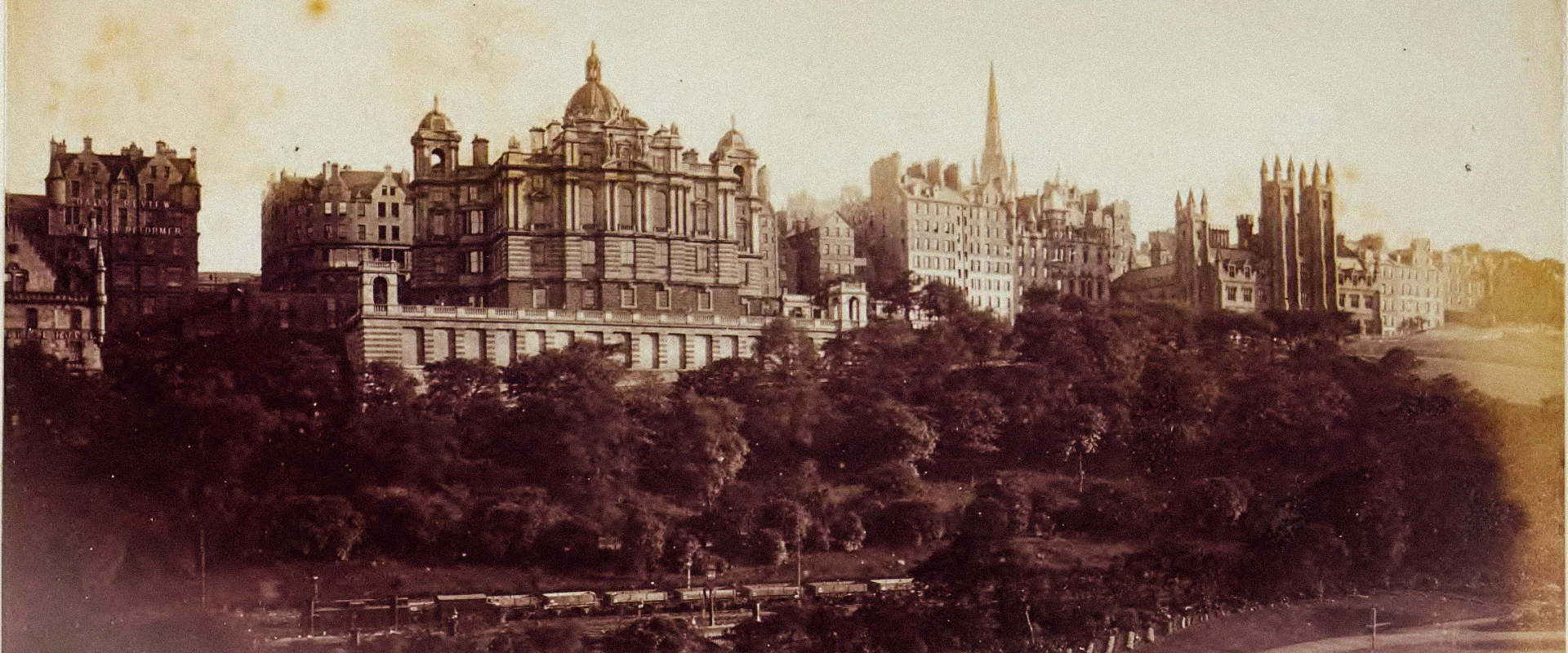
For professor Tom Brush, head of the Daniels School's Strategic Management Department, a photograph of the Bank of Scotland taken in the 19th century opened a window into one of the most consequential of American experiments: turning Revolutionary War debt into a foundation for national prosperity.
The effort, an unpopular move by first U.S. Secretary of the Treasury Alexander Hamilton, was inspired by Scottish Enlightenment thinkers Adam Smith and David Hume, as well as models of banking from the Banks of Scotland and England.
The Edinburgh-based Bank of Scotland's classical symmetry and imposing dome suggest permanence and order. But the ideas behind the institution — and their influence on Alexander Hamilton — drew Brush’s attention from the architecture to the internal structure.
As the United States marks its 250th birthday, that connection prompted Brush to review history, reminding him that the nation’s financial strength began in a shortage of financial resources and contention over how to resolve the problem. Financial science was just emerging, and Hamilton's bid to bring it to the new democratic republic led to fierce disagreement.
Christopher Yeomans, College of Liberal Arts Justin S. Morrill Dean, invited Brush to select a work of art from Purdue Galleries for an exhibition in honor of America’s Semiquincentennial. Brush chose a James Valentine photograph, "Bank of Scotland from Princes Street, Edinburgh."
"Purdue Reflects: Celebrations of America at 250 from Purdue Galleries' Permanent Collection" is sponsored by the Cornerstone Institute for Civic Thought and Purdue Galleries and is on display until November 20 at the Patti and Rusty Rueff Galleries in Pao Hall. There is an opening reception at 5:30 p.m. on Thursday, November 5.
Brush’s exploration led him to Adam Smith’s account of Scottish banking in The Wealth of Nations, in which Smith addresses how competing banks supplied credit that helped commerce expand. Private ownership and the possibility of losses encouraged caution, while competition checked the power of individual institutions. Hamilton recognized the possibilities to address American debt in that combination.
A prodigious reader and writer, Hamilton also read David Hume, Smith’s friend and fellow Scottish Enlightenment thinker, whose discussion of public debt helped inform Hamilton’s thinking about finance and economic activity. What caught Brush's attention is the way that Hamilton innovated upon emerging financial ideas and adapted them to the United States different national challenge.
Hamilton’s task was more specific than replicating Scotland’s success.
“He had a different problem than just improving the economy in general,” Brush says. “He had to deal with all these debts.”
As the first Treasury secretary, Hamilton wanted a unified approach to state war bonds accumulated during the Revolution. Uncertainty about repayment had depressed their value. His answer was federal assumption of state war debts and a credible commitment to honoring the nation’s obligations. He believed that consolidation could strengthen public credit and replace fragmented obligations with a more coherent national financial foundation.
Hamilton’s debt proposal provoked resistance over who would benefit. James Madison wanted original bondholders to share in gains from federal assumption; Hamilton argued that tracing ownership was impractical and honoring current contracts would strengthen confidence. He’d been influenced by Thomas Hobbes' belief in “the sacredness of contracts in transfers of securities.”
States that had reduced their debts objected to shouldering others’ obligations. A compromise linked assumption to establishing the permanent capital in Washington, D.C.
The Bank of the United States followed in 1791, combining public and private ownership to manage government funds and extend credit. Liquor taxes helped finance federal obligations but sparked the Whiskey Rebellion.
Underlying these disputes was a divide: Thomas Jefferson and John Adams questioned banking’s broader value — they envisioned an agricultural nation — while Hamilton envisioned credit fueling commerce, prosperity and national strength, rather than simply enriching a small financial elite.
Hamilton’s innovation was adaptation: drawing lessons from Scottish banking and British institutional design without simply copying either. He saw credit not merely as a way to settle yesterday’s accounts, but as a means of financing tomorrow’s enterprise.
That vision also sharpened a fundamental disagreement. Would stronger national financial institutions expand opportunity — or concentrate federal power at the expense of states and ordinary citizens? Opponents challenged both the bank’s constitutionality and its influence. Its charter expired in 1811, underscoring that Hamilton’s achievement was hardly settled.
One of the hallmarks of democracy, and capitalism, are necessary tensions. National coordination can support confidence and commerce while raising concerns about concentrated authority. Private incentives can generate investment, but, as we see in the present, create demands for public accountability. Such tensions are not resolved once and for all; they remain the work of the people and their representatives.
Two hundred fifty years after independence, the United States remains a world financial leader. The dollar anchors global finance, and Treasury securities remain central to international reserve holdings. While that position is not attributable to Hamilton alone, it gives contemporary resonance to his insistence that trustworthy public credit could strengthen a nation.
Brush’s photograph thus invited him into more than historical appreciation; it fostered a deep dive into the U.S. business leadership. Behind the monumental building lies a continuing experiment: using financial institutions to foster growth while contesting who holds power, who benefits and how the public interest is served.

