Forecasting by Design
From Analytical Capability to Institutional Discipline
A forecast does not decide anything on its own.
It can estimate demand, project risk, or simulate alternative futures. It can even do so with impressive precision. But until an organization defines how that forecast will be interpreted, challenged, updated, and acted upon, it remains only an analytical artifact.
That is the final lesson of this book:
models do not decide—systems do.
Across the previous chapters, you learned how to see structure in time, smooth noisy signals, decompose patterns, represent visible and hidden temporal behavior, evaluate forecast reliability, and reason with AI as a structured partner. This chapter steps back and asks the broader organizational question:
What turns those analytical capabilities into disciplined institutional action?
Forecasting reaches its highest value not when it produces a number, but when it helps an organization act with clarity under uncertainty.
From the beginning, this book has argued that forecasting is not a prediction contest. Organizations forecast because they must act before the future is known. They hire before demand fully arrives, allocate inventory before sales are realized, invest before constraints become visible, and design policy before long-term consequences unfold.
Forecasting, therefore, is best understood as a decision-support discipline.
Earlier chapters developed the foundations of that discipline. You learned to distinguish signal from noise, interpret trend and seasonality, recognize dependence and memory, evaluate behavior through residuals, and use AI as a partner in structured reasoning. Together, these capabilities allow us to build forecasts that are interpretable, adaptable, and evidence-based.
But a new challenge emerges at the organizational level.
The question is no longer:
How do we generate a forecast?
It becomes:
How do we design a system in which forecasts are used responsibly over time?
This requires defining:
A useful analogy is the difference between owning a compass and organizing an expedition. A compass can point in a direction. It cannot decide who leads, when to stop, what risks are acceptable, or how to respond when the terrain changes. Forecasts work the same way. They orient. They do not govern.
Governance must be designed around them.
This final chapter reframes forecasting as an institutional capability—a system that connects structure, behavior, trust, and decision over time. In the age of AI, this becomes even more critical. As models become faster and more adaptive, the risk is not too little analysis, but analysis without ownership, speed without reflection, and automation without accountability.
The goal of Forecast by Design is not predictive perfection.
It is disciplined reasoning in time.
This chapter follows the Forecast-by-Design reasoning progression:
Observe → Understand → Practice → Reason → Design → Decide → Integrate → Consolidate → Continue
The learning flow unfolds as follows:
After completing this chapter, readers will be able to:
How does forecasting become an institutional discipline that helps organizations act responsibly when the future is uncertain, contested, and continuously changing?
In the early 2020s, a national environmental and infrastructure planning agency in the Netherlands faced a problem that was not merely technical, but institutional. Its responsibilities included climate adaptation, energy transition, and flood-risk management. The decisions it made would shape coastlines, public investment, and infrastructure resilience for decades.
Technically, the agency was strong.
Its analysts maintained long historical records of emissions, sea levels, land use, and infrastructure performance. Scenario projections extended to 2040 and beyond. Machine learning systems continuously updated exposure estimates as new sensor and satellite data arrived. Forecasts were not scarce. They were abundant.
Clarity was not.
At a quarterly policy review, senior officials examined multiple projections of flood risk and energy demand. Each model was defensible. Each contained uncertainty ranges. Yet each implied a different timing, scale, and urgency of public investment. One projection justified early large-scale reinforcement of coastal barriers. Another supported phased adaptation. A third suggested that current infrastructure could remain sufficient for longer than expected.
The discussion slowed, then stalled.
Some leaders favored conservative projections to guard against catastrophic under-preparation. Others warned that over-investment would crowd out education, housing, and health priorities. Still others asked why the recommended trajectory shifted from year to year. Were the models improving, or was the organization simply reacting to every new analytical update?
What troubled leadership was not disagreement itself. It was recurrence. The same debate returned every cycle, even as data improved and tools became more sophisticated. Analytical advancement had not resolved the governing question: How should commitments be made when plausible forecasts differ and consequences unfold over decades?
During one review, a director reframed the issue in a sentence that changed the conversation:
“We keep debating which forecast is correct. The real problem is that we haven’t designed how decisions should respond when forecasts differ.”
That insight moved the organization forward.
Rather than searching for a single definitive projection, the agency redesigned its decision process. Major infrastructure commitments were linked to explicit risk thresholds rather than to a single point forecast. Review cycles were tied to forecast updates and scenario divergence instead of fixed annual calendars. When model outputs disagreed materially, structured deliberation was triggered. When leaders overrode a model recommendation, the rationale was documented for future review.
Forecasts did not disappear. They became embedded in governance.
Uncertainty did not vanish. It became structured.
Over time, leadership shifted from demanding predictive certainty to evaluating robustness, trade-offs, and adaptive pathways. The key question changed from Which forecast is right? to How should our commitments adjust as conditions evolve?
That shift captures the core message of this chapter. Forecasting creates the most value not when it predicts the future precisely, but when it disciplines how organizations reason, commit, revise, and remain accountable over time. The future will remain uncertain. The responsibility to design decisions that remain coherent in its presence remains human.
The opening story shows why the final challenge in forecasting is not model production, but institutional design. We now turn from observation to understanding by asking what it means to move from forecasting as analysis to forecasting as a governed decision system.
Chapter 1 introduced the central premise of this book: forecasting is not primarily a technical act of prediction. It is a discipline for structuring decisions over time. In this final chapter, that premise becomes organizationally decisive.
Many organizations still treat forecasting as a discrete analytical task. A projection is produced. A dashboard is updated. Uncertainty is summarized. The result is then passed to operations, finance, marketing, or executive leadership. Once delivered, the forecast recedes into the background while responsibility shifts elsewhere.
This workflow is understandable, but incomplete.
The real difficulty rarely lies in producing a forecast. The difficulty lies in deciding how that forecast should shape action when the future remains uncertain, contested, and revisable. Different projections may all be defensible. Assumptions may change. Market conditions may shift. Commitments may outlast the model that initially informed them.
That is why forecasting must be designed as part of a broader decision system.
A useful analogy is a hospital monitor. A monitor can display heart rate, oxygen level, and blood pressure continuously. But the monitor itself does not decide when to intervene, who is authorized to respond, what threshold warrants escalation, or how false alarms should be managed. The value of the monitor depends on the decision system surrounding it. Forecasts operate in much the same way. They are instruments of disciplined awareness, not self-executing decisions.
Decision design begins with a structural recognition: forecasting is not a step at the end of an analytical pipeline. It is a recurring input into a larger system of judgment, governance, and learning.
The central question therefore changes from:
What does the forecast say?
to:
How should this forecast be used, challenged, updated, and governed over time?
This shift redefines forecasting’s organizational role.
Data Understanding grounds forecasting in reality. It asks what the data represent, what operational processes generate them, and what the organization can responsibly infer from them.
Analytical Logic imposes structure on time. It clarifies which elements persist, which adjust, which repeat, and which should be treated as noise.
AI-Enabled Reasoning expands exploration. It helps organizations stress-test assumptions, compare plausible futures, and reason through disagreement at scale.
Decision Design determines how forecasts connect to thresholds, ownership, escalation, review, and accountability.
Together, these pillars transform forecasting from computation into institutional discipline.
This is where the memory anchor of the book matters: Structure → Behavior → Trust. Forecasts begin with structure in the data, reveal behavior through models and scenarios, and earn trust only when their use is governed consistently over time. Without this progression, even accurate forecasts can remain organizationally fragile.
The main decision stake is clear. When organizations treat forecasts only as technical outputs, they often react inconsistently, escalate too late, or overreact to temporary movement. When they design the surrounding decision system, uncertainty becomes governable rather than paralyzing.
A common error is to assume that better forecasts automatically produce better decisions. They do not. Better decisions emerge when forecasts are embedded in explicit rules, responsibilities, and review processes.
Forecasting creates value when it helps an organization coordinate commitment under uncertainty, not when it merely produces a number.
At NorthStar RetailGroup, a demand forecast for household essentials matters only if it is tied to inventory triggers, replenishment ownership, promotional review, and escalation rules when forecast disagreement widens.
If forecasting must be designed institutionally, then the next question is what anchors such a system. The answer lies in the Four Analytical Pillars.
Earlier chapters introduced the Four Analytical Pillars as foundational capabilities. In this final chapter, they must be understood not as separate topics, but as the stabilizing anchors of a coherent organizational system.
This is not repetition. It is consolidation.
A building may contain steel, concrete, wiring, and plumbing as separate elements during construction. But once occupied, those elements must function as an integrated system. In the same way, the pillars of forecasting become most meaningful when they reinforce one another in practice.
Every forecasting system rests on an information foundation. Data Understanding keeps the organization grounded in the operational reality from which forecasts arise.
It asks:
Without this anchor, forecasts become abstract and overconfident. Analysts may model patterns that are statistically visible but operationally misleading. Leaders may interpret numerical movement without appreciating what changed in the underlying system.
Context anchors realism.
If Data Understanding grounds the forecast, Analytical Logic gives it form. It requires explicit commitments about how time behaves.
What persists?
What repeats?
What corrects?
What should count as noise?
How strongly should the past influence the future?
These are not only technical choices. They are disciplines of reasoning. They prevent organizations from reading every spike as a trend or every short-term drop as collapse. Structure makes uncertainty inspectable.
AI expands the number of questions an organization can ask. It helps compare lenses, generate scenarios, surface hidden assumptions, and explore the consequences of divergence across plausible futures.
But exploration is not the same as resolution.
AI does not remove uncertainty. It reveals its shape more quickly and at greater scale. That is valuable only when the organization treats AI as a structured reasoning partner rather than as an authority that settles decisions.
Exploration anchors foresight.
The previous three pillars make forecasting possible. Decision Design makes it durable.
This pillar specifies:
Governance converts analysis into structured responsibility.
This is where the second memory anchor becomes central: Models don’t decide—systems do. A model can estimate likely outcomes. Only a system can define what should happen when those estimates move, conflict, or fail.
At the integrative level, the pillars work together:
Remove any one of them, and the system weakens.
A forecasting system with strong models but weak governance becomes impressive but fragile. A system with good governance but poor context becomes disciplined but misguided. A system with exploration but no accountability becomes noisy and confusing. The strength of Forecast by Design lies not in any single capability, but in their disciplined integration.
A common misinterpretation is to treat the pillars as a checklist rather than as an architecture. The result is fragmented learning and fragmented practice.
Durable forecasting depends less on technical sophistication alone than on whether context, structure, exploration, and governance reinforce one another.
NorthStar’s replenishment planning becomes robust only when weekly sales data are understood in context, model behavior is interpreted structurally, AI is used to probe alternative demand paths, and decision thresholds are assigned to accountable roles.
Once forecasting is treated as an institutional system, a final question becomes unavoidable: what remains uniquely human when AI capabilities expand?
As forecasting systems become more automated, the question is not whether humans still matter. They do. The more important question is what form that responsibility now takes.
AI can update forecasts faster than humans. It can compare more scenarios, summarize patterns more quickly, and surface anomalies at scale. But speed is not judgment, and volume is not accountability.
The role of people does not disappear. It moves upward.
Earlier in the forecasting process, human effort often focused on mechanical tasks: fitting models, tuning parameters, generating comparisons, and preparing outputs. As AI increasingly supports those activities, the human role becomes more concentrated in framing, interpretation, threshold design, escalation, and responsibility for consequences.
This is what it means to say that judgment moves upward.
A pilot using autopilot still remains responsible for the flight. In fact, the responsibility becomes more concentrated in when to trust the system, when to override it, and how to respond when conditions move outside expected boundaries. The pilot’s hands may be less involved in constant adjustment, but the pilot’s judgment becomes more consequential. The same is true in AI-enabled forecasting.
Human judgment remains essential in at least four areas.
People decide what question is being asked, what horizon matters, what risks are material, and what trade-offs should shape interpretation. AI can help explore within those boundaries. It does not define their legitimacy.
When forecasts differ, humans must determine whether the disagreement signals meaningful structural risk, temporary noise, or a shift in assumptions worth investigating. AI may surface the divergence. Human reasoning assigns its organizational meaning.
Forecasts do not naturally tell an organization when to hire, when to expand capacity, when to delay investment, or when to escalate to leadership. Those thresholds require context, judgment, and ownership.
Perhaps most importantly, AI cannot stand behind a consequence. It cannot be morally or organizationally accountable in the way leaders, managers, and institutions must be. When a forecast informs staffing, capital allocation, health systems, or climate infrastructure, responsibility for action remains human.
This does not diminish AI. It clarifies its role. AI supports prediction and interpretation. Humans retain ownership of decision.
The central danger is automation bias: treating numerical or AI-generated outputs as if they settle the question automatically.
In mature forecasting systems, human responsibility shifts away from routine calculation and toward the design and governance of judgment.
At NorthStar, AI may summarize why a responsive forecast diverges from a baseline projection, but category managers and operations leaders must still determine whether the divergence warrants inventory expansion, supplier renegotiation, or continued monitoring.
If human responsibility remains central, then forecasting needs a recurring structure that connects anticipation with action, observation, and learning over time.
Forecasting, when practiced responsibly, is not a straight line from data to prediction. It is a recurring cycle that links anticipation to accountability.
The Forecasting by Design cycle consists of five connected movements:
The organization clarifies the decision, the time horizon, the constraints, the relevant risks, and the ownership structure. Framing asks: What decision are we actually trying to support?
Using context, structure, and exploration, the organization examines plausible futures. Forecasts, scenarios, and AI-assisted reasoning all contribute here. Anticipation asks: What could happen, and what assumptions matter?
The organization translates structured insight into commitments. Action may involve staffing, inventory, pricing, capacity, budget allocation, or strategic posture. Action asks: What do we commit to now, given uncertainty?
The organization monitors what happens next. It does not merely track whether a point forecast was accurate. It observes deviations, surprises, threshold crossings, and signals that assumptions may need revision. Observation asks: What are we learning from what unfolded?
The organization updates future framing in light of evidence. It revises thresholds, ownership, assumptions, and even the decision process itself when necessary. Learning asks: What should change in the next cycle?
These movements are cyclical rather than linear because decisions reshape outcomes, and outcomes reshape future expectations. That is why forecasting must be embedded in a system of recurring responsibility rather than treated as one-time computation.
An organization that forecasts without learning is like a driver who only looks through the windshield and never checks whether the steering actually changed the car’s direction. Forecasting by Design prevents that kind of institutional amnesia.
This cycle also clarifies why accuracy, though important, is not enough. A numerically strong forecast can still fail institutionally if it triggers the wrong action, goes unreviewed when assumptions change, or remains disconnected from ownership. By contrast, a forecast that is imperfect but well-governed may still support resilient and adaptable decisions.
This is the final expression of the book’s spine: Structure → Behavior → Trust → Decision. Structure helps us interpret time, behavior reveals how models and scenarios respond, trust develops when the system is monitored and governed consistently, and decision is the point at which analytical capability becomes organizational action.
A frequent mistake is to interpret forecasting as ending when a projection is delivered. In reality, delivery is only one moment in a longer cycle of action, monitoring, and revision.
Forecasting systems create durable value when they connect anticipation to learning instead of encouraging faster reaction without deeper reflection.
NorthStar frames a replenishment decision, anticipates demand through multiple lenses, acts through explicit inventory policies, observes weekly deviations and stockout pressure, and learns by revising thresholds and review rules for the next cycle.
We now move from conceptual understanding to practice by designing how forecasts should be used, governed, and reviewed in a real organizational context.
From Forecast Outputs to Accountable Action
This SkillBox develops the ability to design how forecasts are used, not how they are produced. You are evaluated on whether you can interpret multiple forecasts structurally, translate disagreement into disciplined action rules, assign ownership, and preserve accountability in an AI-augmented environment.
This is not a model-fitting exercise. It is a governance exercise.
NorthStar RetailGroup is planning inventory and short-term capacity for a core household essentials category. The analytics team has prepared multiple eight-week-ahead forecast lenses for the same decision horizon. Leadership does not want a debate about which model is “best.” Leadership wants a decision system: when should action be triggered, who owns it, and how should disagreement be interpreted?
This is a high-stakes operational setting. If NorthStar underreacts, stockouts and lost sales may rise. If it overreacts, working capital and warehouse burden may increase unnecessarily.
You are given a simulated decision-time dataset containing:
The three lenses are:
No future actual outcomes are provided. This mirrors real decision conditions.
You will:
This exercise matters because NorthStar must decide whether to expand temporary replenishment capacity before uncertainty is resolved. A weak rule may cause either under-preparation or overreaction. A strong rule helps leadership act deliberately while remaining revisable.
Implementation (Python)
import numpy as np
import pandas as pd
import matplotlib.pyplot as plt

np.random.seed(42)

# Historical weekly demand
n_hist = 120
h = 8
weeks = pd.date_range("2023-01-01", periods=n_hist+h, freq="W")
t = np.arange(n_hist+h)

trend = 100 + 0.3*t
season = 8*np.sin(2*np.pi*t/52)
noise = np.random.normal(0, 3, size=n_hist+h)

demand = trend + season + noise
hist = demand[:n_hist]

# Forecast lenses
baseline = hist[-1] + 0.3*np.arange(1, h+1)
responsive = baseline + np.linspace(5, 12, h)
stress = baseline - np.linspace(4, 10, h)

sigma = 5
z = 1.2816  # 80% interval

baseline_hi = baseline + z * sigma
responsive_hi = responsive + z * sigma
stress_hi = stress + z * sigma

df = pd.DataFrame({
    "week": weeks[n_hist:],
    "Baseline": baseline,
    "Responsive": responsive,
    "Stress": stress,
    "Baseline_hi": baseline_hi,
    "Responsive_hi": responsive_hi,
    "Stress_hi": stress_hi
})

plt.figure(figsize=(10, 5))
plt.plot(weeks[:n_hist], hist, label="History")
plt.plot(df["week"], df["Baseline"], label="Baseline")
plt.plot(df["week"], df["Responsive"], label="Responsive")
plt.plot(df["week"], df["Stress"], label="Stress")
plt.fill_between(df["week"], baseline, baseline_hi, alpha=0.1)
plt.axvline(weeks[n_hist-1], linestyle="--")
plt.title("SkillBox 9 — Forecast Lenses (Decision-Time View)")
plt.legend()
plt.tight_layout()
plt.show()
Implementation (R)
set.seed(42)

n_hist <- 120
h <- 8
week <- seq.Date(as.Date("2023-01-01"), by="week", length.out=n_hist + h)
t <- 0:(n_hist + h - 1)

trend <- 100 + 0.3 * t
season <- 8 * sin(2 * pi * t / 52)
noise <- rnorm(n_hist + h, 0, 3)

demand <- trend + season + noise
hist <- demand[1:n_hist]

baseline <- hist[n_hist] + 0.3 * (1:h)
responsive <- baseline + seq(5, 12, length.out = h)
stress <- baseline - seq(4, 10, length.out = h)

sigma <- 5
z <- 1.2816

df <- data.frame(
  week = week[(n_hist + 1):(n_hist + h)],
  Baseline = baseline,
  Responsive = responsive,
  Stress = stress
)

plot(week[1:n_hist], hist, type = "l",
     main = "SkillBox 9 — Forecast Lenses")
lines(df$week, baseline)
lines(df$week, responsive)
lines(df$week, stress)
abline(v = week[n_hist], lty = 2)
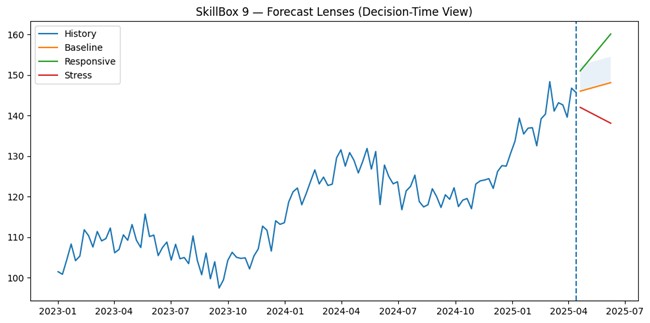
Students must produce:
SB9-1. Lens Role Table
|
Lens |
Structural Assumption |
Risk Highlighted |
Decision Use |
SB9-2. Decision Rule Specification
Complete this template:
If ______ exceeds ______ for ______ consecutive weeks, then ______ is activated, owned by ______, and reviewed after ______ weeks.
The rule must reference:
SB9-3. Governance Statement (≤150 words)
Explain:
If the Responsive forecast exceeds 120 units for two consecutive weeks and its upper 80% band remains above 125, then the Vice President of Operations authorizes a 10% temporary capacity expansion, reviewed after 4 weeks using updated baseline alignment.
This output is not strong because it is mathematically complex. It is strong because it is explicit. It makes disagreement usable, assigns ownership, and includes a built-in review cycle.
A common mistake is to write a vague rule such as “increase inventory if demand seems high.” Such wording sounds practical but is not governable. If a rule cannot be measured, owned, and reviewed, it is not a real decision rule.
If students treat the highest forecast as automatically the “right” one, they are collapsing structured disagreement into a false certainty. That error weakens both Analytical Logic and Decision Design.
Forecasts create value only when someone knows how to use them, knows when to revise them, and accepts responsibility for acting on them.
What makes a decision rule trustworthy: the sophistication of the forecast, or the clarity of the rule surrounding it? Explain in two or three sentences.
In the SkillBox, you translated forecast disagreement into action rules. In the LearningLab, you will use AI to reason more explicitly about assumptions, governance, and the human boundaries of decision authority.
Structured Sensemaking After Forecasts Exist
Chapter 9 completes the transformation of forecasting from an analytical capability into an institutional discipline. Forecasts, by themselves, do not act. They do not assign responsibility, define acceptable risk, or determine when commitments should be revised. Those functions belong to the system in which forecasts are embedded. As emphasized throughout this chapter, models do not decide—systems do .
In the SkillBox, you designed explicit decision rules by connecting forecasts to thresholds, ownership, and review cycles. You moved beyond interpretation into structured action.
This LearningLab extends that work by positioning AI not as a source of answers, but as a partner in reasoning about governance. The focus is no longer on what a forecast says, but on how an organization ensures that forecasts are used consistently, challenged appropriately, and revised responsibly over time.
The objective is to:
This LearningLab reinforces:
AI is used here to expand reasoning about systems, not to automate decisions.
Earlier chapters established how forecasts are constructed, interpreted, and evaluated. Chapter 8 translated those forecasts into structured decision rules. Chapter 9 asks a more enduring question:
What ensures that those rules remain coherent, accountable, and adaptable over time?
This LearningLab helps you move from:
AI is used here to:
AI responses should be treated as provisional reasoning, not authoritative conclusions.
The central shift is this:
Forecasting becomes durable not when models improve, but when governance becomes explicit.
NorthStar RetailGroup has implemented a structured forecasting system:
Yet a deeper challenge now emerges.
Leadership must ensure that this system:
The key questions are no longer technical:
To address these questions, analysts use AI not to determine policy, but to:
AI does not govern the system.
It helps you reason about how governance should be designed.
You will engage with AI at three levels:
Reinforce → Extend → Explore
These modes reflect a progression from understanding to institutional reasoning.
Clarify what it means for forecasting to function as a governed decision system.
AI helps restate core concepts in alternative ways, making the transition from “forecast as output” to “forecast as system” more concrete.
“Key Concepts from Chapter 9.
Pay attention to whether AI explanations:
You should be able to explain, in your own words, why forecasting without governance remains incomplete.
Extend your reasoning from individual decision rules to system-level governance design.
AI introduces comparative and structural perspectives, helping you analyze how governance mechanisms interact across time.
Focus on whether AI recognizes that:
You should be able to analyze forecasting not as isolated rules, but as a coherent and evolving system.
Develop judgment by connecting forecasting governance to broader organizational and societal contexts.
AI supports scenario-based reasoning, helping you explore how governance structures perform under complexity, disagreement, and long-term consequence.
Observe that:
You should understand how forecasting systems support institutional decision-making under uncertainty, not just operational actions.
After completing all three modes:
The goal is to evaluate governance reasoning—not outsource it.
Prepare a structured summary (200–300 words) that includes:
Your response should connect:
forecast → rule → governance → accountability → learning
You must:
Principle:
AI expands analytical range—but responsibility for decisions remains human.
Forecasting systems reach institutional maturity when they integrate:
AI can:
But it cannot:
Insight:
Forecasting creates lasting value not through predictive precision alone, but through disciplined governance that connects analysis to responsibility.
You have now completed the full progression:
understanding → reasoning → decision design → governance
The DesignStudio moves to the final level:
building a complete institutional forecasting system
You will now design:
This is the final transformation:
forecasting as analysis → forecasting as institutional discipline
From Forecast Availability to Institutional Discipline
This DesignStudio develops the ability to design an organizational system around forecasts rather than merely interpret forecast outputs. The focus is on governance, trade-offs, escalation, ownership, and review.
NorthStar RetailGroup is expanding its planning capability across merchandising, supply chain, and finance. Forecasts are now available for weekly category demand, promotional lift, and replenishment risk. The problem is no longer a lack of forecasts. The problem is that different teams use them differently. Some react quickly to forecast increases. Others wait for confirmation. Escalation is inconsistent, and post-decision learning is informal.
Leadership wants a unified governance structure.
Design a system that determines:
You may assume the following:
Develop a forecasting governance design for NorthStar that addresses the following:
Prepare a one-page governance blueprint containing:
Submissions will be evaluated on:
A mature forecasting organization is not defined by having more models. It is defined by knowing how models enter decisions, when people intervene, and how the system learns when forecasts and reality diverge.
Which is harder for organizations: building a forecast or building agreement about how forecasts should be used? Why?
The DesignStudio focused on system architecture. The Mini-Case now asks you to decide in a new context where forecast disagreement affects an immediate operational commitment.
Designing Action Under Structural Uncertainty
A regional logistics provider must finalize a 12-month warehouse capacity plan. The decision affects staffing levels, lease expansion, and capital equipment purchases. Three demand forecast lenses are available. All are based on the same historical data, but each embeds a different structural assumption.
Leadership is unsettled, not because the forecasts are inaccurate, but because they disagree.
You are not being asked to select the “best” forecast. You are being asked to design a disciplined and accountable way forward.
How should the organization commit to warehouse capacity when multiple plausible futures imply different levels of investment and risk?
You are given:
The lenses are:
No actual future outcomes are available.
Part A — Structural Interpretation
In plain language, explain:
Part B — Scenario Design
Define two decision-ready scenarios. For each scenario:
Part C — Governance Rule
Design one explicit rule using this template:
If ______ exceeds ______ for ______ months, then ______ is authorized, owned by ______, and reviewed after ______ months.
The rule must:
Part D — Accountability Reflection
In 150–200 words, explain:
Submit a short case response with Parts A–D clearly labeled.
What is more dangerous in this case: acting too slowly because forecasts disagree, or acting too confidently because one forecast appears persuasive? Defend your answer briefly.
In mature organizations, the problem is rarely forecast production. It is deciding how to act when multiple plausible futures exist. Forecasting by Design does not eliminate disagreement. It makes disagreement governable.
Forecasting reaches institutional maturity when it is no longer treated as a model output, but as a governed system for action under uncertainty. The strongest organizations do not ask only whether a forecast is accurate; they ask how forecast disagreement will be interpreted, who owns the response, and how learning will accumulate over time. In that sense, models don’t decide—systems do, and durable forecasting is ultimately a discipline of responsibility.
At NorthStar RetailGroup, forecasting has now evolved from an analytical capability into an organizational design discipline. Earlier chapters focused on seeing structure, modeling behavior, evaluating trust, and reasoning with AI; this chapter clarifies how those capabilities become operational only when tied to thresholds, ownership, escalation, and review. NorthStar’s forecasting system is therefore no longer just a source of projections, but a recurring structure for coordinating inventory, capacity, and decision accountability. This completes the book’s central arc: forecasting is most valuable not when it predicts perfectly, but when it helps the organization act coherently, transparently, and adaptively over time.
As you respond, explain your reasoning clearly. Distinguish signal from noise. Connect analysis to decisions. Avoid purely technical answers that ignore governance, judgment, or accountability.
Your answer must include:
This CYL assesses:
No code or numerical optimization is required.
A forecast becomes valuable only when it is tied to explicit rules, ownership, and review cycles that guide action over time.
Treating the most precise or highest forecast as the “correct” answer instead of designing how multiple forecasts should be interpreted and governed.
As forecasting systems scale, a new challenge emerges.
What happens when organizations operate hundreds of forecasts simultaneously—across products, regions, time horizons, and decision layers—each updating continuously and often disagreeing?
At that scale, governance itself becomes complex. Thresholds may conflict. Ownership may blur. AI-generated insights may overwhelm human attention. The risk is no longer insufficient analysis, but unstructured abundance.
The unresolved question is not how to forecast more.
It is how to design systems that:
Forecasting by Design provides the foundation. But as systems grow, the next frontier is organizational intelligence—the ability to coordinate, govern, and learn across many interconnected intelligences to make coherent decisions at once.
That question extends beyond this book.
And it remains open.