06-08-2026
Like most students, Rajkumar Karthikeyan knew that enrolling in Purdue University’s Master of Business and Technology (MBT) program would involve short-term sacrifice.
He just didn’t realize how that sacrifice would feel when he could no longer check on his aging grandparents in India. Or, how, with the MBT program’s support, he would turn that heartache into a platform to ease loneliness.
Thanks to that assistance, Karthikeyan and his roommate, Abishek Girish, were named finalists in the 2026 Moonshot Pitch Challenge for their robotic wellness companion concept. The Moonshot Pitch Challenge is sponsored by the Purdue Innovates Incubator, a competition that encourages Purdue students to find solutions to real-world problems in three categories and present them in a two-minute video.
Their project, Ember, named by Girish, warmed the hearts of Moonshot judges.
“In colder regions, people often burn firewood in their homes,” says Karthikeyan. “Long after the flames subside, the ember continues to provide warmth and comfort. It is often unnoticed yet comforting.”
“This is exactly the same thing we envision our companion robot would be for elders living alone. It interacts with them, becomes a part of their life and provides them warmth and comfort.”
Ember is a two-part system involving a family app and a robot that stays with the person. Karthikeyan and Girish envision a humanoid robot companion about the size of a smart phone with a gentle, kind face and a soothing voice. The robot would remind seniors to eat regular meals and take their medications and would listen to their concerns.
“When he's having a cup of coffee, (the companion will ask) ‘What is your favorite song? Do you mind if I play it for you?’” says Karthikeyan.
“If it's lunchtime, it's going to ask him questions like ‘Did you have your lunch today? What did you have for lunch?’ This is more like a personalized companion which will also track their health and well-being. ”Using the app, family members will be able to monitor their loved ones and follow up when they have time or respond to emergencies in real time.
If successful, the idea may be a solution to a challenge faced by a fast-growing population of aging adults who lack a social support system. Market research revealed more than 16 million people over the age of 65 lived alone in the U.S., Karthikeyan says.
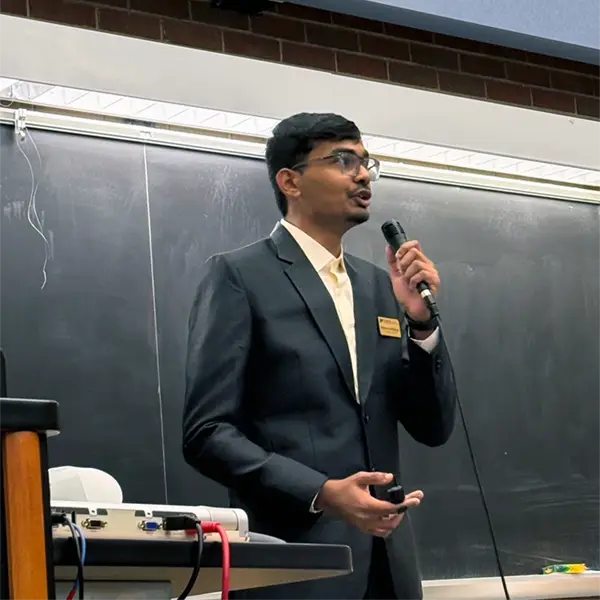
"We were seeing a deeper problem: loneliness. It's strange how in a world where everyone is connected, people can still feel very alone."
“When I spoke to Raj about it, we realized this is not just about safety,” says Girish. “We were also seeing a deeper problem: loneliness. It’s strange how in a world where everyone is ‘connected,’ people can still feel very alone. For many older adults, the worry of being alone during an emergency slowly becomes a bigger fear than the emergency itself.”
But finding a cure for loneliness wasn’t the reason Karthikeyan came to the Mitch Daniels School of Business. He is passionate about building clean, environmentally friendly energy solutions for a sustainable world and dreams of working with Tesla, a leader in the sustainable energy sector.
After graduating from college in India, Karthikeyan spent four years working at Bosch Group as a product development engineer in research and development. He became fascinated by the idea of future core automotive technologies. He followed the work of Tesla and knew people who made it to Tesla via Purdue.
For Karthikeyan, who wants to stay in the sustainability mobility space while developing leadership skills, Purdue was a logical next step. He enrolled in the MBT’s technology commercialization track.
“This is basically at the intersection of the evolving digital technologies that we all hear about everywhere with AI and machine learning, natural language processing and others…and business,” Karthikeyan says.
Karthikeyan says the MBT program introduced him to emerging technologies and the evolution of the industry. A new understanding of AI and its many uses directly impacted his work with Ember, and his business courses showed him how to turn an idea into a marketable product.
“This program bridges technology with business,” says Karthikeyan. “It introduces you to the technology and helps you understand how you can use this technology in the business landscape and show you how you can successfully commercialize this technology.”
For Rob Elliott, the Daniels School clinical assistant professor of management and MBT’s managing director, Ember is the perfect example of the program’s mission.
“I am incredibly proud of the work of Raj and his teammate,” says Elliott. “This project lies squarely in the realm of what MBT brings to the School of Business: the intersection of emerging technology and human factors applied to a gap in the marketplace.
Girish is pursuing his master's degree in engineering management at Purdue’s College of Engineering.
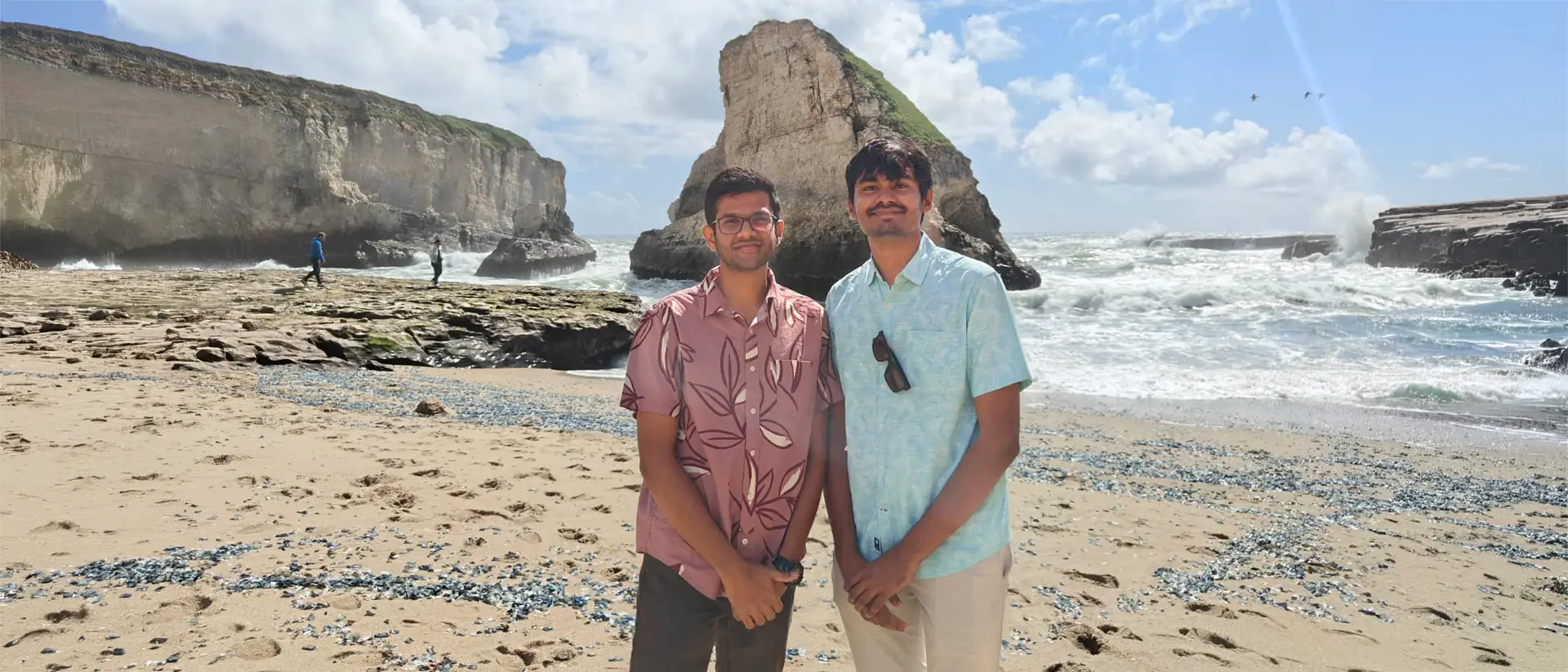
The two grew up 60 miles from each other and majored in mechanical engineering at the PSG College of Technology, a highly respected college in Coimbatore, India. They met after enrolling at Purdue in 2025.
“Everyone starts a WhatsApp group for everything. So, we had WhatsApp groups for students coming in from India to Purdue. We met and we eventually became roommates.”
But that move came with a price: the loss of family connection. A few months later, they discussed the difficulties of maintaining contact with family living around the world.
“We have this tight schedule and there is an 11-hour time shift between our location here at Purdue and India,” he says. “So, most of the time when I am awake, my grandparents would be sleeping and when they are awake, I would be sleeping. We don't get to call them when we are free. So, how do we get to know that our grandparents are doing well without calling them or without trying to disturb them every time?”
By the end of the conversation, Ember was born. At that point, they knew they had something special, but they did not know what their next step should be.
“We thought, ‘Okay, we should do something while we are here at Purdue,’” says Karthikeyan. “Purdue has a lot of resources to offer. Why not try to utilize something?”
Karthikeyan says he heard about Purdue Innovates through the Daniels School of Business. That’s when he and Girish learned about the Moonshot competition. They pitched their idea and became one of the top five finalists in a field of 46 competitors.
“This has been a tremendous experience,” says Karthikeyan. “I was just blown away by the efforts that Purdue does to bring in the creative side of people.”
“Moonshot gave us a platform to do more than just pitch,” says Girish. “It forced us to sharpen the problem, explain our ‘why’ clearly, and make decisions on what we should build first. More importantly, it helped us get feedback from people who think differently than us. Those conversations are what make the idea stronger.”
Karthikeyan and Girish are scheduled to complete their programs in May 2027. With internships, capstone projects, classes and eventual full-time jobs on their dockets, Karthikeyan says it will be difficult to continue developing Ember, but it is a concept to which he and Girish are committed. They have already found support and resources within the Daniels School of Business and the Purdue Research Foundation to move forward.
“We want to take Ember forward using the feedback and connections we’re building through Moonshot,” says Girish. “The next step is to keep iterating, test what actually works and move towards a real product that makes families feel calmer and helps people feel less alone.”
Read more - From Building Code to Creating Impact: Rama’s MBT Journey >>
Explore the residential MBT Explore the online MBT Speak to a recruiter
If you would like to receive more information about pursuing a business master’s at the Mitch Daniels School of Business, please connect with us and a program specialist will be in touch!