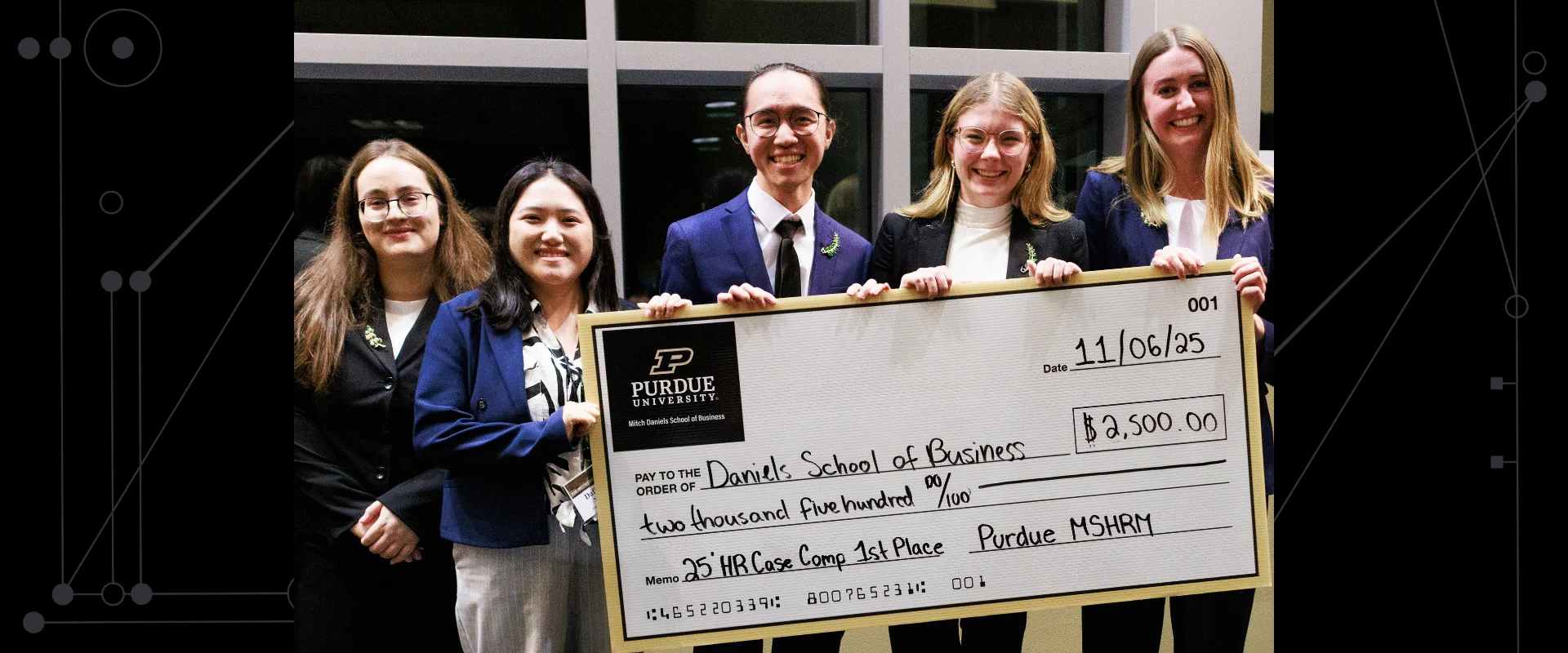
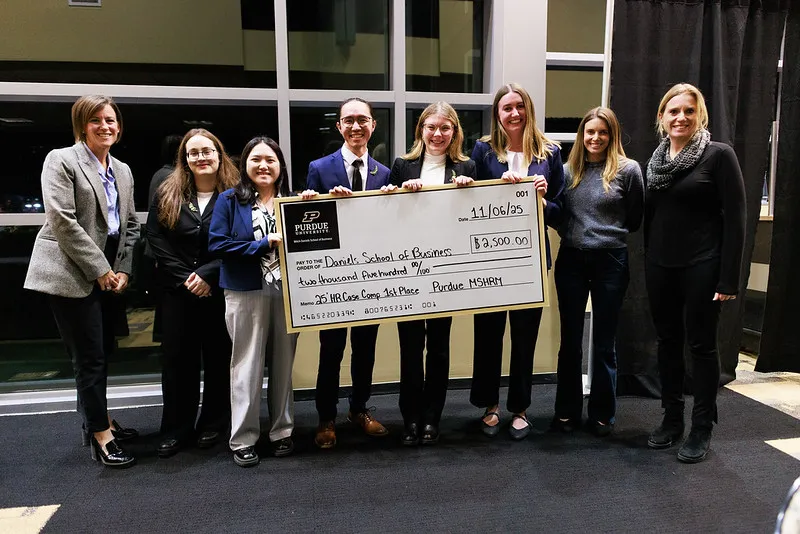
For the members of the Mitch Daniels School of Business graduate-student team, winning the 2025 Purdue HR Case Competition was an unexpected coup. With two team members in the dual degree program and all of them early in their program, they still needed to finish a change management course. Yet the team — Nathan Li, Selma Fisher, Daffodil Xiong, Julia Lamb and Marina Shano — triumphed at the recent MSHRM case competition with a forward-thinking proposal focused on overcoming organizational challenges in AI adoption. Undaunted, they started with what they didn’t know, spoke to faculty about where to begin, and created a unique solution that earned them the winning spot among graduate teams.
The competition centered on Eaton’s need to foster AI adoption among its managers. Eaton is an energy-efficient products and services company that helps customers manage electrical, hydraulic and mechanical power more safely and sustainably. They sought to deploy AI-powered digital assistants across their operations to help managers save time on administrative functions, granting bandwidth for strategic work and innovation. Despite this promise, managers felt overwhelmed by the numerous tools. The case charged teams with developing a solution to address not only the technical but also the human factors behind successful AI integration, including which AI tool works best for what tasks.
“Initially we sat down, went over the case, broke it down and decided what everybody's strengths were, whether we wanted to be in charge of stakeholder engagement or maybe were more of a creative thinker. We were trying to break down how we could use our team to the best of their abilities,” says Fisher. The team researched and scheduled meetings with faculty. “Purdue has a real advantage, having such esteemed faculty. Obviously, we didn't tell them what the case was about, but we more just used their knowledge and their resources and any advice they could give us.”
The Daniels School’s team’s winning edge lay in its solution’s creativity and depth. Rather than just recommending technical fixes, they proposed “Angie” — an AI-powered digital assistant designed to guide managers through Eaton’s many digital tools. Angie would serve as a personalized, friendly entry point for managers to access relevant AI platforms, ask questions and receive tailored support based on tasks at hand. This human-centric conceptualization made the technology both approachable and relatable, addressing trust and engagement.
“Which of the 30 different AI platforms that we have would be best for this project? Angie would be able to tell you,” Lamb says.
The team also incorporated behavioral science, notably nudge theory, to motivate gradual and enthusiastic adoption rather than top-down enforcement. Their change management plan leveraged frameworks like Lewin’s Three-Step Model and Kotter’s 8-Step Process, which grounded their recommendations in proven research. They designed practical interventions, such as brief “power-up” meetings for peer learning and sharing AI successes, making adoption social, collaborative and less intimidating.
Their preparation involved daily team meetings over a one-week blitz, dividing responsibilities according to each member’s strengths: stakeholder engagement, creative ideation, communications, ROI analysis and organizational alignment. Recognizing gaps in change management experience, the team sought advice from MSHRM faculty, integrating expert insights without violating competition rules about external assistance. This openness to feedback and focus on leveraging all available resources contributed greatly to their inventive solution.
Crucially, members supported one another through the pressure of balancing coursework and competition deadlines. Clear communication, realistic time management and inclusive brainstorming helped keep the group calm and motivated. Each member contributed differently, whether by synthesizing research, presenting recommendations, or refining engagement tactics. This environment of mutual trust fostered both creativity and resilience.
The competition accelerated their growth in several areas:
For the team, the biggest lesson was the effectiveness of a multidisciplinary, collaborative approach. Tackling complex challenges as a group allows for more robust solutions and richer learning. The Daniels School team members found that staying focused under pressure and embracing different viewpoints leads to superior outcomes — skills directly transferable to real-world business and HR roles.
The Daniels School team’s victory demonstrates how graduate students can lead with empathy, creativity and rigor to solve modern workplace problems. As AI becomes increasingly central to HR and organizational strategy, successful AI adoption strategies depend not just on technology but on carefully managed human change. Their experience offers inspiration and a template for future leaders hoping to bridge the gap between innovation and practice and to turn workplace technologies into true engines for productivity and professional growth.
If you would like to receive more information about pursuing a business master’s at the Mitch Daniels School of Business, please connect with us and a program specialist will be in touch!