PhD in MANAGEMENT
The Management Information Systems PhD program at the Daniels School of Business offers students the opportunity to work closely with world-leading faculty who are deeply engaged in understanding how digital technologies transform businesses, industries, and society.
Our scholars publish in leading journals such as Management Science, Information Systems Research, and MIS Quarterly, and bring an exceptional breadth of expertise spanning digital transformation, the digital economy, platform ecosystems, Artificial Intelligence (AI) for business, human–AI interaction, FinTech, information security and privacy, multimodal data, intelligent agents, and the societal and ethical implications of emerging technologies. This expansive range of interests allows doctoral students to explore research questions with both technical rigor and business relevance, from value creation and workforce empowerment through technology design to the policy and strategic consequences of digital innovation. The program places strong emphasis on emerging areas such as AI and digital transformation, ensuring students’ work remains at the forefront of an evolving technological landscape. Students engage in active research projects early in their training and benefit from a collaborative, mentorship‑driven environment—an aspect repeatedly highlighted by current doctoral students as a defining strength of the Daniels MIS community.
The PhD program in MIS is designed to produce world-class scholars in Management Information Systems. We measure our goal in the ability to place our PhD students in institutions where research, teaching, and service are encouraged and rewarded. In line with this objective, we train our PhD students to recognize critical IS/IT research questions that may span one or more problem areas and to structure problems so that they can be effectively addressed. For this, students must master analytical and/or empirical methodologies from disciplines such as economics, operations research, and computer science. Coursework, graduate assistant appointments, and mentoring relationships are aimed at developing these research capabilities.

Purdue University’s long-standing reputation as a research powerhouse—particularly in technology, engineering, and data science—creates an exceptionally rich environment for MIS doctoral training. The university’s strong connections to industry and its world‑class strengths in engineering and computer science give MIS PhD students access to cutting‑edge courses, interdisciplinary collaborations, and research opportunities that few institutions can match. Within this broader ecosystem, the Daniels School of Business offers comprehensive institutional support, including competitive funding packages, extensive research infrastructure, and a collegial academic community that prioritizes rigorous, high‑impact inquiry. Doctoral students frequently emphasize not only the depth and quality of methodological and technical training they receive at Daniels, but also the supportive, collaborative culture that defines both the faculty and the broader doctoral student community—an environment that enables scholars to push intellectual boundaries and thrive personally and professionally.

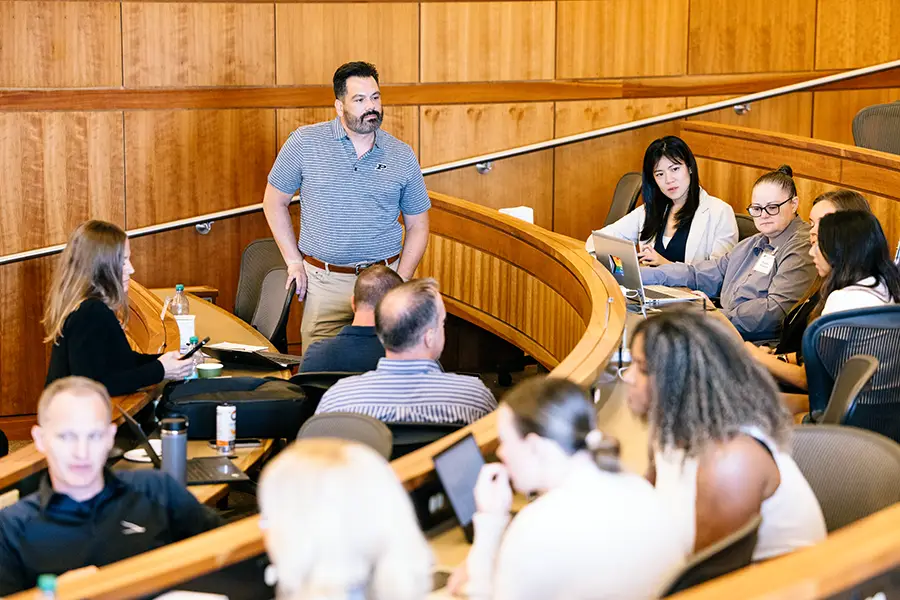
We intentionally foster a collegial and supportive environment where students are both challenged and encouraged to excel. Our program emphasizes close collaboration with faculty and peers, creating a scholarly community that is rigorous, engaged, and future-oriented. You’ll develop as a researcher within a learning environment designed to prepare you for a long, successful, and resilient career in academia.

The MIS program at the Daniels School of Business is defined by research that has translational impact by shaping industry practice, informing public policy, and advancing societal well‑being. Faculty in the program are widely recognized as thought leaders and visionaries in digital transformation and have pioneered influential ideas that now underpin much of the modern digital economy. For instance, their work has introduced foundational concepts such as the Long Tail phenomenon and omnichannel retailing, pioneered the use of digital traces for driving the technology-driven user experience flywheel, demonstrated the predictive value of social media signals, and developed cutting‑edge predictive and interpretable AI algorithms that empower businesses to make smarter, data‑driven decisions.
Their research has informed strategies adopted by governments around the world as they develop policies and national frameworks for fostering the growth of digital economy. In industry, their findings have helped formalize strategies used by major global retailers, guided platform companies in addressing issues like discrimination and digital equity, and influenced product design, recommendation systems, and consumer‑experience practices across e‑commerce and digital platforms. Research insights are regularly translated into action through partnerships with leading organizations, large‑scale executive education initiatives, and collaborations that shape digital and AI transformation efforts across sectors including tech, retail, pharma, finance, and healthcare. Our faculty are regularly interviewed by media for their expertise and evidence-based insights. Together, these efforts demonstrate the program’s unique ability to produce rigorous scholarship that drives academic conversations while creating measurable, lasting impact in the real world.

Graduates of Purdue's MIS PhD program over the years have gone on to secure research-focused faculty positions and positions in industry at the following institutions...

If you have questions about doctoral study in Management Information Systems (MIS), feel free to contact our PhD Coordinator, Dr. Mohammad Rahman, at mrahman@purdue.edu.
For questions about the admissions process or other PhD programs at the Daniels School of Business, email businessphd@purdue.edu and an Admissions Specialist will connect you with the appropriate department representative.