09-01-2026
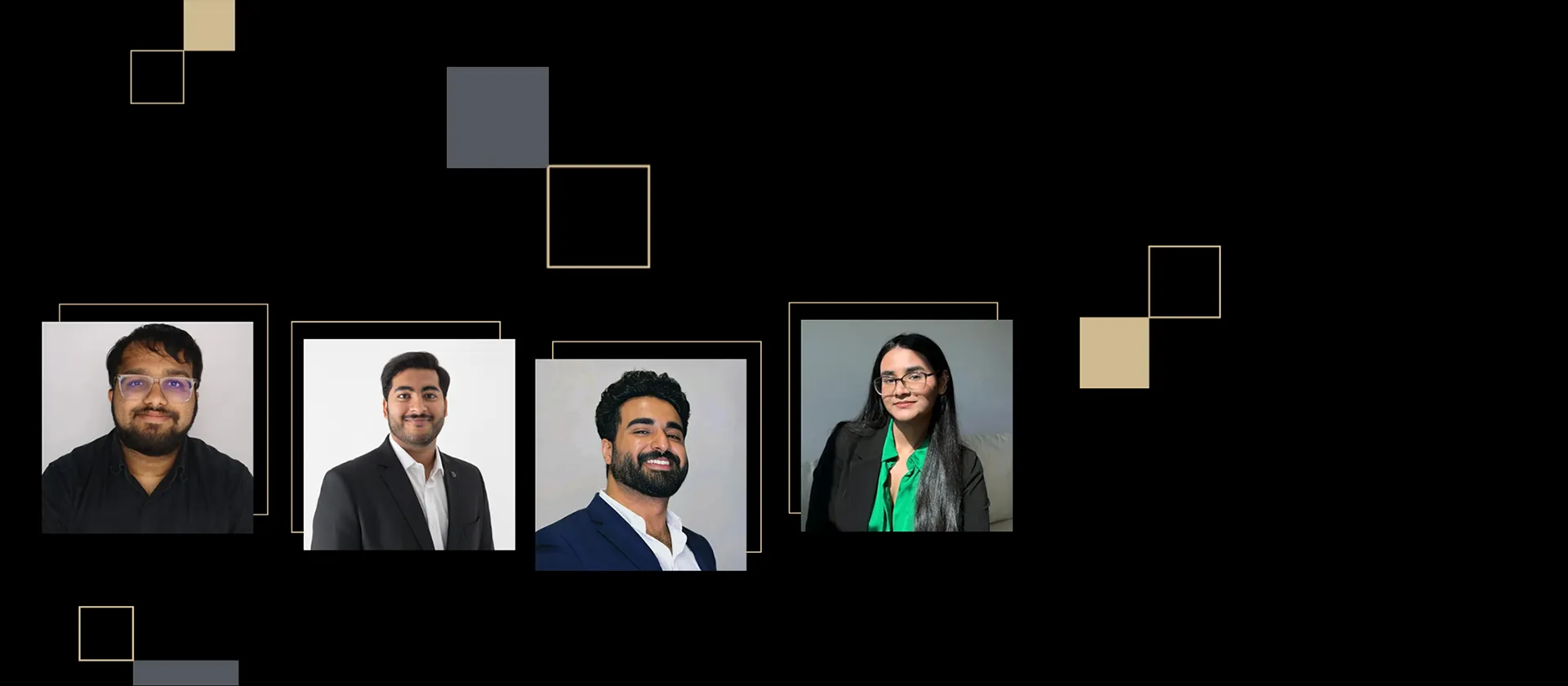
When Practicum in Finance master’s students Peter John, Jay Goradia and Abraham Thaliath took on their client, BioScope Innovations, they found themselves in a niche world of rapid lipid testing. A long way from finance domains like defining markets, refining financial models and projections, and helping a startup ready itself to raise capital.
BioScope Innovations works in the food safety space and uses new technology to speed up testing of high‑value protein sources like beef. That matters to retailers and suppliers who currently wait a week or more for lab results on products that can spoil while they sit, potentially costing millions. The practicum team’s task was to answer the questions every investor would ask founder Rob Donofrio, an experienced life‑science leader now building BioScope with limited resources: How big is this opportunity, how fast can it grow, and can the company make money?
They deliberately picked BioScope. “Since we’re doing finance all throughout our Master of Finance program, we thought maybe we should get exposure to a bit of consulting, a bit of marketing as well,” says Goradia.
Their first major obstacle was the market itself. Rapid food safety testing is large, fragmented and full of overlapping segments. BioScope wanted to start in the protein space, anchoring on beef because it carries the most commercial value, then expanding to other meats. Translating that into the credible total addressable market (TAM), serviceable accessible market (SAM) and serviceable obtainable market (SOM) turned into a semester‑long learning curve.
“The hardest thing was there was not enough clarity on the data, because this is a very niche method in the industry,” Goradia says. “On Google alone, it was pretty hard, but then we researched more. I actually dug through a lot of research papers, and then we used some data from PitchBook.”
Even with better sources, the numbers told different stories. Every time they thought they had a TAM, they discovered double counting — labs appearing in multiple categories, suppliers captured twice, digital platforms layered on top of service revenue. They would narrow the scope to fix overlaps and then find they had “assumed too much,” in John’s words, and had to build the model back up again.
BioScope’s founder added useful pressure. In early conversations, Donofrio offered a directional target: he envisioned a TAM in the 8-10 billion range. The students’ initial model produced about 15 billion — “really inflated,” as Goradia puts it. That discrepancy forced a deeper conversation about assumptions: which segments truly belonged in BioScope’s first horizon, what geographies made sense and how quickly adoption could grow.
To keep the analysis honest, the finance team built a separate tab in their model, grading the strength of every key assumption. If they were only 30% or 40% confident in a figure, they marked it as such. “We didn’t randomly assume,” John says. “We are only sure about it so much. So, if you have a different number altogether in mind, you can use the same number, and then [the] model would adjust it.” That level of transparency turned uncertainty from a weakness into something BioScope’s team could work with.
Technically, they were stitching together both top‑down and bottom‑up approaches. John explained that they started from the global food testing market for the TAM, then narrowed by geography to determine the SAM, and finally built a three‑year SOM from the ground up — by segment, customer type and product line. It required not just spreadsheet skills but the willingness to keep revising a story until it fit both the data and the founder’s reality.
John explains that they started with the entire food testing market as their total addressable market.
This is the broad, top‑down view: all global food testing activity that could, in principle, use technologies like Bioscope’s rapid testing platform.
In their model, TAM was “the entire food testing market,” the big umbrella number before any filters by geography or segment.
From there, they narrowed the TAM by geography and focus. John says they took the global food testing market and then “narrowed it down based upon geography,” moving from worldwide to regions such as North America and surrounding countries.
That geographically focused portion became their SAM — the part of the total food testing market that Bioscope could realistically serve based on where it planned to operate.
Finally, they defined the SOM as what Bioscope could actually capture within a near‑term planning window.
John notes that “for the SOM, we do a three‑year projection,” and whatever they could reasonably sell by the end of year three was treated as the SOM.
They built this bottom up: dissecting segments (such as beef and other proteins), mapping out the supply chain tiers and then applying moderate assumptions about adoption to estimate the slice of SAM Bioscope could plausibly win in its first few years.
Midway through the semester, the practicum’s focus expanded. The external team was building the market view; an internal team needed to translate those insights into a tool BioScope could use for investor conversations. John drew on an AI in finance course with Professor Xinde Zhang to propose something more ambitious than a standard deck.
“We utilized that particular AI coding skill to develop a tool for them,” he says. Instead of hard‑coded slides, they built an interactive platform where Donofrio could plug in new numbers in front of investors. “You have real‑time API agents pulling in market data and repositioning your tool,” John explains. A built‑in chatbot allowed “what if” questions — such as changing growth rates or pricing assumptions — and the model responded in real time.
For a founder who Purdue Research Foundation's (PFR) Dipak Narula described as having “limited resources” but strong commitment to commercialization, that flexibility was exactly the kind of leverage the practicum was meant to provide. Narula’s broader goal at PFR is to push promising technologies — from low‑TRL lab inventions through prototypes and into startups — faster than the traditional university timeline, using coordinated efforts in engineering, marketing and finance. BioScope’s practicum team became one piece of that coordinated push: translating a complex technology into a finance story that investors could grasp.
The Daniels School is CFA-Affiliated: Read more >>
The BioScope project tested both technical and soft skills. On the finance side, the students practiced:
On the interpersonal side, they had to learn how to question a client’s initial expectations without eroding trust. Goradia describes revisiting the inflated TAM with Donofrio, adjusting assumptions collaboratively until they reached a range he found plausible. John talks about learning to “think of businesses, not numbers alone,” including environment, supply chains and regulatory realities that sit behind any revenue line.
The project also demanded a tolerance for feeling out of depth. The team had to go from zero to 60 on biotech knowledge — fast. Understanding the supply chain for protein testing and the language of food safety required more reading and, in hindsight, earlier outreach to subject matter experts on campus. “It was daunting at first,” says John, but working through that discomfort became part of the learning outcome.
Finance students learn skills to land jobs. Learn how they prepare for networking on Wall Street.

While John, Goradia and Thaliath were shouldering this year’s struggle, alumna Swasti Jain was orchestrating practicum opportunities from the other side of the table. A graduate of the first MSF cohort to take the practicum, she now works for Fino Advisors and with Frellmann Water Technologies, a company built around a Purdue‑developed process that destroys PFAS and other contaminants in water.
Her own practicum story parallels BioScope’s. Assigned to a portfolio company then called Moonshot Hydrogen, she was asked to build a financial model to help the founders decide whether to proceed and how to structure funding. She delivered that — and exceeded expectations. Recognizing the company’s role in green infrastructure, she researched RINs and carbon credits as additional revenue streams and then went beyond simply flagging the idea.
“It is not just about telling them that they can do this but actually helping them understand what the process looks like and then actually doing it for them,” she says. “I spun it around in a way that is more actionable for them so that the company can actually use it.” The conviction she brought to the final presentation convinced Fino’s founder, René Ramirez, to hire her. She now helps design practicum projects for new MSF cohorts, including work that contributed to Frellmann’s seed funding and continuing fundraising efforts.
Jain sees the practicum as a bridge between theory and the kind of zero‑to‑one company building she does daily. “You are not just putting money in a company. You are building the company,” she says. For prospective students, she emphasizes how rare it is to find a program where a practicum can directly lead to a job, as it did for her. “I have not been able to find any other university that provides so many opportunities to actually go out there and understand what is happening in the real world,” she said.
By the end of the semester, BioScope had something it did not have at the beginning: a clearer sense of the market it could credibly pursue, a financial model grounded in explicit assumptions and a dynamic tool for investor meetings. Donofrio, Narula noted, is now “armed with both product, market and finance data” as he goes out to seek his first round of external funding.
For John, Goradia and Thaliath, the practicum experience, a course designed by the MSF program's academic director, Fabrício d’Almeida, compressed a full startup finance arc into one semester. The story continues with founders pitching investors, new cohorts of MSF students stepping into newly vetted projects and mentors like Swasti returning to guide them through the same uncertainty — this time with the confidence of having already made it to the other side.
Apply Now Talk to a Recruiter Career Outcomes
If you would like to receive more information about pursuing a business master’s at the Mitch Daniels School of Business, please connect with us and a program specialist will be in touch!