10-27-2025
Each year, the Council of Supply Chain Management Professionals (CSCMP) EDGE Conference proves to be a transformative experience for Daniels School of Business graduate students, introducing them to the latest topics in the field.
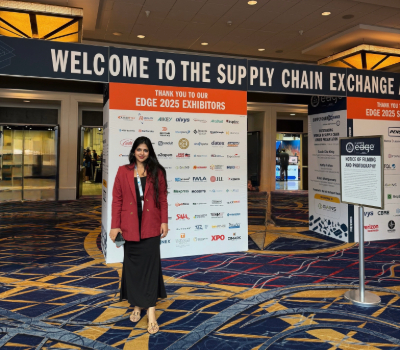
Rushitha Datla (MSGSCM '25) attended — the global supply chain management program funds the registration costs for its students — and got a firsthand look into the evolving landscape of global supply chain management. Attending sessions, engaging with CEOs and executives, and exploring emerging technologies, Datla returned to classes better prepared to step into the supply chain workforce in the current economic climate.
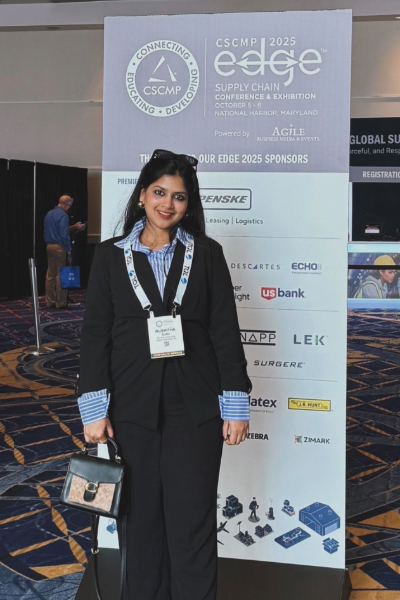
Change management stood out as a central theme in the CSCMP conference sessions Datla attended. Other prominent pressing issues, Datla says, are “the labor shortage and rising logistics costs, the need for digital integration across fragmented systems, and the pressure to increase resilience amid geopolitical uncertainty.”
Speakers, she says, “emphasized that while e-commerce growth continues, companies are struggling with warehouse space, labor reliability, and the challenge of balancing efficiency with flexibility. “
Many organizations are rapidly integrating automation and AI in all aspects of operations.
“Another recurring theme was the lack of clean, connected data, a barrier to automation and AI adoption that limits visibility and slows decision-making across global networks,” Datla says.
AI is revolutionizing mundane processes, of particular interest to Datla after her internship — she worked on invoice matching. What had once seemed time-consuming and dense to resolve is now far more manageable. While automation streamlines operations and boosts efficiency, Datla notes a consensus among panelists: technology can augment but not replace the essential human elements: accountability and decision-making in organizations.
Datla was particularly struck by seeing robots in action. They mimicked humans, negotiated with humans and were capable of citing sources.
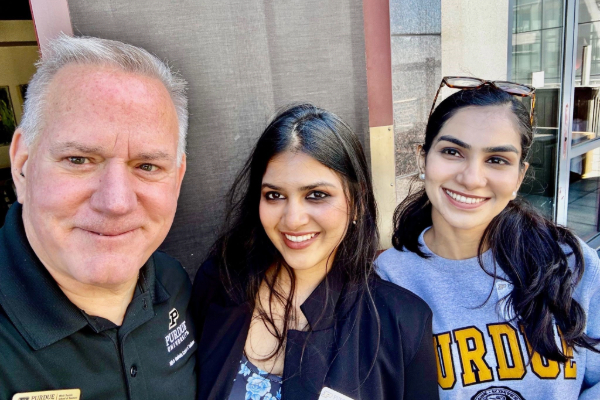
One of Datla's memorable encounters was with Jeffrey Hermann, CEO of Hermann Services, whose leadership philosophy centered on three pillars: innovation, people and purpose. His company’s transition from a family-run business to a sustainability-focused logistics provider left a deep impression. Initiatives such as launching an electric truck fleet powered by clean energy illustrated how the supply chain industry is advancing environmental stewardship. The broader takeaway was that sustainability is now foundational to strategy in leading companies.
“The conference shifted my perspective by showing that the future of logistics is not just about automation; it is about collaboration between technology and people," Datla says. "AI and robotics can handle repetitive tasks, but the human role in decision-making, critical thinking, and ethical judgment remains central. It reinforced that resilient, sustainable supply chains depend on balancing digital intelligence with human insight."
Asked if she bookmarked a best practice for her professional practice, Datla says, “I plan to apply the concept of ‘simulate before you spend.’ Before investing in automation or layout redesigns, leading companies are using digital simulations and real-time slotting analytics to test operational scenarios. This approach minimizes costly trial and error and ensures that automation investments deliver measurable value.
“The conference strengthened my interest in pursuing a career focused on AI-driven supply chain strategy," she says. "Hearing how companies like Walmart and C.H. Robinson are embedding intelligent systems into planning and procurement inspired me to explore how data and automation can be applied to improve forecasting accuracy, supplier collaboration, and working capital efficiency."
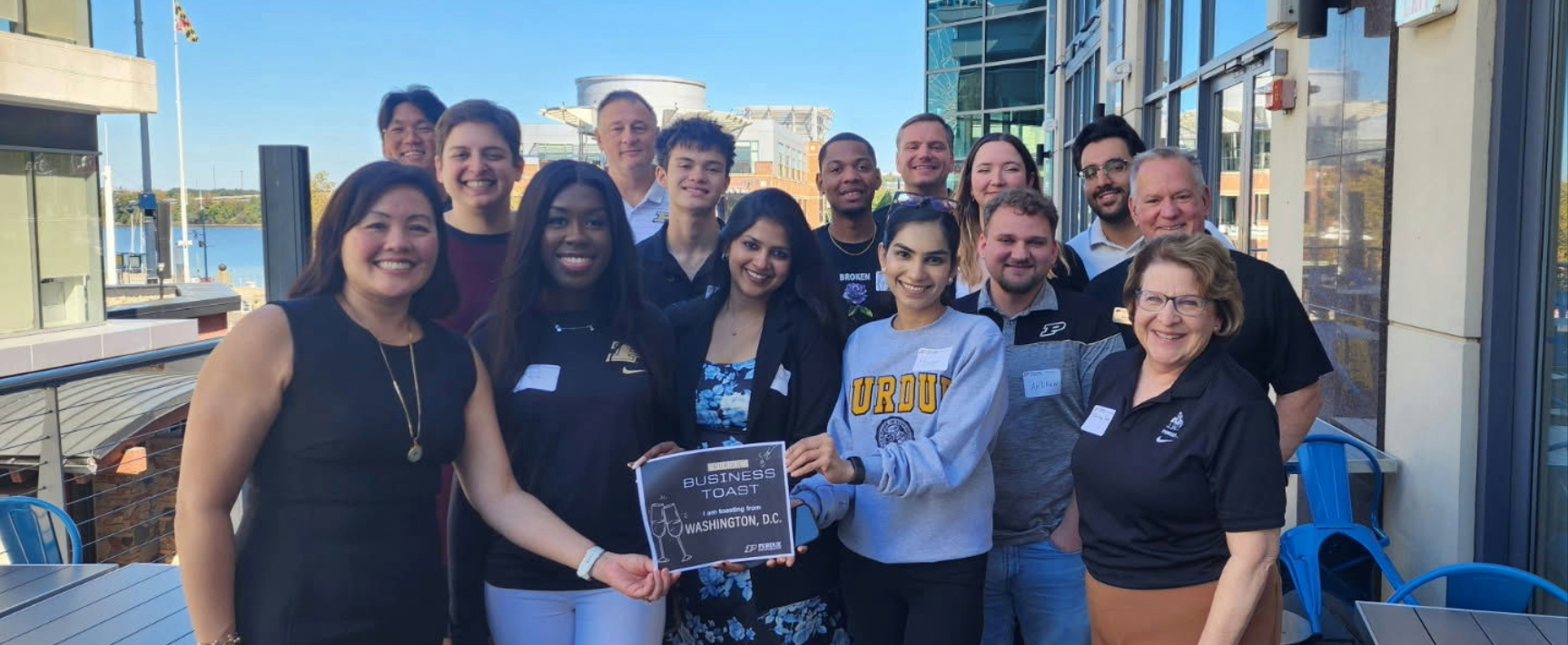
Datla and her fellow Daniels School MSGSCM attendees benefited from the opportunity to network. By attending events like the Purdue Business Toast and informal meetings with alumni, exhibitors and executives from companies including Amazon and Caterpillar, they forged connections — sharing stories and lessons from across the industry. Datla encouraged her peers to approach networking not as a transactional exercise but as an opportunity to broaden perspectives, learn from others' journeys and build genuine relationships that can lead to future support and growth.
Conversations with seasoned executives impacted Datla’s career aspirations, reinforcing the importance of continuous upskilling. As the supply chain industry continues to evolve, she knows personal development will be crucial to stay ahead throughout her career. For Datla and other master’s students, the conference was part of that continuous learning.
Datla summed up many of the other takeaways from the 2025 CSCMP Edge Conference:
Tariffs, regional conflicts and shifting trade policies are forcing firms to rethink their sourcing and manufacturing footprints. Leaders spoke about the post-pandemic world as one of constant volatility, where planning for everything and hoping for the best has become standard practice. Organizations are diversifying suppliers, nearshoring production and building contingency models to stay agile against sudden market or policy changes.
The session on Future Proofing Warehouse Operations and Automation was particularly impactful. It demonstrated how companies are using simulation tools, flexible automation and process redesign to strengthen operational resilience. Panelists stressed that automating inefficient processes only magnifies problems; the key is to first streamline workflows, clean data and ensure system integration before deploying robotics. This process-data-automation sequence was described as the foundation of long-term supply chain resilience.
At the exhibition and in panel discussions, several technologies stood out, including Autonomous Mobile Robots (AMRs), AutoStore systems and AI-powered control towers for predictive analytics. Tools like Spot DC for dynamic warehouse slotting and agentic AI planners that autonomously optimize routing and labor allocation are transforming how logistics is managed. Among these, agentic AI is expected to have the largest long-term impact by enabling always-on supply chains that can act and adapt in real time while humans focus on strategic oversight.
If you would like to receive more information about pursuing a business master’s at the Mitch Daniels School of Business, please fill out the form and a program specialist will be in touch!