When a firm invents something and wants patents in several countries, two internatioal procedures — the Paris Convention and the Patent Cooperation Treaty — set different filing deadlines. The authors model which route a firm takes and when it files, based on the invention's quality and how its payoffs arrive over time. They find the route that delays and pre-screens applications tends to draw the most valuable innovations.
What happens to a local economy when a town cuts taxes and the public services those taxes fund? The authors study Ohio towns voting on whether to renew local tax levies, comparing places that narrowly voted to cut against otherwise similar places that kept them. Incomes fell in the towns that cut, with the largest drops in lower-income areas.
Does monetary policy change how many people join the labor force — and does it work the same way everywhere? Comparing Japan and the US, the authors find that after the central bank raises rates, labor force participation falls in Japan but temporarily rises in the US. Building and estimating a New Keynesian model with sticky wages, they trace the gap to how rigid each country's wages are, and show that years of aggressive easing lifted participation in Japan while barely moving it in the US.
Why do cash-rich firms increasingly buy other companies with cash rather than borrowed funds? The authors build a model where firms hoard cash because cash offers dose deals faster and fend off rival bidders. As valuable know-how becomes easier to transfer between firms, growth concentrates among repeat acquirers — and interest rates shape who ends up innovating.
Why do assets that all look equally safe — like different US Treasuries — still pay slightly different returns? The authors build a model where investors accept lower returns on assets that are easier and cheaper to trade. Measuring how convenient each Treasury is, they show the more convenient ones fetch higher prices and lower yields.
What happens to asset prices when buyers can't be sure an asset is genuine? The authors study markets where assets can be faked and verified, each at a cost. The mere threat of fraud holds prices down by making the asset harder to sell, while actual fraud can push prices up into a bubble — and a small change in conditions can tip the market into collapse.
In over-the-counter markets, big banks act as dealers behveen buyers and sellers, and rules limiting how much risk a bank can carry shape how willing it is to play that role. The paper models how a dealer manages its holdings under these rules and asks what happens when regulation tightens. It finds that as a dealer nears its regulatory limit, the cost of trading through it rises sharply, leaving the market harder to trade in.
When asset market disturbances occur, how should a central bank step in — and by how much? The authors work out the best response across a wide range of models, showing it comes down to steering the gap between different assets' returns: keep those gaps steady when markets run smoothly, but let them move when financial strains make credit hard to come by. They apply this to designing asset-purchase and lending programs.
In over-the-counter markets, buyers and sellers trade privately and often can't tell how good an asset really is — and owning it doesn't reveal its quality. The authors build a model showing that as such assets change hands, both sides grow more wary of quality, even when the true average hasn't changed. When assets are re-traded often, this creeping doubt thins out trading and dries up market liquidity.
Does quantitative easing make government debt safer or more fragile over the long run? The authors build a model where the central bank's bond holdings normally send profits to the treasury. They find that QE eats into that cushion: debt drifts higher and moves closer to the point of default, and although borrowing costs can stay low for years, they may eventually jump — turning once manageable debt unsustainable.
What would the April 2025 'Liberation Day' tariffs do to the US economy? Using a model of trade among 194 countries, the authors find the outcome hinges on retaliation: with no pushback the tariffs could modestly help the US, but if partners retaliate the US ends up worse off. They also find a flat 19% tariff would beat the administration's country-by-country approach.
How quickly did the 2025 US tariffs show up in store prices? The authors track daily prices from major US retailers, tagging each product by where it's made and the tariff it faces. Prices started climbing right after the March announcements and rose gradually, with imported goods rising about twice as much as domestic ones — adding roughly 0.7 points to overall inflation by September 2025.
Did decades of globalization hold down US inflation, as many assume? The authors argue the common story is incomplete: moving production overseas didn't just lower costs, it also changed spending in ways that pushed prices up. Feeding both forces into a standard model, they conclude the rise of trade from the mid-1990s actually added to US inflation through about 2010, easing once trade growth stalled.
If the US raises tariffs and channels the money into other tax cuts, does the economy gain? The authors build a model of trade and taxes in which companies shift their supply chains only slowly. They find that putting tariff revenue toward lower taxes or investment subsidies helps more than simply rebating the cash, and that tariffs raise more revenue early on — before buyers find other suppliers — especially when temporary.
This three-part mini-course explored the applications of machine-learning methods in structural macroeconomics, emphasizing both theoretical foundations and practical implementation. The focus was macroeconomic modeling, but the computational techniques extend to a wide range of research applications. A meal followed each session.
Lecture 1Introduction to machine learning — its definition, relation to classical algorithms, and the curse of dimensionality — together with the historical and practical context of ML across industry and academia, and guidance on when (and when not) to apply it in research.
Lecture 2Core methods: Gaussian process regressions (Bayesian approach, kernels, implementation in Julia) and neural networks (activation functions, the universal approximation theorem, SGD training), with guidance on choosing between them.
Lecture 3Implementation strategies for embedding ML into dynamic programming, best practices for GPR and neural nets (grid-point selection, transformations, optimization) with medium-to-large examples, and advanced methods including Bayesian active learning, set typicality, and estimation.
Why did the Great Depression hit some US states far harder than others? The authors measure how much each state's economy shrank and compare it to what the state mainly produced — farm goods, manufactured goods, or services. Using a model of the regional economy, they show that these differences in what states specialized in help explain why the downturn was so uneven.
In the Great Depression, before bank deposits were federally insured, the Postal Savings System let people put money in government-backed accounts at some post offices. The authors compare towns with and without such a post office and find that where one operated, nearby banks lost deposits and were more likely to fail — a safer option pulling money away from shaky banks during the panic.
When did lasting economic growth actually begin? Studying England from 1250 to 1870, the authors separate real progress in living standards from the wage swings caused by plagues like the Black Death. They find that living standards barely improved before 1600, then began a steady climb around then — roughly a century before the Industrial Revolution is usually said to start.
As factories adopted computer-controlled machine tools from the 1970s on, how did US manufacturing change? The authors track which industries were most exposed to these machines and follow their output and jobs. More-exposed industries produced more per worker but employed fewer production workers, and many of those workers shifted from metalworking into other kinds of manufacturing.
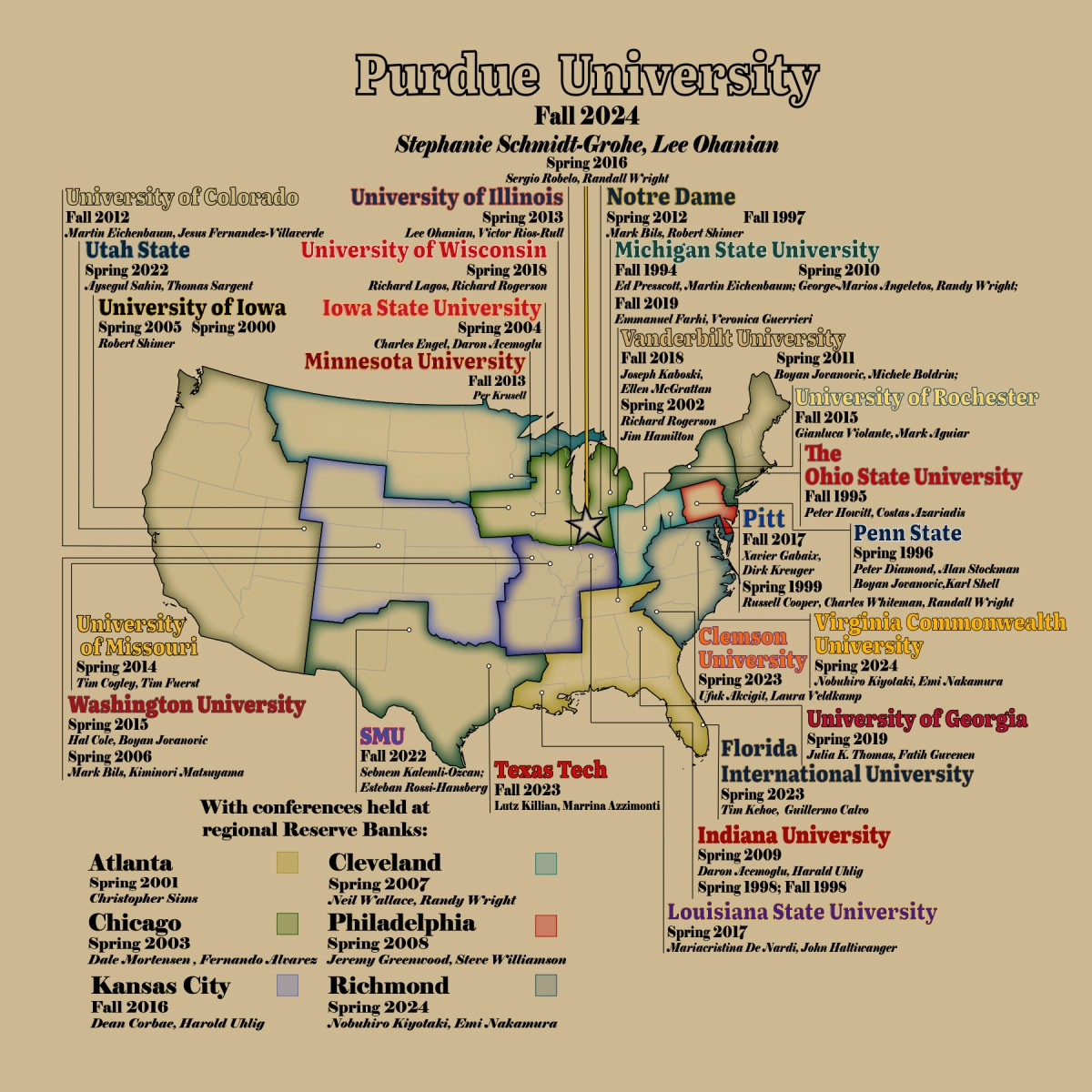
September 6-8, 2024
Purdue's Mitch Daniels School of Business hosted the 30th anniversary of the Midwest Macroeconomics Meetings, a conference for frontier academic research in macroeconomics. The plenary speakers were Stephanie Schmitt-Grohe (Columbia) and Lee Ohanian (UCLA; Hoover).
Founded in 2011 by Mario Crucini, Gerhard Glomm, and Ping Wang, the series traces to gatherings first held at Michigan State (1994), Ohio State (1995), and Penn State (1996).