Fall 2025
Breaking the boundaries between business and STEM means more than plopping down a business school next to an engineering school. It means offering spaces where the integration is mutual and complete.
The Daniels School of Business is ambitiously breaking down the silos between business and technology. It’s no longer enough for business students to cross into engineering and computer science realms, nor build prototypes in basement classrooms adapted to meet code.
In the new Daniels School building, Purdue will welcome industry, alumni, faculty and students from across disciplines.
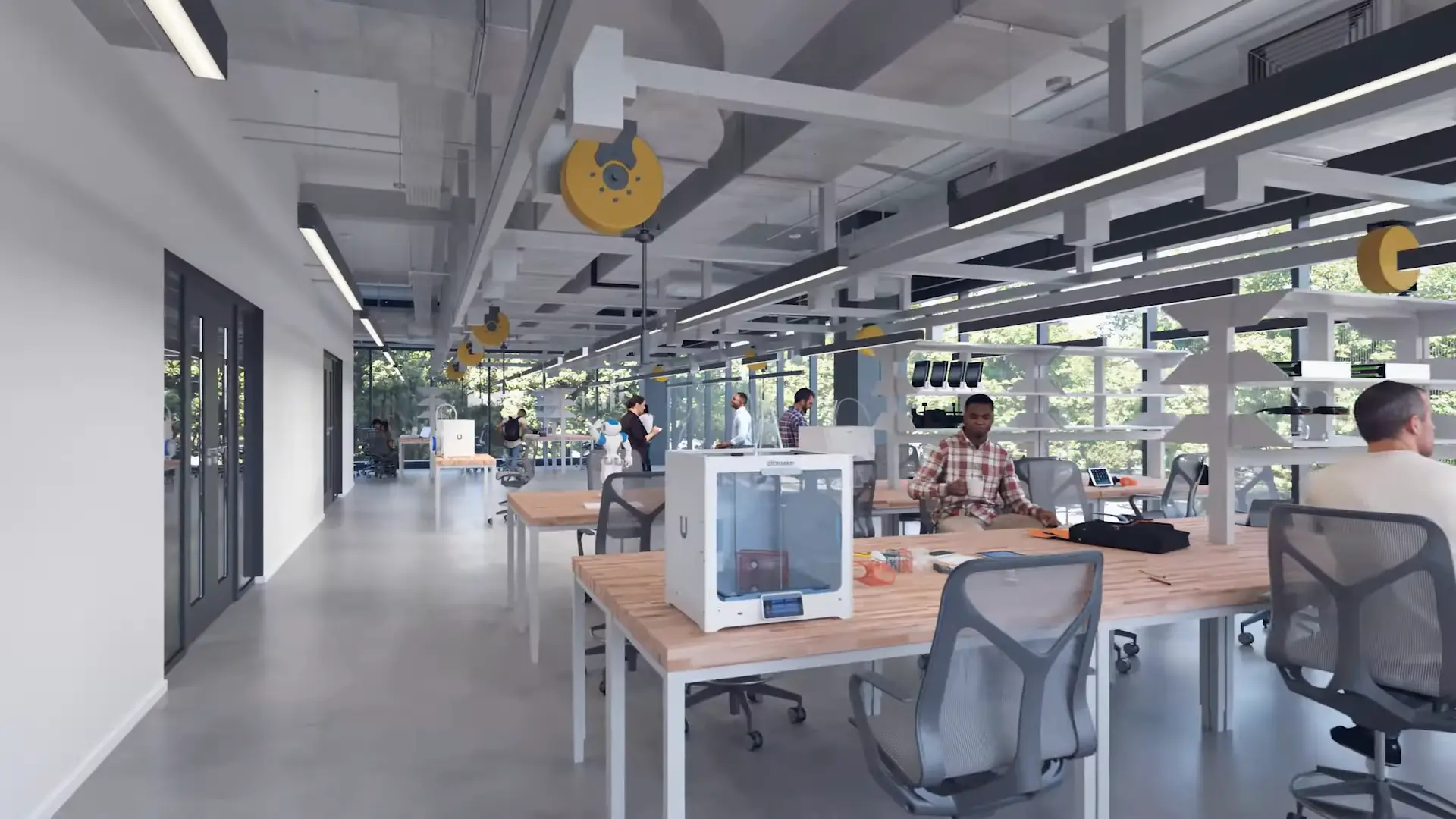
At the heart of this transformation are flexible lab and prototyping environments designed from the ground up to help business students bring technological ideas to life and welcome development opportunities and mentorship — minus the intimidation of traditional, hyper-technical labs. With lab spaces, flexible rooms for large projects, a fintech space and a simulation lab, students and alumni alike will feel at home, ready to experiment, collaborate and mentor the next generation.

Accenture Chicago includes an innovation showcase, which served as inspiration
“These spaces were conceptualized as environments that create that collaboration across schools, across students, and across other scales like students to faculty and centers to industry,” says Michael Schur, architect and strategist for Gensler, the architectural firm working with BSA LifeStructures, Administrative Operations and Purdue University on the new building.
Early in the process, the planning team embarked on strategic visits, dubbed "safaris," to a variety of business schools as well as tech and business spaces — including Accenture Chicago. Logan Jordan, clinical professor and associate dean, recalls, “Of all the places we went, Accenture was the most transformative. They told us, ‘No university has ever come to see us with the sole purpose of trying to replicate what we do in the space.’ That’s the commitment to giving our students a real industry experience.” This transformative insight guided the very ethos of the Innovation Showcase and lab spaces: dynamic, industry-aligned and centered around real-world readiness.
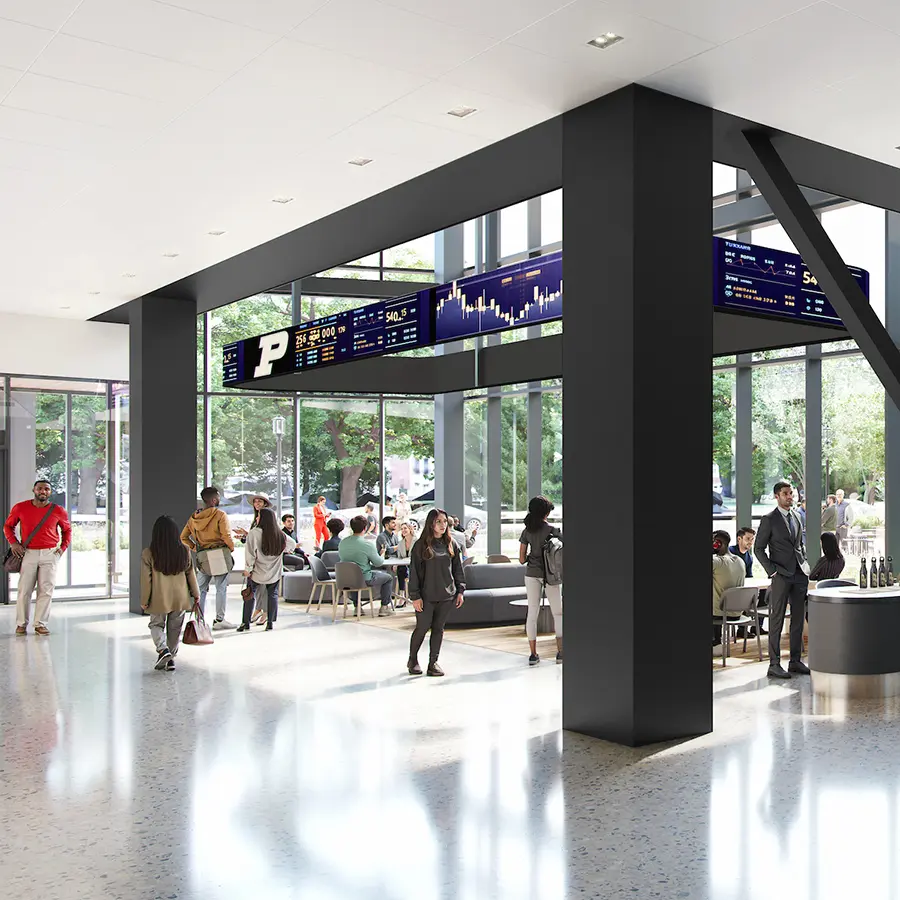
Also visible through the first-floor glass will be a kind of trading floor — a visible, tech-forward space where digital tickers and Bloomberg terminals make the real-life pulse of financial markets tangible for students. Not tucked away, but front and center on the main floor, the fintech space ensures students are immersed in the rhythm and reality of modern finance. Adjacent is the Innovation Showcase, situated at the high-visibility corner of Sheetz Street and Mitch Daniels Boulevard, which will function like retail, putting on display what's happening within the building. While not everyone may have the opportunity to visit the upper floors of the building, passersby will get a glimpse into what is being physically manifested within.
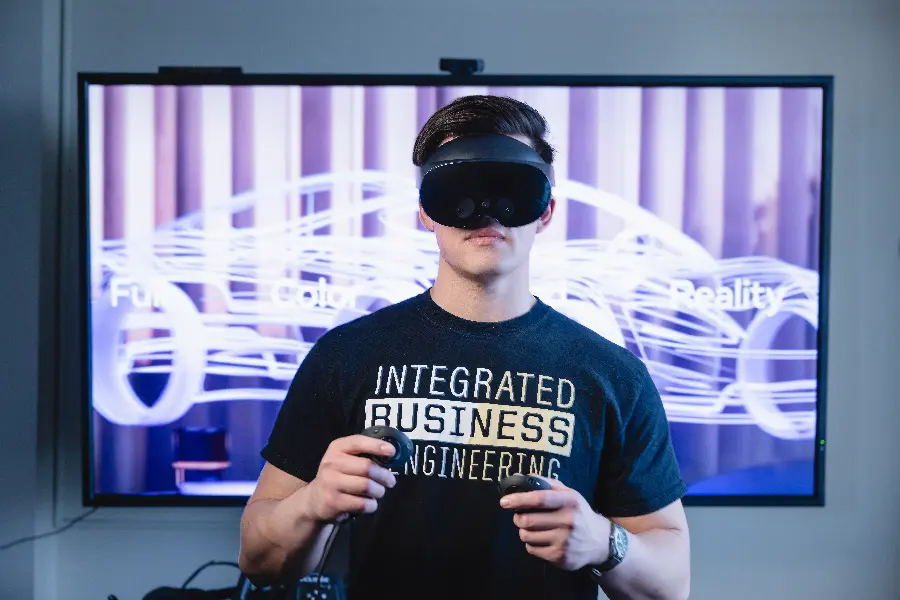
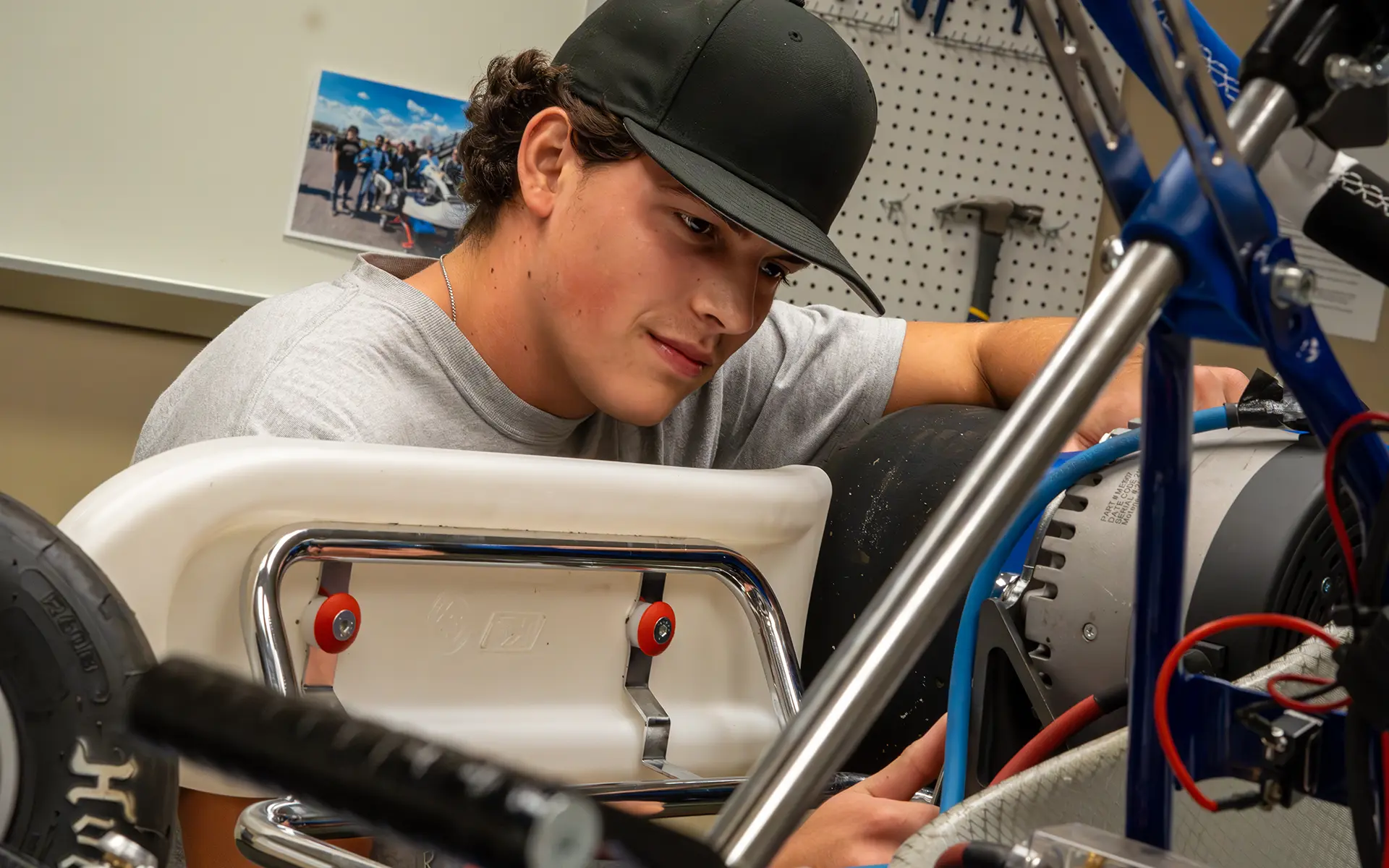
They’ll be able to see evolving projects that marry physical prototypes, AR/VR experiences and industry engagement. As Gensler’s Interior Designer Maggie Marlin puts it, “This was the intent: put on display what’s happening within the building. You might pass by and glimpse an EV go-kart or an interactive digital projection … it’s about showing the world that business is happening here, innovating here.”
Ryan Case, Integrated Business and Engineering (IBE) program director, offers a detailed vision for the new business/STEM labs. “Everything in the lab is on casters,” Case explains, “so if I need a project bay twice the size, I just take out one section and create a bigger bay. All the pneumatics and power feed from the ceiling on adjustable tracks — so plug points and functions move as the projects move.”
"We’re giving customers something to touch and feel, whether it’s hardware or software for the front-end of an app. Instead of pitching an abstract idea, our students put a prototype in the customer’s hands." — Ryan Case
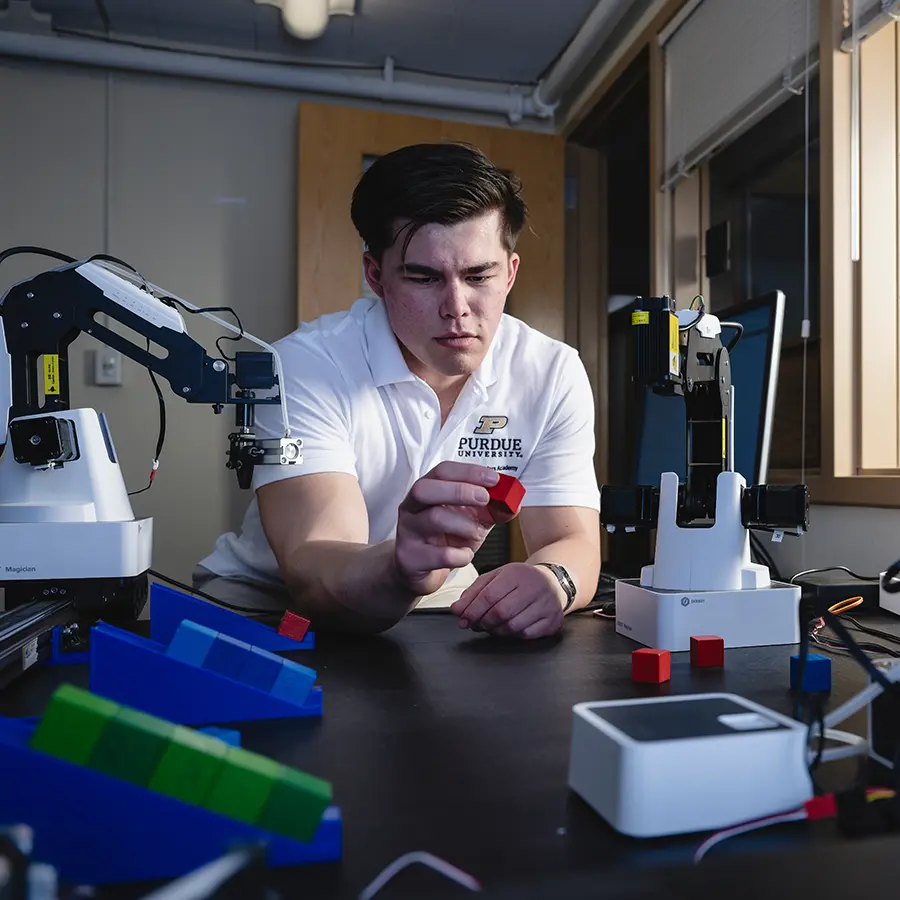
This modularity is essential: projects range from EV go-kart builds, drones and 3D-printed prototypes to collaborative capstones involving engineering, business and polytechnic students. Dividing the lab into clean and unclean zones facilitates both electronics assembly and more rugged fabrication — mini lathes, mini mills, soldering benches and high-ventilation workrooms allow students to rapidly iterate and return functional prototypes for client feedback, closing the loop from idea to market faster than ever.
The result, says Case, “goes beyond the business case: we’re giving customers something to touch and feel, whether it’s hardware or software for the front-end of an app. Rapid prototyping means that instead of pitching an abstract idea, our students put a prototype in the customer’s hands. This is what makes us a STEM business school: we're committed to making and doing, not just analyzing.”
According to Marlin and Schur, Gensler drew on deep engagement with students, alumni and industry. Marlin describes their iterative approach, gathering feedback from students whose internships took them to places where they worked hands-on outside of campus. Gensler listened to “what things worked, what things will help support them in their learning and what things they could leave behind.”
Schur adds, “We looked at the quantitative aspects, benchmarking against what other institutions are doing, knowing that the Daniels School of Business will be a top 10 business school in the coming years.” They expanded their institutional focus beyond other schools to include industry. They mapped out campus traffic, program needs and faculty input — aiming always to situate business at the core of engineering and STEM.
The design intentionally breaks silos, welcoming business, engineering, and polytechnic students to co-create and connect. “We want engineers and techs to take business classes and we want them to get business minors as well,” says Case. Flexibility is central, from rapid reconfiguration to emerging tech needs.
In equipping these spaces, the Daniels School sought not only flexibility but future readiness. Alumni and industry are key partners in updating tech — metal printers, robotics, technology that is still a twinkle in someone’s eye — so students are always hands-on with what’s current. “We need their expertise in seeing what’s coming 5, 10,… 20 years in the future,” says Case.
As projects grow, the labs will flex. Electronics can be designed and soldered on one side, mechanical parts milled and printed on another, and finished prototypes can displayed in the showcase. There’s even a conference table for a movable VTC board and camera so clients and teams can interact wherever the prototype happens to be located within the lab.
The school’s integrated approach enables students to go beyond the business case, beyond simulations. Students will blend analytics, market research and prototyping. When students present a case proposal, it won’t be just slides. It will be tangible, something that demonstrates full-cycle thinking.
This new paradigm signals more than a physical transformation: it's a cultural shift. As Marlin observes, “Traditional labs can feel intimidating; we wanted a space where students feel welcomed — where business and engineering truly collaborate, curiosity is sparked and learning is active.”
For alumni and supporters, these new spaces are an invitation to reengage, mentor and help shape the next generation of business leaders ready for the challenges of tomorrow.
With industry-inspired spaces and purposeful collaboration, Purdue’s Daniels School isn’t just keeping pace in the STEM-business landscape — it’s setting the tempo for what’s next in business education.